The exact population of these islands is not known, but it is estimated at about twenty thousand. There are also several neighboring groups which are controlled by the same government, where the Tahitian language is extensively used, and in most of them the Tahitian Bible and other printed works are the only literature. Tahiti has nearly twelve thousand people, about four thousand of whom are in the city of Papeete.
Many of the natives lead a sort of gypsy life, going from island to island, or from district to district; for as a people they soon grow tired of one thing, and want a change. They delight in anything new and startling, and if they cannot have new experiences for themselves, the next best thing is to hear news of interesting things which have happened. One of the first questions we are greeted with when we meet a native acquaintance is, “Eaha te parau api?” which means, “What’s the news?” It is a great pleasure to a native to be able to gratify his questioner with a bit of news, and so he sometimes manufactures some.
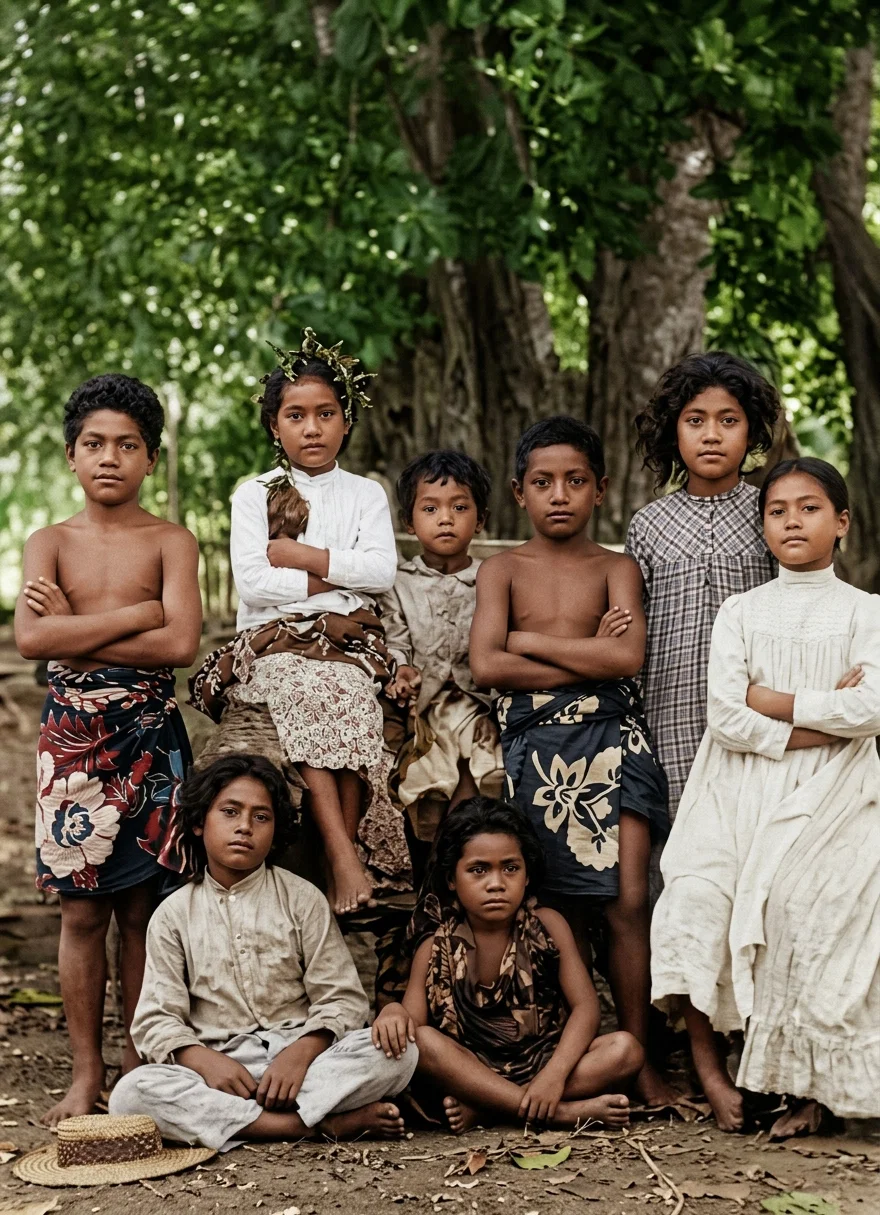
There is no word in the Tahitian language for home, and home is not to them what it is to us. More children are given away at birth to be brought up by the godmother or some relative or friend than are kept and brought up by the parents, and the children are continually going back and forth from one family to another, it being very seldom that all the children of a family are at home at the same time. The little girls do not have dolls, but they all like to hold the baby, and it is passed from one to another like a plaything. In fact, the baby is the plaything for the whole family, as well as the arbitrary ruler. But when he gets older, and can run around and play, he is allowed to entertain himself, which he proceeds to do by playing in the water of the lagoon or in the river for hours at a time, climbing trees and eating green fruit, whipping tops, walking on stilts, and in many other ways too numerous to mention.
Parents give little heed to their children, unless wishing their assistance, and the children have many idle hours in which to play and invent mischief. Where there are schools, most of them are put into school as soon as they are old enough; but they do not attend regularly, and leave while still very young, but few gaining an efficient knowledge of the French language. Though lacking in much of the most essential knowledge, they know many undesirable things of which our white children are entirely ignorant.
While young, they are expected to sow their wild oats, and then, when married, to steady down and unite with the church. The parents make the arrangements for the marriage of their children, and some are married while still very young. Often several families live in a house of one or two rooms, and as they sleep upon mats laid on the floor, they do not require much room for beds. They are never troubled for table-room; for they sit on the ground, and eat around a table-cloth of leaves. If the house is crowded, they eat outdoors. The food is seldom boiled, but is cooked in the native oven by means of hot stones; and as knives, forks, spoons, and plates are rarely used, a soup-bowl only being required by each person to hold the water or sauce which is taken with the fish and vegetables, there are not many dishes to wash. When through eating, each person washes his hands, rinses out his bowl, and puts it away to drain. Then the work is done, and they can enjoy a social chat, or lie down and take a nap. They sleep a great deal during the day, and often, immediately after eating a hearty meal, go and take a cold bath in the river. They seem to think it aids digestion to take either a bath or a nap right after eating, and that vigorous work would be a hindrance to digestion.
Restored with AI
CHILDREN OF TAHITI.
While sitting in a group chatting, a cigarette is lighted at frequent intervals, and tossed from one to another, each one taking a few puffs at it. The women are just as much addicted to this habit as are the men, and the children all know how to smoke, sometimes imitating their elders by rolling up dried leaves and smoking them when they cannot get tobacco.
Meals are eaten very irregularly, and unless the man is working by the day, he usually does the cooking. The women do the washing and ironing, and make the hats, but they do not know what hard work is. Those living in the vicinity of Papeete take in washings for the white people, few of whom do their own laundry work; most white families also employ native or Chinese cooks. The clothes are carried to the river, and rubbed and pounded with a stick until clean. After being bleached, they come out looking fresh and white. The ironing is done with a large flat-iron, which is heated with charcoal that is kept burning inside the iron. The women are never in a hurry, but take time to visit while at their work, and the ironing is generally well done.
The houses of the natives are not tastily ornamented, but are quite bare and often grimy. To make up for the lack of curtains, the cobwebs and dust are allowed to accumulate for years upon the window-panes in some houses. No carpets are used here, but foreign matting and native mats instead. The native mats, woven from the leaves of the Pandanus palm, are neat and comfortable for a warm country. The floor is seldom painted, and when washed, is scrubbed with brushes made of cocoanut husks. After being rinsed, it is rubbed over with lime-juice. The juice whitens the wood, and makes the floor look very nice.
These people are very proud and have much dignity. Like some of their white brothers, they think much about what man will say, and have a great aversion to being ridiculed. Many are church-members, but their religious service is cold and indifferent, and there seems to be but little spiritual life among them. Their worship is more of a form than anything else. Yet we know that all that makes one nation different from another in knowledge or customs is its education and environments. God has a message for every kindred, nation, tongue, and people, and some will surely be saved from among this people.