A cyclone is a horror that we are apt to consider indigenous to the West, as far as this country is concerned. Fortunately, in the East we rarely suffer from such manifestations of the power of wind; but on September 26 a funnel-shaped cloud appeared out of Lake Ontario a little before 4 P. M., and gathering force as it came from the lake, swept over the Niagara peninsula from northwest to southeast. Running parallel to the Welland Canal, it cut a swath fully three hundred feet wide from lake to lake, and did an incredible amount of damage, killing five people and injuring many others. The section of country involved includes Tonawanda, in New York State, and Merritton, in Ontario, Canada, where the damage was the greatest. In Tonawanda the tornado demolished houses, uprooted trees, overturned freight-cars, and swept a clean path several hundred feet wide for a distance of ten miles. Our engraving shows some of the wrecked freight-cars at Tonawanda, showing how box- and coal-cars were wrenched from their trucks and thrown off. Tonawanda is the great center of the lumber industry, and the damage to the lightly constructed wooden buildings was naturally considerable. Thousands of feet of pine were swept into the river. After passing over Tonawanda, the tornado took a southeasterly course, and visited small towns farther on. While crossing from Grand Island to the main shore, the tornado formed a waterspout fifty feet high in Niagara River. As it swept east, it destroyed buildings right and left; thousands of telegraph-poles were demolished.
As already stated, Merritton was the greatest sufferer by the cyclone. It is a manufacturing town, one and one-half miles from St. Catharines, Canada, on the Welland Canal. There are two large paper-mills and a cotton-mill there. The two buildings of the Lincoln paper-mill were destroyed. The roof was picked up, the walls were smashed in, and the heavy machinery went tumbling through the floor. Eighty employees were at work, and it was a miracle that only one person was killed. Over $150,000 worth of damage was done to the two buildings of the paper-mill. The ward schoolhouse, containing seventy-five pupils, was overthrown; one girl was killed, and a score were badly injured. Twenty children732were injured in another schoolhouse. “Orange Hall,” the local home of the Orangemen, was razed to the ground.
Restored with AI
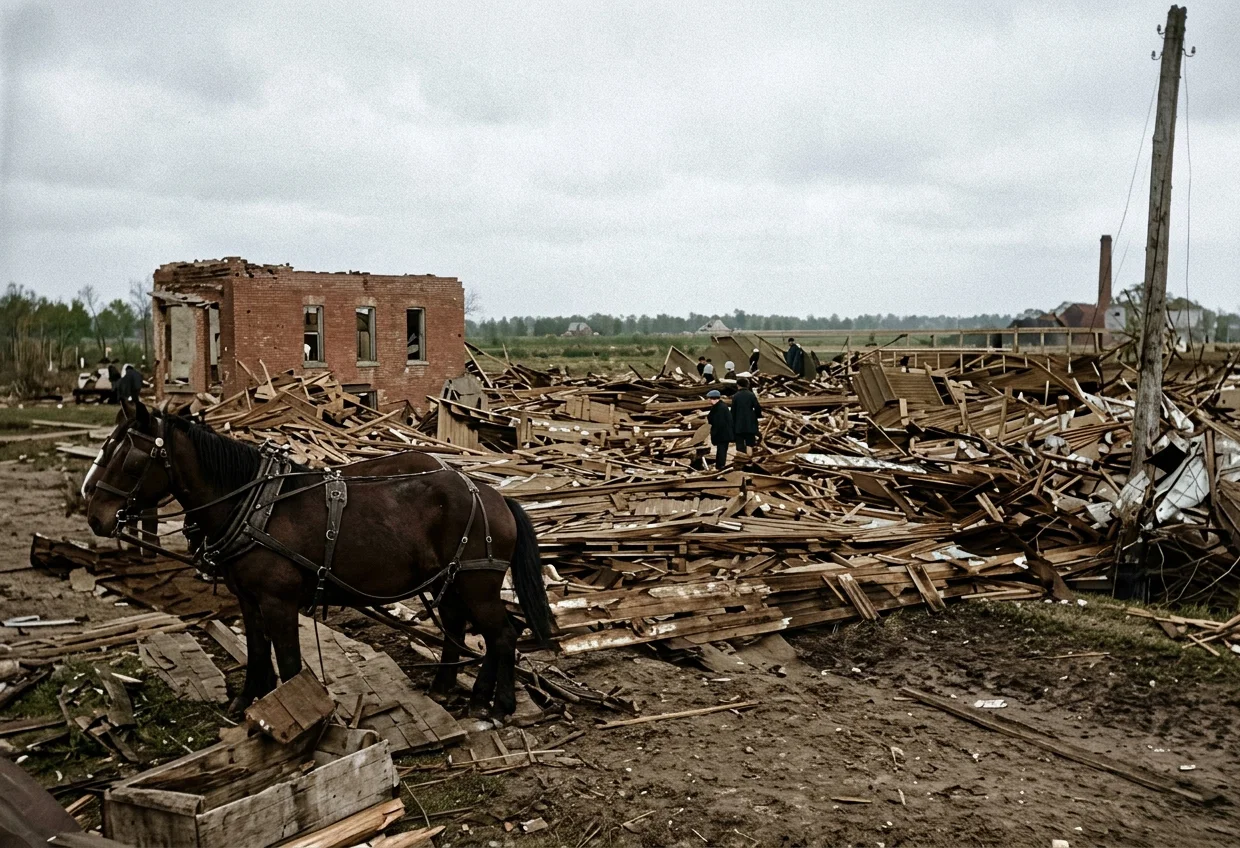
By permission of the “Scientific American.” THE WORK OF THE CYCLONE AT MERRITTON, CANADA.
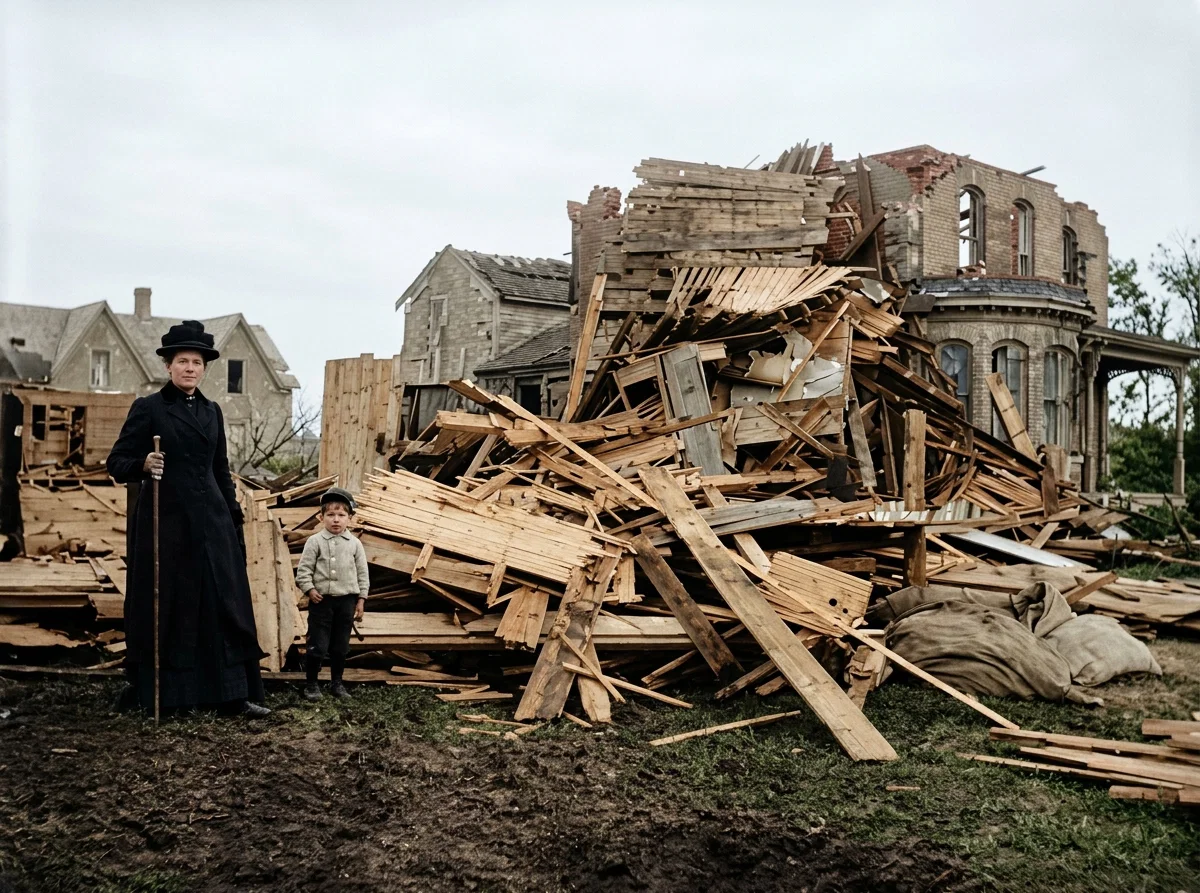
Our engraving shows the terrible destruction of the cyclone. In front are the ruins of Orange Hall, the schoolhouse where the child was killed is in the background to the left, and the chimney of the Lincoln paper-mill is shown to the right. In the picture of the house of John Gardner is shown the cyclone’s power, which in a moment turned a substantial house into kindling-wood, and also wrecked a brick house.
The Presbyterian church was completely destroyed. The spire of the Episcopal church was torn down, and the power-house of the Acetylene Gas Company was also wrecked. In all, twenty buildings at Merritton were destroyed, and it is thought the loss will be fully $225,000.
The cloud took a zigzag course through the town near the paper-mill, where there were several cars loaded with paper. They were tossed into the mill-race, and the air was filled with flying paper. Some bits were picked up five miles from Merritton. At Grantham the storm played several tricks. One house was blown down, and a red-hot stove was picked up and carried across the road. A baker’s wagon at Merritton was picked up, and the boy driving it was carried sixty feet and deposited in the street. St. Catharines also suffered greatly. The cyclone lasted but five minutes at Merritton, and its approach was watched by many of the townspeople.
Restored with AI
By permission of the “Scientific American.”
HOUSE COMPLETELY WRECKED BY THE CYCLONE AT MERRITTON, CANADA.
Outside the tornado belt, the sun was shining brightly. A cyclone of this nature has never before been known in this region. The cloud, its appearance, and its method of working, as well as the devastation that it wrought, are all identical with the cyclone of the West.