L. A. REED.
LIGHT is composite; every ray contains within itself seven different colors. Under ordinary circumstances, these colors are not made manifest; but when the ray passes through a glass prism, no two colors take exactly the same path, and we have all seven brought to view.
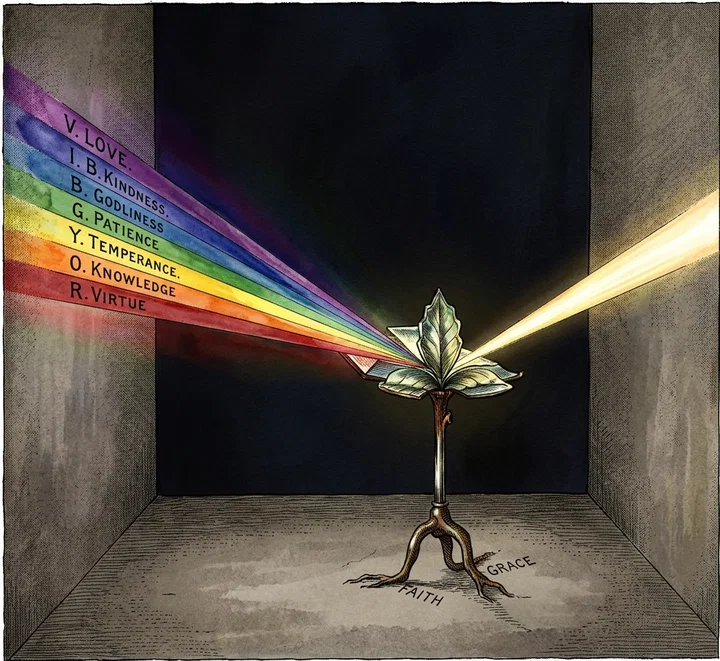
And so the light which comes from God is one light; and yet every ray has within itself seven different colors, if I may so speak. These are, virtue, or fortitude; knowledge; temperance, or self-control; patience; godliness, or piety; brotherly kindness; and charity, or love.
We found that red is the least bent in passing through the prism; orange, a little more; and so each color following, until violet bends most, and stands outside all the others.
And as we consider these graces, we mark the same quality. Virtue, or fortitude, the very synonym of unyielding determination and fixedness of purpose, is first; it is revealed in one's character, just as the red in the ray of light is revealed,—by its least refrangibility, by its being least bent. It is an excellent quality as a foundation of character; but lacking the reaching-out element of sympathy, could not alone make a perfect character.
Knowledge is next given. Knowledge reaches out a little farther; it knows of something besides its own wants, begins to see the needs of others, and is one of the links of character uniting fortitude and love.
Then comes temperance, or self-control. Our fortitude tended to make us exacting, stern, unyielding, unsympathetic; but knowledge has come into the character, teaching us the value of, and making us ready for, self-control, which, coupled with patience, makes us godlike, or puts us in possession of godliness. But being like God, who is love, we shall now show the last two qualities,—brotherly kindness and love.
Thus observing these graces carefully, one by one, we see their refrangibility increasing with each one. Each character reveals these attributes, just as light reveals the colors,—by a difference of refrangibility (bending quality) in each one,—and in love, the analogue of violet, we have this refrangibility in the highest degree.
But let no one think that by this bending, we mean a bending aside from the path of right. Fortitude, or virtue, is in the character for a purpose; it can not be turned aside from the path of right. And though the red is slightly bent by the prism, in doing so, it follows rigidly the laws of light, which are the laws of God for light. The violet, though having the greatest refrangibility of all, can not be turned this way or that, as we choose; for it follows forever in the path God marked out for it.
By bending-quality, with reference to these graces, we have meant only the reaching-out quality of love and sympathy, or kindness. And this quality enters more and more into each grace enumerated, until we have it in complete perfection in the graces of brotherly kindness and love.