A STRIKING cartoon, called “Peace on Earth,” is here reproduced, which appeared in a recent issue of the Belfast Weekly Telegraph. It not only shows how the czar’s proposal is looked upon by the nations; but also, to an extent not possible in words, impresses the mind with the incongruity of his peace proposal, in the face of the present preparations for war in all the world. The naval demonstration seen in the distance, the populous camp nearer by, the guns of the fort, the war-like outfit of the stalwart soldier, make ridiculous the emblems of peace shown by his hands, and the dove-like wings with which he is overshadowed.
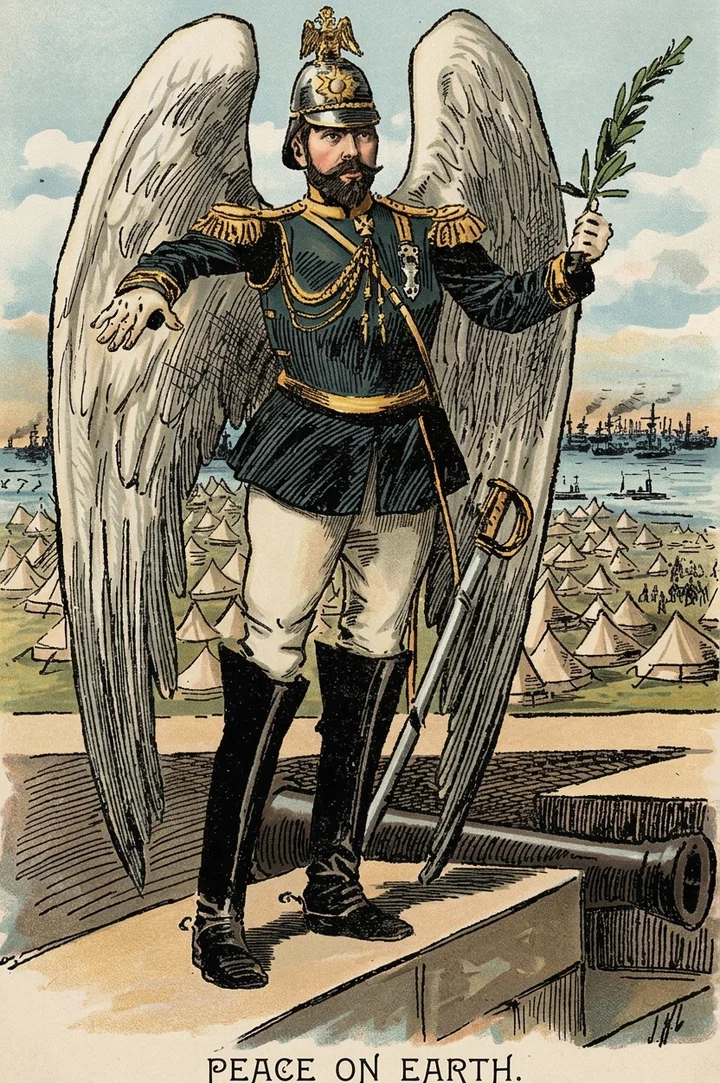
But there can be nothing more absurd in the picture than the thing it is evidently designed to represent,—the proposal by the crowned head of the greatest nation in Europe for an international peace conference, immediately followed by a decree for a material enlargement of his navy. Equally illogical is the relation of the nations to this peace proposal; for while they all received it with words of favor, nearly all began to plan for extensive additions to their fighting forces, the only exceptions being those nations that are unable to do this because of financial embarrassment.
On the same page of the paper from which this cartoon is taken is an article entitled “The Armies of the world.” The writer enumerates the number of soldiers in the standing armies of the six greatest countries of Europe, with the number of trained men who could be called out at once in case of war, and the reserve men, who are more or less untrained. After naming figures that aggregate twenty-three million six hundred thousand, he notices, in the following language, the inability of the mind to grasp the facts stated: “But arrays of figures like the foregoing are confusing, and merely serve to stir up the waters of ignorance into a bubbling flood. No one can understand what these figures really mean; for beyond a certain point, it is impossible to realize the immensity of numbers, not to speak of the facts that lie beneath them.
To assist the mind to a better understanding of the relative sizes of the standing armies only, a picture is given containing eight soldiers, attired in the uniforms of their several governments. The Russian is first, standing at a height of about four and one-half inches. Next to him stand French, German, and Austrian representatives, each about two inches in height. Following these are the Italian, Spanish, and British soldiers, standing respectively, one inch, half an inch, and one fourth of an inch high. The representative of the United States is only an exclamation point, so small is the regular standing army of this country, as compared with those of the nations of the Old World. Another series of drawings equally impressive is given, showing the relative number of soldiers to citizens in the larger countries. The soldier of the United States is shown having five hundred civilians under his care; the Briton has fifty-five; the Russian has thirteen; the German, twelve; while each French military representative has to guard only nine citizens, in order that the whole nation may be protected by arms. From this we see that one man out of every five in France is a soldier! It is no wonder that militarism and the civil powers conflict.
These statements and figures apply only to the nations named. The smaller countries of Europe add to the number given five million four hundred and seventy thousand more soldiers, while the total number for the world is estimated at forty-four million five hundred thousand men. “When one looks around, and sees all the nations of the earth arming themselves for war, and subscribing to the principle that might is right, one can not but be struck with the irony of it, as one remembers the civilization, and the superiority of mind over matter, of which this nineteenth century boasts.” The time when nations shall learn war no more seems a long way off, judging from the world’s point of view at the present day.
H. E. S.