The Sabbath-school contributions for this quarter are to go to spread the gospel in Japan, where Brother Grainger has already been sent to begin the work. Now the more we know of a people, the more interest we take in them; and our willingness to help them is directly commensurate with our knowledge of, and interest in, them. I believe that the boys and girls who read the REVIEW will be willing to make sacrifices in order to give their pennies and dimes to help send the gospel to Japan, when I tell them how much the people there need it. I will first tell something about the little girls in Japan, and at some future time I may write something about the boys.
When girl babies come into the homes in Japan, they are far more welcome than they are in China, where they are sometimes killed because they are not wanted. As soon as the friends of the family learn that a baby has arrived, they all pay it a visit. Each one carries a present, such as toys, cotton or silk to make it dresses, and many other things that the little one cannot appreciate or understand. When the child is seven days old, she receives her name, and the family eat rice cooked with red beans to bring her good luck. Children are not given the names of living members of the family in Japan; but the little girls are named from beautiful objects in nature, such as snow, sunshine, flowers, etc.
When the infant is a month old, she is taken to the temple to be dedicated to a god. Great preparations are made for this visit. She is dressed in the finest silk, with a pattern of gaily colored flowers all over it. The god to whom she is consecrated is chosen from a long list of gods that are worshiped in Japan. It is supposed that after she is placed under his protection, he will take special care of her; but her subsequent history often proves how mistaken this idea is. In order to induce the god to do his duty well, and to obtain the blessing of the officiating priest, the parents make offerings to both.
Restored with AI
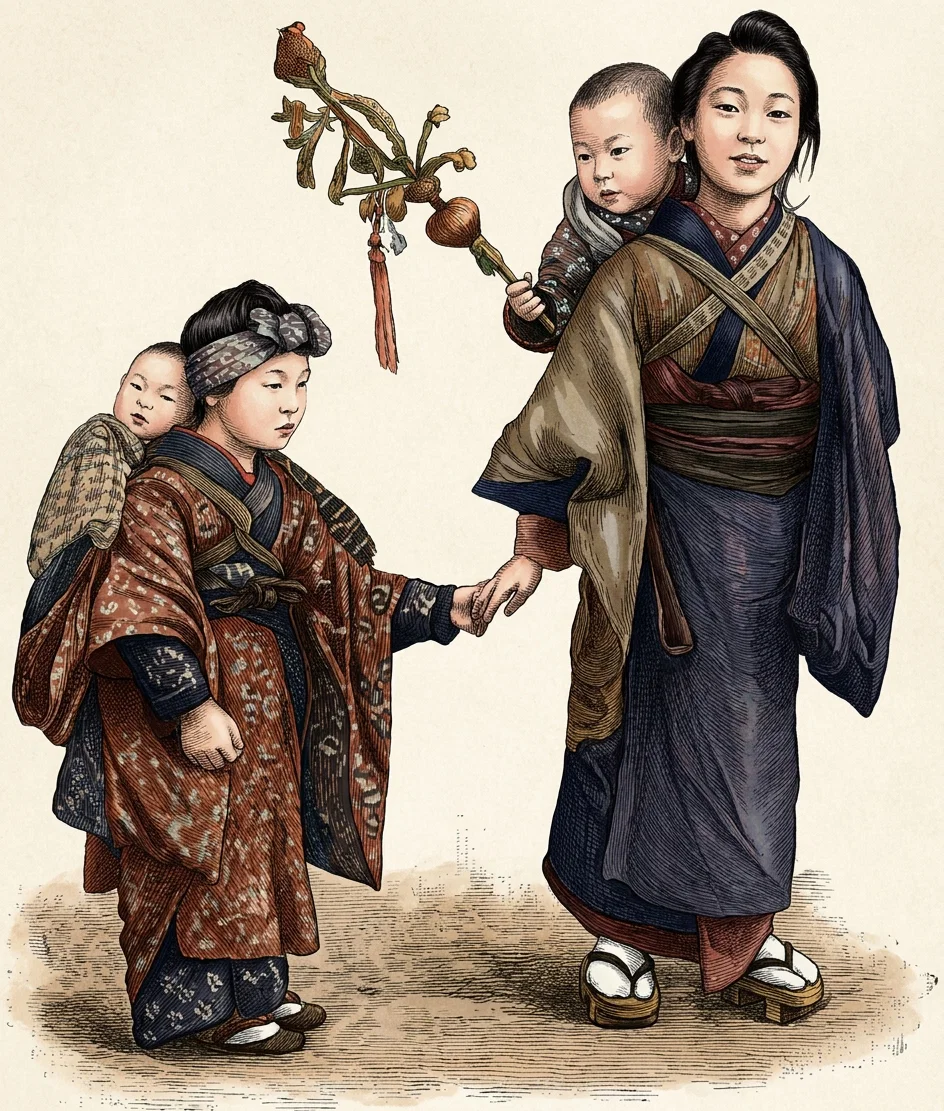
THE “LITTLE MOTHERS” OF JAPAN.
At an early age the baby is strapped upon the back of a nurse or an older member of the family. It is not uncommon to see a little girl, seemingly but a little larger than the one upon her back, hopping about in a lively fashion, with the head of the baby bobbing up and down with every movement, till one almost expects that it will be shaken quite off. But no such accident ever happens, and the babies seem to flourish and grow hardy. They live much in the open air, bareheaded in sunshine and rain alike, going wherever the older children choose to play.
Many of the little ones in Japan suffer from lack of suitable food; for their mothers do not understand feeding them properly. I visited a woman one day whose little three-year-old girl was sick, and found her coaxing the child to eat hard rice cakes and raw fish. On one occasion our own little daughter's Japanese nurse told me that the Japanese mothers had been asking her what we fed our baby. They thought that it must be very fine food for children, as she was unusually large and strong; and they wanted to get some like it for their own little ones. She told them that we fed her condensed milk. Not long after that, one of the women came to her and said that her baby seemed to have some difficulty in swallowing the food that she told her about. The nurse questioned her, and found that she did not understand diluting the milk, and had been trying to feed the milk, just as it came from the can, to an infant only a few days old! You can see the need of instructing these mothers even in the bodily care of their little ones.
The natives of Japan have no chairs or furniture in their homes, and when the baby is taught to sit alone, she is placed on the floor, but not with her limbs straight in front of her, as is the custom with us. Her limbs are bent under her, and she sits upon them. The floor is covered with a soft matting, which is kept clean and neat, for shoes are never worn in the house, but are always left at the door. It is not so much trouble to remove one's shoes in Japan as it is in this country; for those worn there are quite different from ours. They consist of oblong blocks of wood, hollowed out beneath, and held on the foot by a thong that passes between the toes. These shoes look quite awkward, and produce a very ungainly carriage, but they possess the advantage of never cramping the feet. When the children outgrow their clogs, their heels stick out over the back, and the feet do not suffer. Their toes become quite prehensile as a result of grasping the thongs, and one often sees workmen in Japan using their toes to help them with their work, where the assistance of another man would be required in this country.
After the little girl has emerged from babyhood, she finds that there are many things for her to learn, some of which are by no means pleasant. She discovers, among other things, that, being a girl, she can have but little independence. If she is possessed of a strong will, she must surrender the exercise of it, and always obey the older members of her family, especially the male portion of it, even in matters pertaining to things of very little consequence. She must learn, above all things else, to be obedient and polite,—two very excellent qualities if not carried too far in the wrong direction, as is often the case with her. She must always seem cheerful, and be pleasant to others, no matter how much her own heart may ache. This idea is carried so far that a Japanese will sometimes tell you that his mother has just died, and break into a merry laugh, not because he doesn't grieve at the death of his mother, but it would not be polite to make you feel bad by seeing him display sorrow. Self-control is the great lesson that is inculcated from earliest years. The little girl must learn to suppress all emotions except such as will be pleasing to others. The result of this training is seen in the gentle, dignified, attractive women of Japan. Members of a Japanese household are extremely polite to one another. One never sees such demonstrations of affection as kissing or embracing between members of families. Even after a prolonged absence, they greet one another with the most formal bows, accompanied by courteous speeches in regard to their mutual welfare.
The little girls are taught to sew, cook, and serve food. They do not use sewing-machines in making their garments, but simply baste them together. When they are washed, they are ripped apart, and spread upon boards to dry. They need no further ironing. Besides these necessary accomplishments, the girls are now often sent to school, and become quite well versed in literature.
When the child becomes a woman, she finds that instead of being allowed more freedom, the restraints become much stricter, and that she is little more than a puppet in the hands of others. When she reaches the age of sixteen, her parents expect her to marry some young man of their selection. One who is a friend of the family is consulted in reference to the matter, and she immediately begins to canvass among her acquaintances for a suitable young man who wishes a wife. When she finds one that she thinks will do, she reports to the maiden's parents. Should the parents be pleased with her selection, the young lady is informed of it, and arrangements are made for a meeting at the home of the go-between. If the young man likes the girl, he signifies it to the go-between; and if no objections are raised, they are married, and go to housekeeping at the home of the groom's parents.