Scientific American.
The “Kaiser Wilhelm der Grosse” has added further records to those which she has already placed so rapidly to her credit. She has accomplished the longest all-day run by covering 564 knots within the twenty-four hours; and she now holds the record of an average hourly speed of 22.35 knots for the whole trip across the ocean. This is 0.34 knot faster than the best trip of the “Campania.” When she left New York on this trip, she passed the Sandy Hook Lightship at 4:30 P. M. Six days later she passed the Needles at 3:10 P. M., the total distance covered
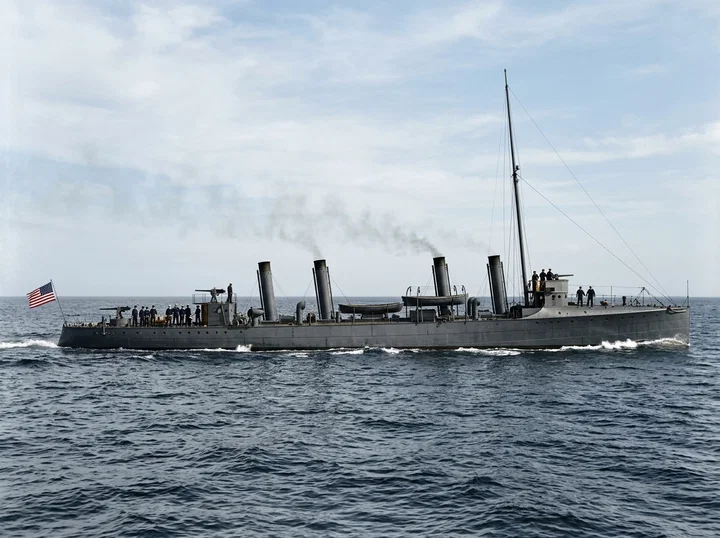
The accompanying cut represents the new torpedo-boat-catcher “Bailey,” so named by order of the United States Navy Department, after the distinguished naval officer Theodoric Bailey, who was second in command to Farragut in the action of passing Forts Philip and Jackson on the Mississippi. The “Bailey” is one of three torpedo-boat-catchers for which provision was made at the last session of Congress. The sum appropriated for each boat was $250,000. In advertising for bids, the Navy Department stipulated that a speed of thirty knots an hour would be exacted on the official course. The details of the design were left to the discretion of the builders.
The “Bailey” is the first torpedo-boat-catcher ever built in the port of New York.
The yards of the contractors are located on the Harlem River. When completed, as she will probably be before the close of 1898, the “Bailey” will stand for the fastest craft possessed by the United States government. This statement is made on the expectation of the builders to attain a speed with the new boat of thirty-three knots an hour. Just what may be expected of the two sisters of the “Bailey” cannot at this time be conjectured; they have yet to be heard from. In making the great speed demanded of the new torpedo-boat-catchers, there will be no opportunity for jockeying work. Specified weights must be carried, and on the occasion of the official trial run, the boat must be in service trim. The designs which have been submitted to the Navy Department by the contractors, and approved, embrace the following principal features: length, 205 feet; beam, 19 feet; depth of hold, 13 feet, 5 inches; displacement on trial 235 tons; and displacement when in commission, 265 tons. The trial weights must not be under the following figures: hull, 67.5 tons; machinery, 115 tons; water, 10 tons; ordnance, 12.6 tons; coal, 20 tons; and equipments, 9 tons.
The armament will be a powerful one for a boat of this size. It will embrace four six-pounder rapid-fire guns and three eighteen-inch torpedo discharge tubes. The latter are for Whitehead torpedoes.
The six-pounder guns will be mounted, two on the main deck, one on each side amidships, and two on platforms supported by the conning-towers. The deck guns will have an arc of fire from sharp on the bow to right astern. The guns on top of the conning-towers will have an almost all-around fire.
The province of the torpedo-boat-catchers, or, as the British term them, “destroyers,” is literally to destroy or capture torpedo-boats proper. The average torpedo-boat does not possess a speed much exceeding twenty-two or twenty-three knots. A torpedo-boat like the “Ariete” of the Spanish navy, which is credited with a twenty-six-knot showing on the measured mile, is an exceptionally high-powered craft. Even the “Ariete” could be easily overhauled by such a craft as the “Bailey.” Having run the little torpedo-boat down, the catcher annihilates her with a heavy fire from her six-pounder guns. The one-pounder is a heavier piece than is given to torpedo-boats. In consequence, the light one-pounders which the latter usually carry are no match for the heavy guns of the pursuer. In the case of the “Bailey,” this government hasp. 56 for the first time placed six-pounder guns on its torpedo-boat-catchers. The “Dupont” and “Porter,” both torpedo-boat-catchers now in service, are armed each with four one-pounder guns. The British practise is to equip their destroyers with one twelve-pounder rapid-fire gun and three six-pounders.
The “Bailey,” like the “Dupont” and “Porter,” will be able to do battle with battleships after the fashion of torpedo-boats. When thus engaged, she will have recourse to her torpedo-tubes. But, as above shown, the principal duty of the new craft will be to drive off and annihilate with gun fire the torpedo-boat torments of the battle-ships and cruisers. Speed alone will enable the “Bailey” to do this, and this speed the catcher is expected, by reason of her size, to be able to maintain in a high sea.
The “Bailey” is essentially a seagoing vessel. Her bunker capacity is deemed sufficient to enable her to steam three thousand knots at economical speed. In time of war she may be expected to accompany the battle-ship fleet, and to serve both as a scout and defense for the heavier vessels.