To get before the mind of the reader again the great fact that an intense spirit of war is to characterize the days just preceding the second coming of Christ, it will be well to quote one of the prophecies presented in the preceding article. It reads: “My bowels, my bowels! I am pained at my very heart; my heart maketh a noise in me; I cannot hold my peace, because thou hast heard, O my soul, the sound of the trumpet, the alarm of war.” Jer. 4:19. As stated in last week’s paper, the verses following this quotation from Jeremiah show very clearly that the prophet is viewing the scenes of the last days.
Restored with AI
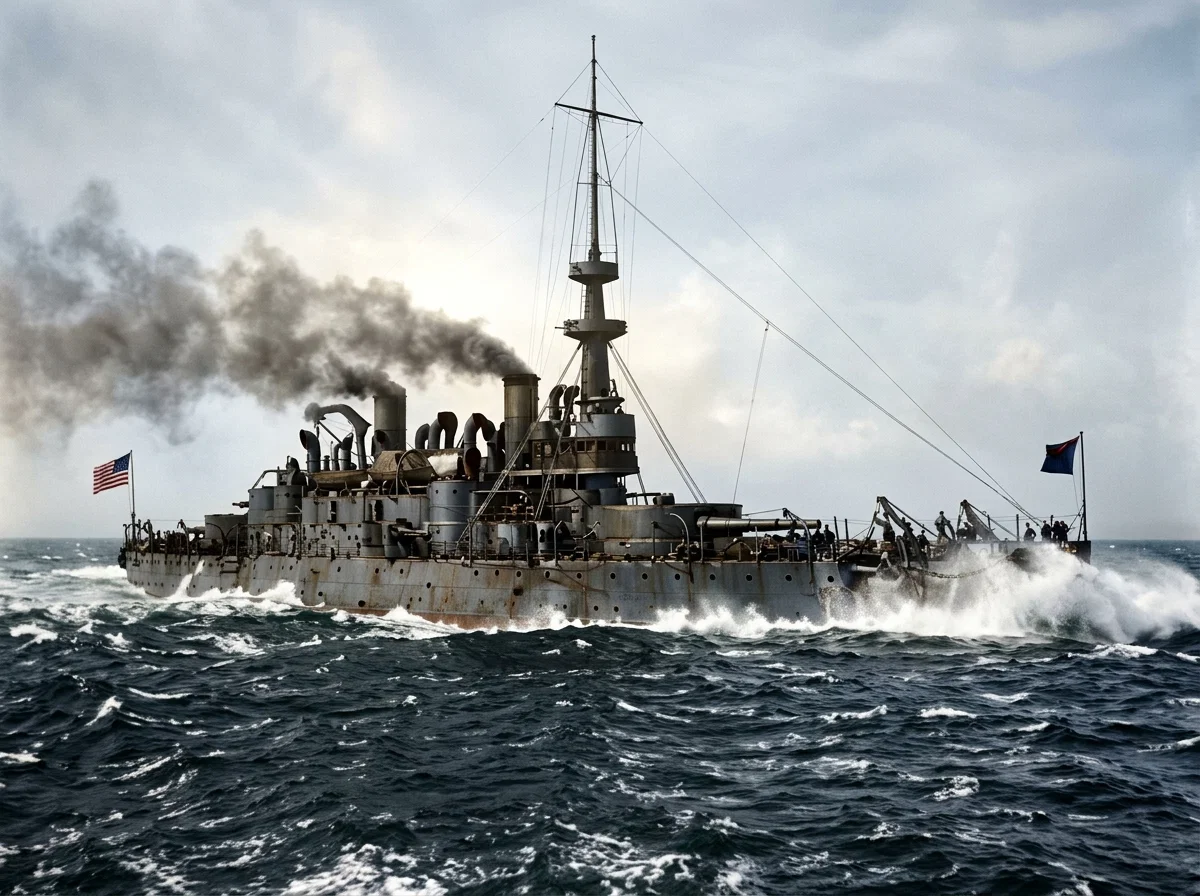
By permission of the “Scientific American.” The “Indiana,” a modern iron-clad, and one of the best and most powerful men-of-war of to-day.
There is nothing that more impressively marks the literal fulfilment of the prophecies concerning the warlike condition of the world in these last days, than a view of one of our modern war-ships. The marvel of the whole world is that this marine fighting-machine has been developed so suddenly. Prof. R. H. Thurston, of Cornell University, in the North American Review, December, 1897, speaking of the American navy, says that “this fleet—exemplifying the marvelous ingenuity of the American mechanic and inventor, the wonderful constructive skill of the marine engineer and naval architect, and the most extraordinary of all modern combinations of accurate design, with beautiful and exact construction, and demanding the highest skill of most thoroughly trained officers for its management, concentrating in minimum space maximum power, and uniting offensive and defensive power as does no other product of science and skill—is the outcome of but ten years of work on the part of our engineers, naval constructors, and ship-builders.” Note that these modern war-ships “unite offensive and defensive power as does no other product of science and skill;” and further, that this skill “is the outcome of but ten years of work.” Who would have believed, twenty-five years ago, that such results would be achieved so soon! But we are in the time of fulfilling prophecy, and should expect to see marvelous things produced by sudden developments.
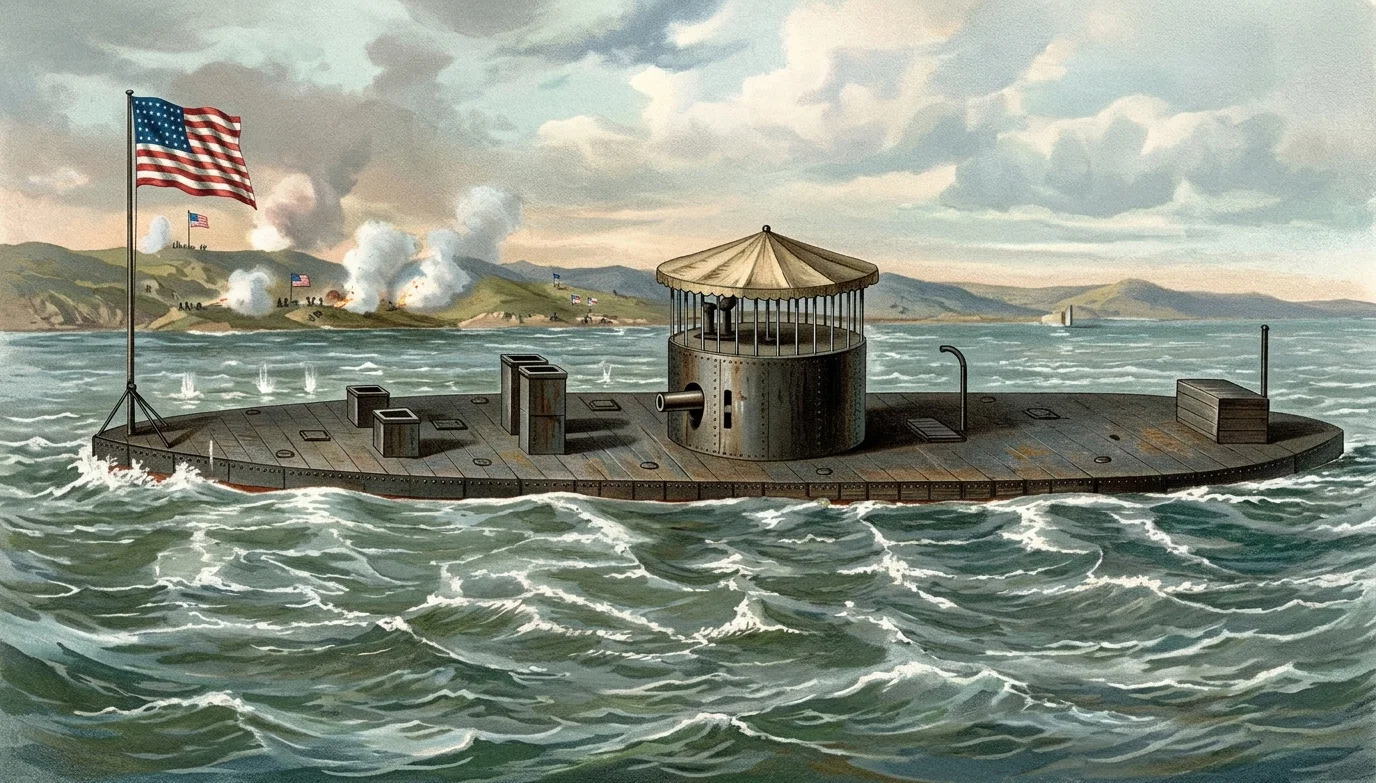
Perhaps the sudden developments in the terrible fighting qualities of the modern man-of-war can be more fully brought before the mind by contrast. The “Monitor,” represented on the following page, insignificant as it would appear to us now, steamed into Hampton Roads, March 9, 1862, just in time to defeat the “Merrimac,” and thereby keep her from destroying the Northern fleet. There is no telling what different turn the Civil War might have taken if the “Monitor” had not been invented and built just at the time she was.
“The ‘Monitor’ was a flat-bottomed vessel of about thirteen hundred tons’ displacement, armored on the sides and on the deck, which was only eighteen inches above the water. She carried a single revolving turret, mounting two eleven-inch smooth-bore, muzzle-loading guns, which could be fired only once in seven or eight minutes. The side armor was made up of five one-inch plates, tapering to three inches at the bottom, on twenty-three inches of backing. The deck was formed of two one-inch plates on six inches of wood. The turret was made up of eleven thicknesses of one-inch plate.” The “Merrimac,” against which the “Monitor” fought in that memorable battle, had her sides armored with four-inch plates, and over her deck a sloping roof was built with iron armor of about the same thickness. But this armor of the “Merrimac,” light as it may seem to us now, was sufficient to resist the shots of the “Monitor’s” guns throughout the whole day of their hard fight.
But turning from the “Monitor” and the “Merrimac,” both of which were the marvel of their time, and from the battle between them, the details of which are familiar to all, note the terrific power of the modern war-ship. The “Indiana,” represented in our illustration, is 348 feet long, 69 ft. 3 in. broad, and her displacement is 10,288 tons. She has four thirteen-inch guns, two in her revolving turret forward and two in her revolving turret aft;808also eight eight-inch and four six-inch guns to complete her main battery. Her secondary battery consists of twenty six-pounder and six one-pounder “rapid-fire” guns, and four Gatling guns. All her guns are, of course, of the breech-loading type. Her steel armor is eighteen inches thick, and she cost $3,020,000. Mention should also be made of the frightfully destructive torpedoes with which all these men-of-war are provided, but it will be necessary to reserve a description of them for another article.
Restored with AI
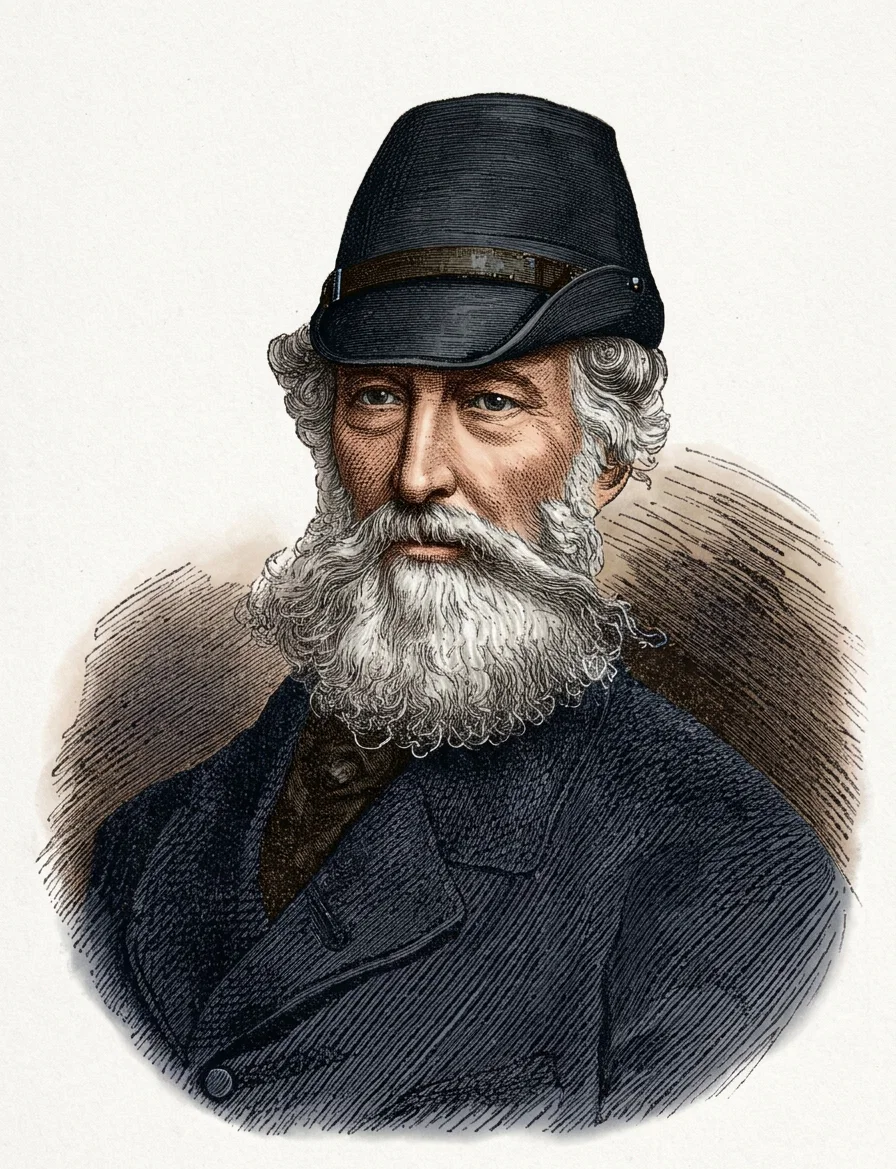
By permission of the "Scientific American." The late Alfred Krupp, of the great Krupp gun and iron works, Essen, Prussia. His works employ over 20,000 men, largely in making guns.
Each pair of her thirteen-inch guns can be fired every three minutes, and each pair of the eight-inch guns, once a minute. The six-inch guns can be fired twice a minute, and the six-pounders, twenty times a minute. In an engagement of only thirty minutes, she would discharge, with furiously murderous velocity, a total of 83,600 pounds, or something over forty tons, of steel projectiles. She would not deign to train one of her big guns on such a craft as the “Merrimac” or the “Monitor;” for a few minutes’ work from one or two of her smaller pieces would soon settle the fate of all such structures.
And the eleven-inch guns of thirty years ago that had to be loaded at the muzzle, and with their consequently short, stubby barrels, must not be confused with the eleven-inch guns of to-day. Then, a charge of from ten to sixteen pounds of powder was considered large, and a ball weighing from forty to one hundred and eighty pounds was the maximum. A few inches of iron armor was all that was needed to withstand the shots from such guns. But the modern breech-loading gun, as shown in last week’s paper, hurling, with all the force generated by the explosion of half a ton of powder, a steel shot weighing as much as a ton, is an altogether different weapon.
Men who are trained to war stand in awe of the frightful thought of bringing this modern fighting machinery into action. When we consider how suddenly it has appeared, and with what almost superhuman rapidity it is developing, who can doubt that the deadly weapons for the “battle of that great day” are now being hurriedly put in readiness for the final struggle? Are not the nations fulfilling the word, “Prepare war”? Joel 3:9.
Do you ever take the time to consider how the Spirit of God, through the Testimonies as well as the Bible, has been trying to awaken us to the situation about us to-day? With these fulfilling prophecies in mind, read the following:—
All heaven is represented to me as watching the unfolding of events. A crisis is to be revealed in the great and prolonged controversy in the government of God on earth. Something great and decisive is to take place, and that right early. If any delay, the character of God and his throne will be compromised. The armory of heaven is open; all the universe of God and its equipments are ready. One word has Justice to speak, and there will be terrific representations upon the earth, of the wrath of God. There will be voices, and thunderings, and lightnings, and earthquakes, and universal desolation. Every movement in the universe of heaven is to prepare the world for the great crisis.
Intensity is taking possession of every earthly element; and as a people who have had great light and wonderful knowledge, many of them are represented by the five sleeping virgins, with their lamps but no oil in their vessels,—cold, senseless, with a feeble, waning piety. While a new life is being diffused, and is springing up from beneath, and taking fast hold of all Satan’s agencies, preparatory to the last great conflict and struggle, a new light and life and power is descending from on high, and taking possession of God’s people who are not dead, as many now are, in trespasses and sins.—Special Testimony entitled, “An Appeal to our Ministers and Conference Committees,” pp. 38, 39.
Restored with AI
The iron-clad “Monitor,” the best type of war-ship in 1862.
“Intensity is taking possession of every earthly element.” Do you see that it is really so? Are you, in company with “all heaven,” “watching the unfolding of events”? The rapidity with which the work is going on shows that the end cannot be far off. Are you ready for it? Are you seeking to lead others to a knowledge of what all these things mean? Above all, are you, by every word and act of your life, pointing them to the only refuge, the sympathizing and tender Saviour? “Arise ye, and depart; for this is not your rest: because it is polluted, it shall destroy you, even with a sore destruction.”