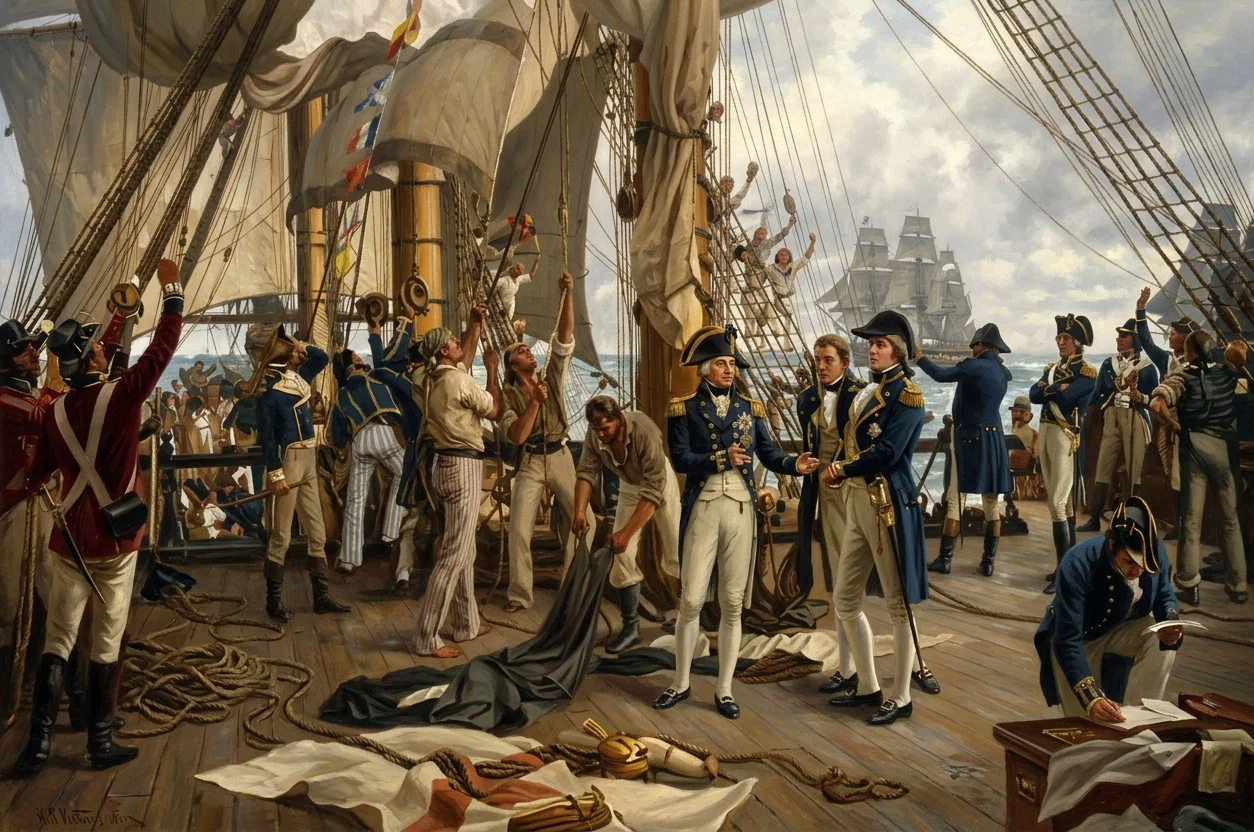
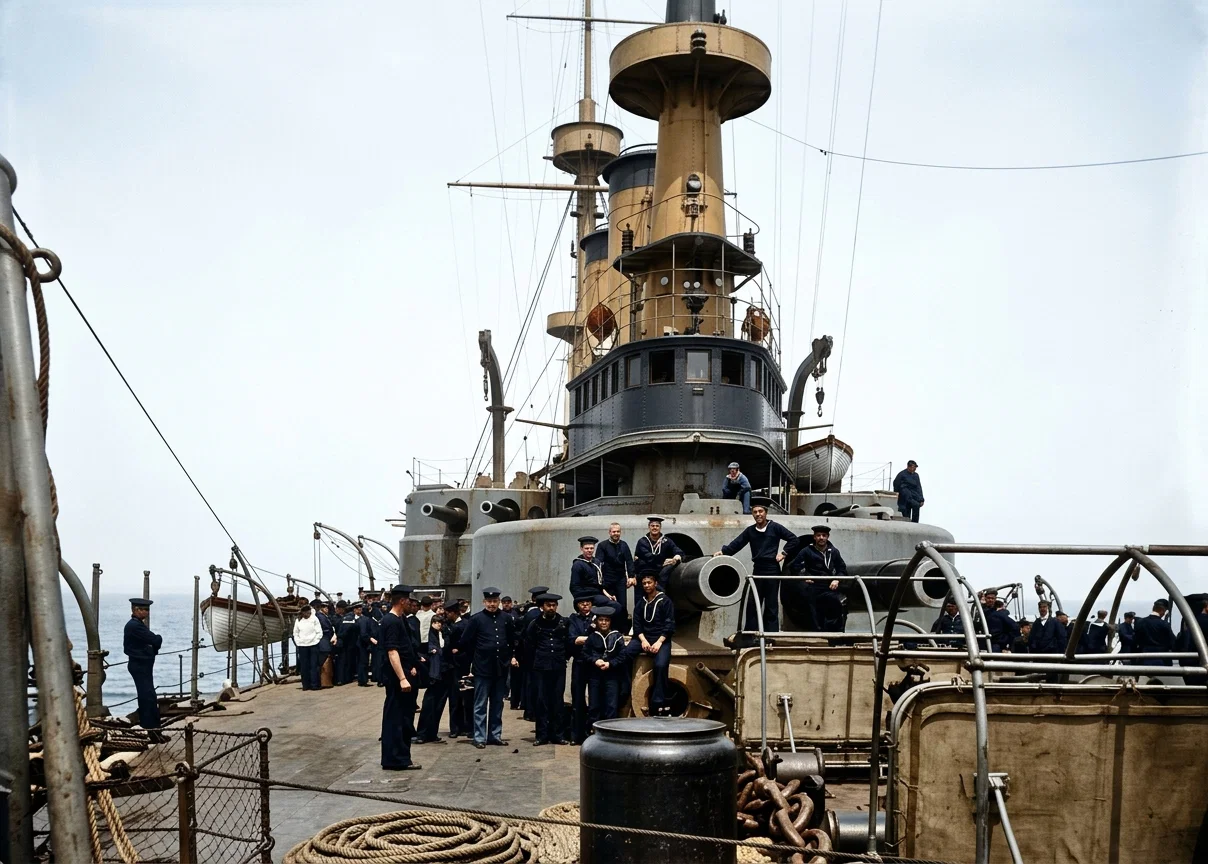
England alone has a line of battle-ships thirty miles long. Previous to 1860 any country in possession of a single gunboat like the great “Indiana” could have swept from the seas all the navies of the world. Compare our two pictures of two mighty war-ships—the one at the beginning, the other at the end, of this century. Shaking from her steel-armored sides, almost as so many drops of water, the comparatively small and forceless cannon-balls of those times, and turning her ponderous cannon and “rapid-fire” guns upon the best men-of-war in those days, it would have been mere child’s play for the “Indiana” to break them in pieces, and send them to the bottom of the ocean.
Restored with AI
Trafalgar—1805. Nelson's flag-ship, "The Victory," entering battle, at the moment of running up the signal "England expects every man to do his duty."
But what will be the direful results when England, with her armies and thirty miles of these terrible war-ships, together with all the armies and navies of the nations of the world, is plunged by the rage of demons into the final war! For while England is considered the greatest naval power to-day, other nations are making all possible haste to float navies that can humble the British Lion on the high seas. Even Japan, which has been considered among the “benighted heathen,” encouraged by the results of her recent naval victories over China, is equipping a navy that bids fair soon to challenge the world.
A person who does not see fit to give his name has an article in the December Cosmopolitan entitled, “Our Late War with Spain.” The matter is written upon the supposition that the quarrel between the United States and Spain over Cuban questions had actually resulted in war. From this he proceeds to draw, from the present war facilities, a description of what would occur if the fleets of Spain and America should begin a fight. The picture he presents is a vivid one, yet all that he says is entirely in keeping with the fearful possibilities of a naval engagement. In describing the supposed fight, this gentleman says:—
Five—six—seven explosions take place on the American vessels. It is the enemy’s shells. One has struck the steel top of an observation tower, and carried it away, leaving the headless body of the young officer at the glass to sink to the floor. The body is hastily removed, and a new man appears standing, telescope in hand, in the now unguarded opening, sweeping the horizon as calmly as if nothing had occurred.
The signal “Full speed ahead” has been reserved for this moment. Almost before the heavy guns of the enemy have been recharged, the vessels have crossed the two-mile limit, and the signal to begin firing is hoisted on Admiral Bunce’s flag-ship. Not only do words fail to describe the terrific forces brought into action in the modern sea battle, but the imagination itself can present but a feeble counterpart. Officers who were in the fight off Havana say that from the moment the action was fairly opened, they worked amid horrors. “We seemed to be in the crater of an active volcano,” one said, describing the scene. “The ears were split with sound. Comrades disappeared in fragments before our eyes. Fury appeared to take possession of the living. There would be an explosion, and when the smoke had partly cleared, it would be found that a whole section had been shot away.”
Under cover of the dense smoke which quickly enveloped the waters, a new engine of war was brought for the first time into play. Well in the rear of the line as it departed from Havana, was the American liner “St. Louis.” A thousand mechanics had hastily cut port-holes through her thin iron sides, and mounted three hundred six-pound rapid-fire guns. Along the center upper deck had been erected a slight iron platform, on which one hundred and fifty Gatling and Maxim guns were in place, with twenty more on platforms built around the40masts. Each of the six-pound guns had a capacity of ten shots a minute, or a total rain of three thousand shells, each capable of piercing light armor, or causing death and destruction if it entered a turret port-hole. When the subject had been discussed prior to the breaking out of the war, the idea of thus equipping a fast merchant steamer had been pooh-poohed, the claim being set up that the big guns of the battle-ships would leave nothing of the merchantman before she could come within the limited range at which her six-pounders would be effective. With her great speed in reserve, the “St. Louis” hung on the rear and out of reach until the action had well begun. As the pall of smoke began to descend, her officers recognized their opportunity, and came on without attention from the enemy until almost alongside the “El Pelayo,” one of the Spanish battle-ships. Then there was let loose a broadside of one hundred and fifty three-inch guns and the entire one hundred and seventy Maxim and Gatling guns.
It was believed by the officers on board the “St. Louis” that the guns of the Spanish ship were never fired after the receipt of that first minute’s iron and leaden hail. It was found afterward that numberless bullets from the repeating guns and many shells from the rapid-fire guns had penetrated every port-hole and opening. A single three-inch shell had killed every man in one turret. Before the discovery was made that the ship had ceased fighting, nearly eight thousand three-inch shells and more than fifty thousand bullets had been rained upon her—the greater part rattling harmlessly from her armored sides. Nevertheless a small percentage penetrating the openings was sufficient to leave nothing alive above the water-line. And it was all so quickly done! In four minutes the “St. Louis,” comparatively little injured, was able to cease firing, and turn her prow in pursuit of another adversary.
Under the cover of the smoke, three Spanish cruisers managed to get away, and, rounding Cuba, reach a neutral port well to the south. One battleship and two cruisers were sunk during the engagement, going down suddenly, with all on board. The remainder cannot be said to have surrendered. They simply ceased firing; and when taken possession of, were a mass of ruins above the water-line— everywhere encumbered with the dead and the dying. The water was full of sailors who, in the craze of the awful din, had jumped overboard, preferring death by water to the seemingly certain death on board ship.
A curious thing had happened to the second-class battle-ship “Texas.” In her construction the naval engineers had arranged a torpedo compartment in the after part of the ship, covered with three-quarter-inch armor. A small shell from a Spanish rapid-fire gun penetrated this iron, and struck one of two Whitehead torpedoes which were being handled preparatory to use. The explosion which followed seemed to blow the upper part of the ship to atoms, and to penetrate to the magazines; for a second explosion immediately followed, hoisting one of the great turrets bodily into the air. Captain Wise, who was on the bridge at the time, was blown into the water, and escaped by clinging to some wreckage.
It was a victory, but gained at what a cost in lives!—a victory which left not a single vessel belonging to the victors in condition to renew the fight.
If a simple knowledge of the frightful possibilities of a modern naval battle would cause a man to write such a description of an imaginary fight as the foregoing, what will the awful realities be when all the armies and navies of the world are gathered by the “spirits of devils” to “the battle of that great day”? If God had seen fit to give no other line of evidence than that presented in the wonderfully warlike attitude of the nations to-day, it would be sufficient to show clearly that “the end of all things is at hand.” But this is only a small part of the evidence piling up all about us to-day. Truly there can be no mistaking it. “The coming King is at the door.” Yet how many of the world’s inhabitants are unacquainted with this great truth!
Restored with AI
By permission of the “Scientific American.” United States battle-ship “Indiana,”—the heaviest armed ship of the United States Navy.
Are we doing all we can, individually, to tell the discouraged and unhappy sinners of this world what a wonderful and complete Saviour we have found? Are you earnestly telling all around you that “this gospel of the kingdom shall be preached in all the world for a witness unto all nations; and then shall the end come;” “and that, knowing the time, that now it is high time to awake out of sleep; for now is our salvation nearer than when we believed”?