IN our previous articles, showing that the great spirit of war in the world is a conspicuous sign that we are in the last of the last days, only the weapons of warfare have been dwelt upon. When we consider the vast number of men in the navies and standing armies of the world, and the immense sums of money expended to equip and maintain them, the picture becomes still more appalling and impressive.
The “World Almanac for 1897” informs us that the armed force of the leading nations of Europe amounts to 18,550,946 men; and, in addition to these, 2,260,302 armed men from some of the lesser countries stand ready to be called to the battle-field in a moment. Think of it! Over twenty million men under arms in the Old World alone, without mentioning what is being done to prepare for war in the United States and other countries not included in the list. Perhaps it may be said that the standing army of the United States is insignificant, and that, therefore, there is no evidence of war here; but it is an open secret that this country is rapidly building up one of the best navies afloat, and nowhere are more of the big cannon manufactured than here. While the United States has not, as yet, established a very large standing army, she is drilling a strong militia in every State; and she believes that her resources are such that she could drill and call into action an immense army in a short time if it should become necessary.24
But returning to the more than twenty million men under arms in the Old World, consider what it means. When such vast armies, equipped with the terrible weapons of modern warfare, are brought into action, who can estimate the awful results? In 1812, when Napoleon Bonaparte was at the height of his military power and glory, the records inform us that he “could count not far from four hundred and seventy-five thousand men ready for the field.” Napoleon was then preparing to invade Russia; and, speaking of his armies, he wrote to Davout, “I have never made greater preparations.” All Europe was then in arms against him, and stood in terror before his army of less than half a million men. The world has stood in awe as, in bewildered contemplation, it has viewed the military exploits of Napoleon, one of the greatest of all the military chieftains of the past. But suddenly turning the gaze from Napoleon and his time to our own day, how tamely insignificant seem the armies and equipments of those times, compared with what we see all about us now! And if half a million men, under skilful generals at that time, were the terror of civilized Europe, what will it be when the multiplied millions of men, armed with their modern death-dealing weapons, are urged on by “unclean spirits” to “the battle of that great day”?
Restored with AI
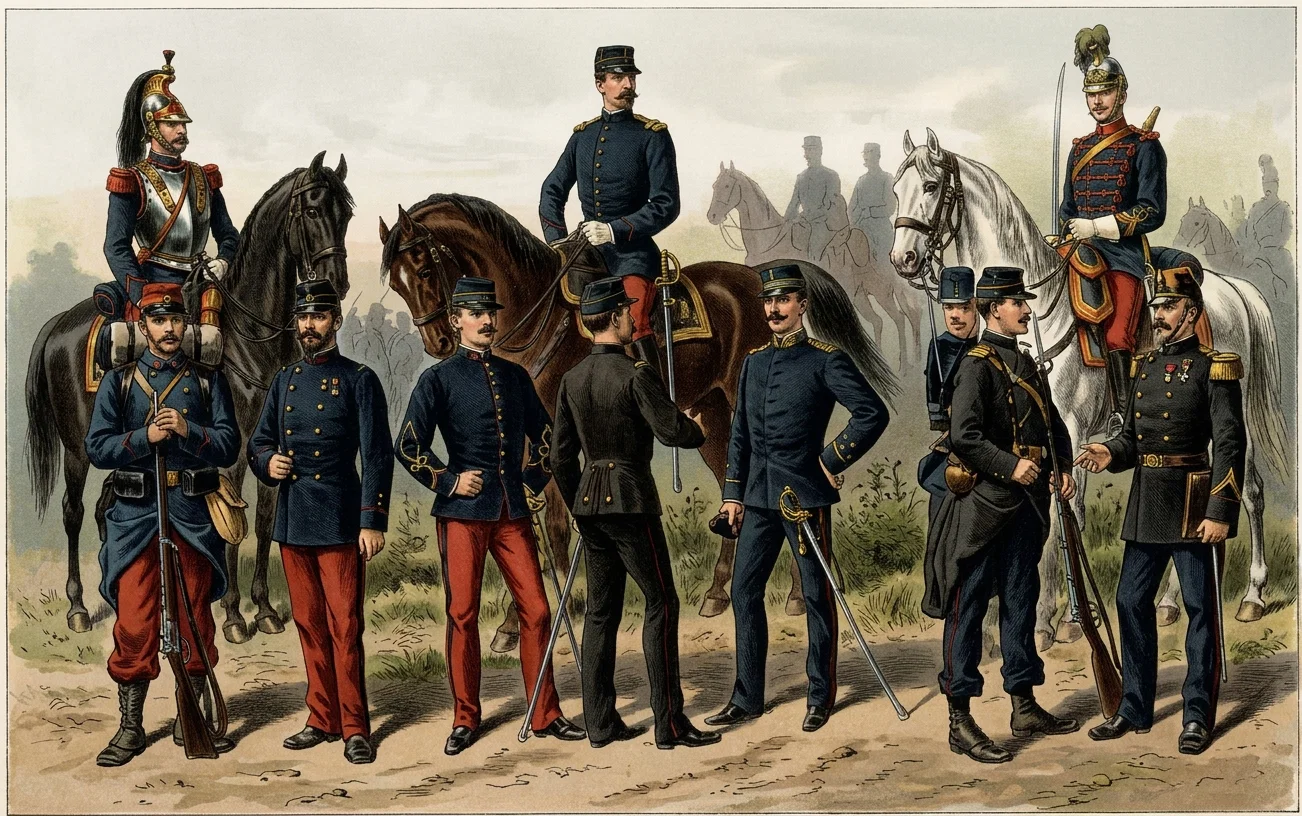
Styles of the French Army. War-footing, 2,000,000.
No wonder that such unparalleled preparations for war should cause the Marquis of Salisbury, at the opening of the British Parliament, Jan. 19, 1897, to say: “What would you say is the great change which has passed over Europe since the older of us were young men?—It is this tremendous increase in the burdens which the necessity of self-defense has cast upon every nation of the world. That burden goes on getting higher and higher; a larger and larger part of the population is devoted to military service; more and more money has to be spent in the provision of the mechanical apparatus of war; and as the conquests of science are extended, not only are all previous efforts determined to be obsolete and have to be thrown away, and something new introduced in their place, but a larger and larger proportion of the public wealth has to be devoted to this unremunerative purpose. The burden has become so serious to many nations that many have thought that the day will come when nations will rather rush into war, and provoke a decision, once for all, than continue to groan under the suffering which modern necessity forces upon them.”—London Times, Jan. 20, 1897, page 6.