THE FALLING STARS AMONG THE INDIANS.
By G. L. Wilson
G. L. WILSON.
Audubon, Iowa.
The various ways of counting time have brought the nations into confusion; but when events are tied to heavenly phenomena, we see God’s purpose in the planets, as he said: “Let them be for signs, and for seasons, and for days, and for years.” Gen. 1:14. “He appointed the moon for seasons.” Ps. 104:19. So the Dakota Indians count their months by moons, showing their knowledge of the new moon of the star-shower of 1833 to be a natural consequence. The Dakota Indians include parts of two of our years in their chronology by “winter counts.” Any event which stands out as the greatest, in the estimation of the tribal chronologer, is used for the name of the year.
A Dakota record, on a buffalo-robe, by “Lone Dog,” of the Yanktonai tribe, gives the “winter counts” by picturing events, one for each year. Like Hebrew, the record is written from right to left, through the center of the robe. On this buffalo-robe is pictured yearly events from 1788–9 to 1874–5.
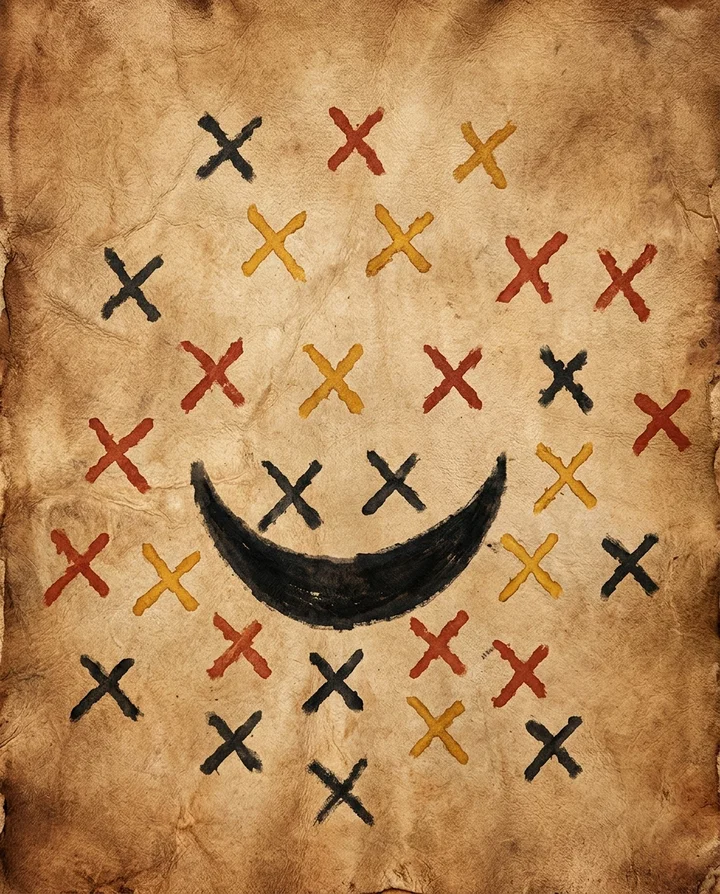
“The-Blaze,” a Dakota of the “Sans Arcs” adoption, pictures the year 1833–4, with six stars over the crescent moon, for a new moon. (Fig. 1.) He calls the count “Many-stars-fell Winter.” “Lone Dog’s” buffalo-robe has it pictured with many stars falling around the moon. (Fig. 2.) He calls it “The-stars-fell Winter.” “The Swan,” a Minneconjou chief, has it still a little different, and extends the “tails” of the stars. (Fig. 3.) “Battiste Goode” calls it “Storm-of-stars Winter;” and pictures it as a tent surrounded by falling stars. (Fig. 4.) “White-crow-killer” calls it “Plenty-stars Winter.” “American-horse,” an Oglala Dakota, calls it “The-stars-moved-around Winter,” and pictures a diamond-shape for the new moon, with stars all around it. (Fig. 5.) “Cloud Shield,” also an Oglala Dakota, calls it “It-rained-stars Winter,” and pictures out a rectangle of stars. (Fig. 6.)
The usual form of the star may be called a cross like a plus-mark or x. It is quite evident that if these markings are an afterthought, they must have been made by an astronomer who knew that the time of the star-shower was at new moon; and an astronomer would be more likely to use the common sign for new moon, rather than the crescent as it appears in nature, as astronomers use the latter to show first and last quarters, rather than new moon.
In “Lone Dog’s” count, going around further to the left, we see a sign for an eclipse of the sun, set for 1869–70. This was on the line of totality, over the Dakota Territory, Aug. 7, 1869. Other counts mention this same eclipse.