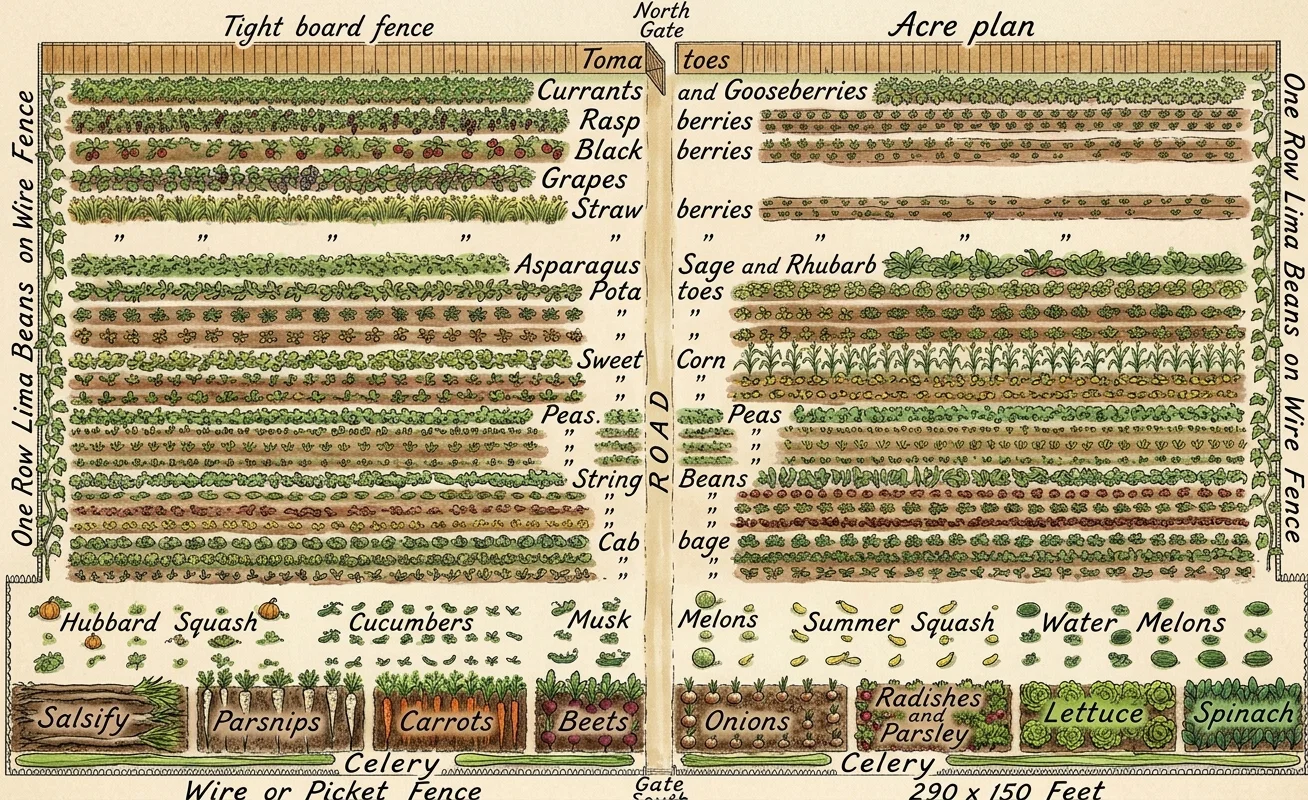
LAST week we gave directions for making a small, temporary garden. Now let us who live on the farm see what we can do for the Lord with a permanent acre-garden.
Restored with AI
Tight board fence Celery Wire or Picket Fence North Gate Acre plan 200 x 150 Feet
Where should the garden be situated?—If possible, it should be near the house, as it can then be given more attention. The way many gardens have been neglected is a good reason for hiding them in the corn-field. A well-cultivated garden is an ornament, and something that its possessor can justly take pride in. If it is neglected, and the weeds are allowed to grow, and hide the crooked rows, it is an eyesore to the owner and a byword among the neighbors.
Concerning the nature of the soil and the slope of the ground, but little need be said. The richer the soil, the better. A sandy loam and a southern slope are to be preferred. Have a tight board fence on the north side, if possible, to protect the garden from the cold winds. The other sides may be surrounded either with picket or close wire fence. The fence should be made tight enough to keep out chickens. This acre is to be for the Lord; therefore it should be a pleasure to keep it free from weeds, and in the best condition.
The methods of gardening have advanced during the last fifty years. Horse-power has taken the place of the spade, hand-rake, and hoe; and garden-drills are rapidly taking the place of hand sowing.
For a modern garden of one acre, make the rows longer one way than the other, so it can be easily cultivated with horse and plow. If a horse is used, the tomatoes, currants, gooseberries, blackberries, raspberries, grapes, strawberries, asparagus, rhubarb, and sage may be planted in rows about four feet apart. Sweet corn, potatoes, cabbages, and beans may be planted in rows three and one-half feet apart. If you do not have a horse, and wish to cultivate your garden by hand, all these may be planted one foot nearer together, thus saving considerable land. Melons, squashes, and cucumbers require the same distance under any kind of culture. The narrow rows to the south will have to be tilled by hand. If farm animals are running loose, the Lima beans on the north and south should be changed to some other place; corn should not be planted close to the fence. Celery needs some shade, so it would be well to plant it near the south fence. This arrangement of the garden is not arbitrary, but may be varied to suit the taste.
Many small gardeners raise all their plants; and as it is not yet too late to plant tomatoes and cabbages, let us see what we can do. Fill an open box, about twelve by eighteen inches in size, three fourths full of mellow soil. With the finger or a small stick, make small trenches half an inch deep, and two inches apart. Into these trenches drop ten or more seeds to the inch. Cover and “firm” (press the soil over the seed) with the palm of the hand. The boxes may be carried out-doors during sunny days. Never plant seed of any kind without firming the soil. This is absolutely necessary. Many persons carelessly drop seeds into the ground; and when they do not come up, they begin to accuse the seedsman of selling worthless seed. Much poor seed is sold; but in many cases the real fault is with the careless planter, and not with the seed. If buying seed in small quantities of your grocer, ask him to supply you from some well-known firm, that takes back all unsold seed in the fall, and brings fresh seed every spring. Next week I will tell you how we can set out tomatoes and cabbage plants in the field. This week we will mention only those that ought to be planted early.
Beets may be planted in rows from twelve to eighteen inches apart. Into trenches about one inch deep drop the seed one fourth of an inch apart. Draw the soil over the seed, and firm with the feet. Carrots, parsnips, salsify (vegetable oyster), and turnips may be planted the same as beets. Spinach may be planted according to the directions given last week for planting lettuce.
Almost every person has a way of his own for planting potatoes. Some cut the potato, leaving but one eye to the piece; others leave more; while some of the largest potato-growers claim an increase of thirty bushels an acre by planting the whole tuber. Drop the pieces, or whole tubers if you wish to experiment, in a trench previously prepared, sixteen inches apart, cover with the hoe two inches deep, and firm the soil with the feet. If you wish to fertilize the soil before planting, scatter well-decomposed stable manure in the trench; a wagon-load would not be too much for four rows of this length.
If you wish, you can have a succession of such vegetables as radishes, lettuce, beets, spinach, etc., by planting every two or three weeks until the middle of July. In like manner you can have a succession of sweet corn, beans, and peas.
The following amount of seed and plants will be required for this acre-garden, to keep it cropped as it should be:— Four qts. extra smooth peas; 4 qts. early dwarf wrinkled peas; 1 pkt. later wrinkled peas; ½ lb. spinach; 1 oz. celery; 4 qts. onion-sets; 1 oz. early cabbage; 1 oz. late cabbage; 4 ozs. early beets; 4 ozs. Blood Turnip Beet; 1 oz. carrot, Early Scarlet Horn; 1 oz. carrot, Chantenay or Danvers; 1 oz. tomatoes, early; 1 oz. tomatoes, late, Ponderosa; ¼ lb. radish, Early Turnip; ¼ lb. radish, Long-rooted; ¼ lb. lettuce; 4 qts. beans, Green String; 4 qts. beans, Wax String; 4 qts. beans, Bush Lima; 4 qts. sweet corn, Extra Early Cory; 4 qts. sweet corn, medium; 4 qts. sweet corn, late; 4 qts. cucumbers; 3 ozs. muskmelons; 3 ozs. watermelons; 3 ozs. squash, summer; 3 ozs. Hubbard squash; 1 pkt. sage; 1 bu. early potatoes; 800 strawberry plants; 100 asparagus roots; 20 rhubarb roots; 45 gooseberry bushes; 45 currant bushes; 90 raspberries; 35 grapevines.
Buy your seed in bulk for a garden of this size, or, in fact, for a smaller garden, if you are sure the seed is as good as that in sealed packages. There is usually about half an ounce in the small packets, and the seed so bought costs two or three times as much as if purchased by the ounce or pound.
I have avoided naming the varieties, except such as are known and planted almost the world over, as some varieties that do well in one section would not do well at all if grown in another. ARTHUR F. HUGHES.