Why was it that the Lord “spake not unto the fathers, nor commanded them in the day that he brought them out of the land of Egypt, concerning burnt offerings or sacrifices”?
Having lived for two hundred and fifteen years “in the midst of idolatry and corruption [in the land of Egypt], they had no true conception of the holiness of God, of the exceeding sinfulness of their own hearts, and their need of a Saviour. All this they must be taught.”
At Mount Sinai they covenanted with God to obey his voice and keep his commandments, a thing which the natural man can not do. They heard his voice, that voice which “shook the earth;” but within forty days from that time they had made a golden calf, and had prostituted themselves to the most abominable rites of heathenism. By the conditions of the covenant which they had just made, the whole multitude merited instant death; but through the covenant of grace given to Adam, and afterward confirmed to Abraham, the repentant ones were forgiven. See Exodus 32 to 34:9.
After this fearful transgression, they saw “their utter inability in themselves to keep God’s law,” and therefore their need of a Saviour.
The plan of the tabernacle, the material for its construction, its order of service, the priesthood, etc., had been revealed to Moses during that forty days in which the children of Israel had grown impatient at his long absence, and had persuaded Aaron to make the gods of gold (Exodus 25 to 31); but Moses said nothing to them about it until after the great transgression had been repented of, and their need of a Saviour was apparent to them. Since the record of their sin, and the fearful reckoning of God for the same, are recorded in chapter 32, their thorough repentance, in chapter 33, verses 4–8, and God’s revelation of himself as a God of mercy and forgiveness in chapter 34, we could not expect the tabernacle and its services revealed to them before chapter 35; and this is the exact place we do find it. First, the material for the construction of the tabernacle is called for. “Take ye from among you an offering unto the Lord: whosoever is of a willing heart, let him bring it, an offering of the Lord.” Verse 5. And the record is: “The children of Israel brought a willing offering unto the Lord, every man and woman, whose heart made them willing.” Verse 29. Second, the Lord called certain men by name, and filled them with the Spirit of God and with wisdom to direct, or to do, the work of the building of the tabernacle, and to make all the instruments connected with it. Verses 30–35.
After this, follows the record of the construction of the tabernacle, the making of the robes, etc., for Aaron and his sons, the priests. This is found in chapters 36 to 39. Chapter 40 speaks of the setting up of the tabernacle, and the arrangement of everything for the services. All things ready, the record is: “And he [Moses] put the altar of the burnt offering by the door of the tabernacle of the tent of the congregation, and offered upon it the burnt offering and the meat offering as the Lord commanded Moses.”
Now the Lord has spoken to Israel concerning burnt offerings and sacrifices. Now the people are prepared to understand the meaning of these. But before their sin and subsequent humiliation and repentance, God could not reveal to them his purpose “concerning burnt offerings or sacrifices.”
Before this, their idea concerning the real meaning of sacrifices was as far from truth as it was concerning the holiness of God and the spirituality of the law. During their sojourn in Egypt they had largely forgotten these things, which were plain to Adam, Seth, Enoch, and Noah, also to Abraham, Isaac, and Jacob. All this had to be taught them.
How great must have been the blindness of mind and heart resulting from their intercourse with idolaters and idolatry in Egypt, when, after all this revelation of divine glory and power, they could prostrate themselves before the gods of gold, and say, “These be thy gods, O Israel, which brought thee up out of the land of Egypt.”
“And they rose up early on the morrow, and offered burnt offerings, and brought peace offerings; and the people sat down to eat and to drink, and rose up to play.” That the “play” here mentioned was far from innocent pastime may be easily seen from Ex. 32:25. Still they were offering “burnt offerings” and “peace offerings” to the one who, they said, had brought them up out of the land of Egypt.
Therefore, their conception of God, of his law of holiness and purity, and of the proper use and meaning of sacrifices and offerings, had been so completely perverted in Egypt that all the power and glory of God thus far revealed had failed fully to enlighten them.
How foolish it would have been for the Lord to require sacrifices of them before they had learned the need of them, and also what they typified.
In offering a sacrifice, the heathen thinks he will conciliate his god. He has violated his conscience, his sense of right; his god is angry, and longs to wreak his vengeance upon him. He offers an animal, by which he hopes to appease wrath, or at least divert it for the time being from himself.
The gospel idea is just the opposite of this. The offering represents the Son of God as the infinite gift to reconcile man to God. “When we were enemies, we were reconciled to God by the death of his Son.” “Hereby perceive we the love of God, because he laid down his life for us.” This reverses the heathen idea of sacrifice. “The wages of sin is death.” Christ tasted death “for every man.” “Hereby perceive we the love of God.” “The carnal [natural] mind is enmity against God.”
Since love neutralizes enmity, abolishes it; and since God does not allow a vacuum to exist, we may know that the love which overcomes the enmity will surely supplant it. And so it is written, “We love him, because he first loved us.” This is reconciliation.
Yet in his fallen nature, man feels very independent. He does not readily consent to the fact that he is, of himself, nothing, and therefore can do no good thing. In fact, I do not remember having seen a person who would accept salvation by grace until he had convinced himself that he could not accomplish it by his own works; nor does he surrender at once: he applies the old adage, “If at first you don’t succeed, try, try, again.” This is the experience recorded in Rom. 7:15–24. And it is not until by repeated failures he has become convinced of his own weakness that he wails out, “O wretched man that I am! who shall deliver me?”—not until then can he say, “I thank God, through Jesus Christ our Lord.” Here is deliverance.
Not, however, deliverance from God’s requirements; but deliverance from “the law of sin,” which is opposed to God’s requirements, opposed to his law of righteousness. “The law of the Spirit of life in Christ Jesus hath made me free from the law of sin and death, . . . that the righteousness of THE LAW might be fulfilled in us, who walk not after the flesh, but after the Spirit.” Rom. 8:2–4.
It was therefore necessary that God should reveal his law of righteousness to Israel, and give them an opportunity to try to keep it in their own wisdom and strength; before he could reveal their Saviour as shadowed forth in the sacrificial offerings. Yet, as we have seen, these typical offerings were not given to confirm the people in sin, but to represent Christ, the all-sufficient remedy.p. 639
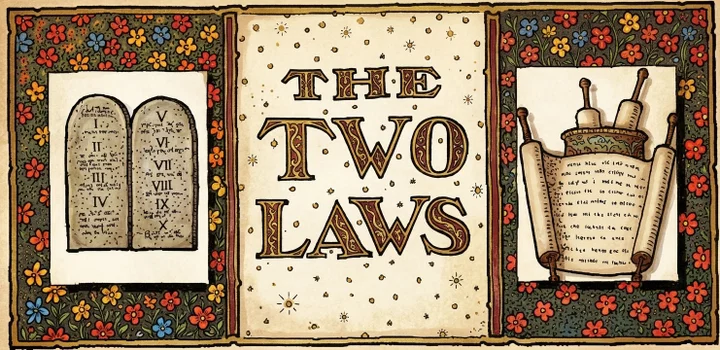
And thus we read: “They had witnessed the proclamation of the law in awful majesty, and had trembled with terror before the mount; and yet only a few weeks passed before they broke their covenant with God, and bowed down to worship a graven image. They could not hope for the favor of God through a covenant which they had broken; and now, seeing their sinfulness and their need of pardon, they were brought to feel their need of the Saviour . . . shadowed forth in the sacrificial offerings.”—“Patriarchs and Prophets,” chap. 32, par. 31. First, the law revealing sin; then, the law of sacrifices shadowing forth the Saviour from sin. Here are two distinct laws. And “the distinction between the two is broad and clear.”
E. J. HIBBARD.