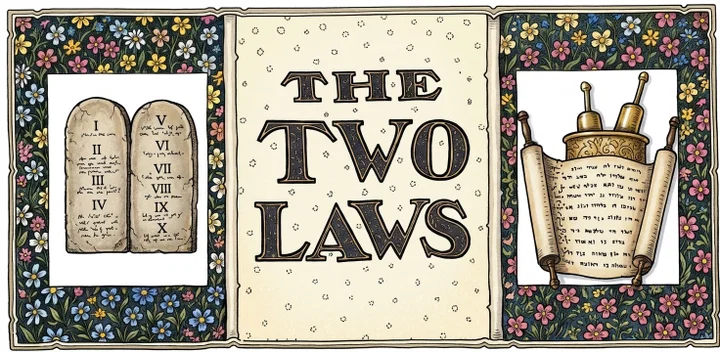
Reasons for the Change.
By E. J. Hibbard
“For the priesthood being changed, there is made OF NECESSITY a change ALSO of the law.” Heb. 7:12.
The first reason, then, for the change of the law is that the priesthood is changed, thus making the change of the law a necessity.
“If therefore perfection were by the Levitical priesthood (for under it the people received the law), what further need was there that another priest should rise after the order of Melchisedec, and not be called after the order of Aaron?” Verse 11.
First we will inquire after the fact, and then notice the effect of the same. Was another priest to arise? And he of another order than that of Aaron? Paul is not announcing a new thing here; but is simply referring to, and building on, that promise of God through David, where he says, “The Lord hath sworn, and will not repent, Thou art a priest forever after the order of Melchisedec.” Ps. 110:4. Of whom is the Lord here speaking?—The One to whom he said, “Sit thou on my right hand, until I make thine enemies thy footstool.” Ps. 110:1. And Jesus himself used this scripture as applying to himself. See Matt. 22:42-44.
But may not several priesthoods exist, and that simultaneously? How is it that the establishment of one priesthood would change or abolish another? To the first question we answer: If the priesthood were of men, it might be so; and this is what we see throughout the world, wherever the religion is man-made. But God ordained the priesthood of Aaron (Heb. 5:4), as well as that after the order of Melchisedec. Heb. 5:5, 6. Now the reason the two could not exist together will appear very plainly as we proceed.
WHY WAS THE LEVITICAL PRIESTHOOD CHANGED?
The question is answered by asking another: “If therefore perfection were by the Levitical priesthood, what further need was there that another priest should rise after the order of Melchisedec, and not be called after the order of Aaron?”
God is perfect. He also demands perfection. Matt. 5:48.
If perfection were by the Levitical priesthood, what further need was there of another?—No need. But since another was to arise, and did arise, there must have been some need of it; for God does no unnecessary thing. He makes no false moves. Therefore the Levitical priesthood was changed to that of the order of Melchisedec, because it did not bring perfection. Perfection to what, or whom?—To sinners, of course. Were not these priests ordained to “offer both gifts and sacrifices for sins”? Heb. 5:1. What did they offer?—Animals—“bulls and goats.” Righteousness is perfection. Sin is imperfection. Therefore, to bring or give perfection, sin must be removed and righteousness imparted. The blood of “bulls and of goats” could do neither the one nor the other; “for it is not possible that the blood of bulls and of goats should take away sins.” Heb. 10:4. Again, the gifts and sacrifices could not make him who did the service “perfect, as pertaining to the conscience.” Heb. 9:9.
They could not take away imperfection nor give perfection. So we see the priesthood could not bring perfection, because their offerings could not purge out sin and implant righteousness.
THE CHANGE OF THE LAW.
REASON No. 1.—“For the priesthood being changed, there is made of necessity a change also of the law.”
But why must the law be changed when the priesthood is changed? This brings us to—
REASON No. 2.—“For he of whom these things are spoken pertaineth to another tribe, of which no man gave attendance at the altar. For it is evident that our Lord sprang out of Judah; of which tribe Moses spake nothing concerning priesthood.”
We have seen that the law made priests after the Levitical order; “for the law maketh men high priests which have infirmity.” Heb. 7:28. This law confined the priesthood to the tribe of Levi and the family of Aaron. It also said, “And the stranger that cometh nigh shall be put to death.” Num. 3:10. Therefore, since our Lord, being of the tribe of Judah, could not be priest according to the law, which required all priests to be of the tribe of Levi, the Father had to change the law when he made him priest; for it is not reason that God should act contrary to a law which he himself had given.
REASON No. 3.—“And it is yet far more evident [that the law had to be changed on the change of the priesthood]: for that after the similitude of Melchisedec there ariseth another priest.” Heb. 7:15. Why would this fact require a change of the law?—“And they truly were many priests, because they were not suffered to continue by reason of death: but this man [Christ], because he continueth ever, hath an unchangeable priesthood.” “The law,” therefore, had to make provision for a succession of priests. But this can not work in the priesthood of Christ, since “he ever liveth to make intercession” for us. Now the priesthood of Christ is like that of Melchisedec, in that he has no predecessor nor successor. “The law” did not fit this priesthood. Hence, its change.
REASON No. 4.—“For if he [Christ] were on earth, he should not be a priest, seeing that there are priests that offer gifts according to the law.” Heb. 8:4. The offerings according to the law were “bulls and goats”—animals. But Christ offered himself. Heb. 7:27. So the gift of himself being contrary to the provision of the law which required the offering of animals, that law must therefore be changed.
REASON No. 5.—“For the law made nothing perfect.” Heb. 7:19. The Levitical priesthood was changed because it did not bring perfection. So, for the same reason, the law must be changed, because it “made nothing perfect.” But why could not the law make the people perfect?—“For the law having a shadow of good things to come, and not the very image of the things, can never, WITH [by or through—by means of] THOSE SACRIFICES which they offered year by year continually make the comers thereunto perfect.”
We have now traced the root of the trouble to the sacrifices. “It is not possible that the blood of bulls and of goats should take away sins.” Heb. 10:4. The law had no other instrument than the sacrifices. These could not remove sin. Therefore the law could not take away sin—an all-sufficient reason for its change when he came and was offered who can take away sin, who can save to the uttermost.
Therefore, SINCE these offerings could not take away sins, and for this reason could not make any one perfect; since the remedial law had no other offerings than these; and since the sole work of the Levitical priesthood, in the atonement for sin, was the offering of these same sacrifices; therefore, the sacrifices, the priesthood, and the law regulating both the sacrifices and the priesthood,—all these must be changed when the offering is made which CAN and DOES take away sin.
THIS OFFERING WAS MADE WHEN CHRIST OFFERED UP HIMSELF. E. J. HIBBARD.