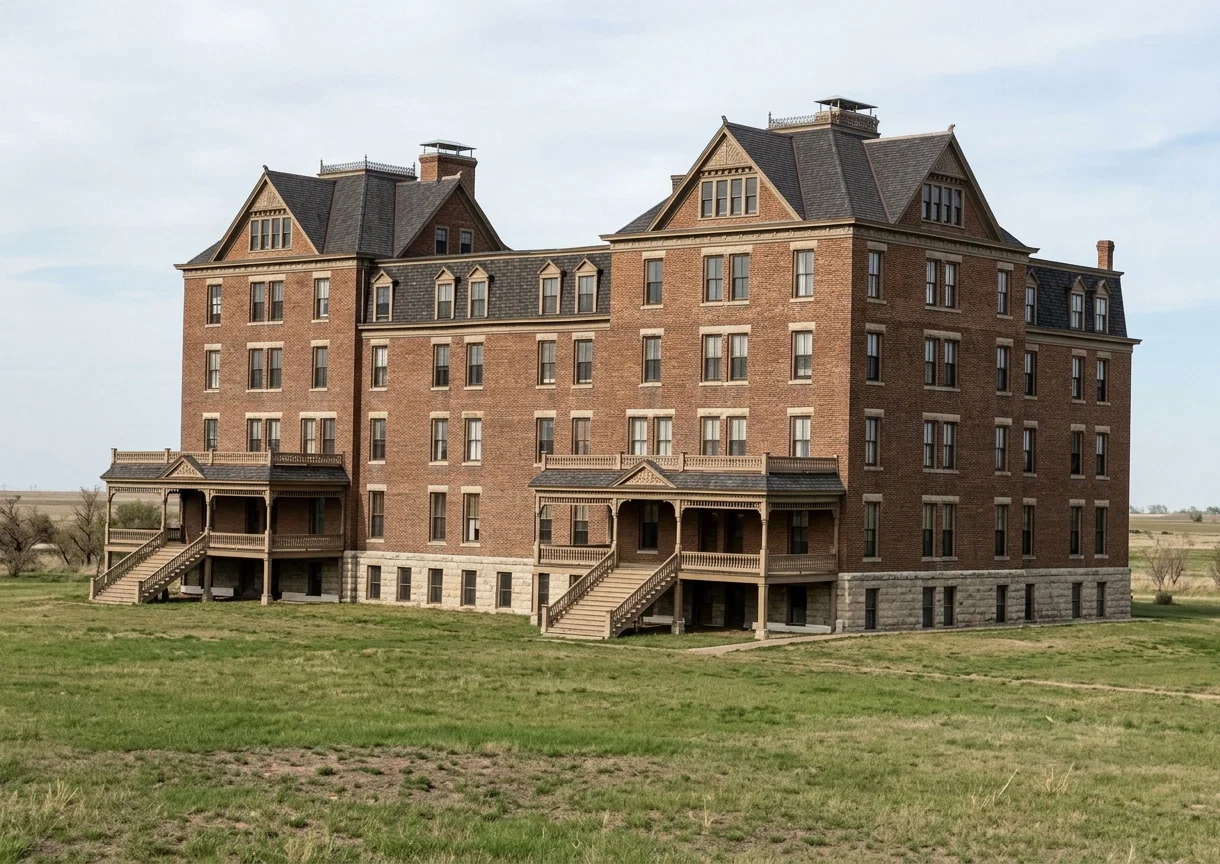
The Nebraska Sanitarium was opened to patients early in the year 1895. It consisted of a comfortable dwelling-house, with barn, the latter being renovated to serve as a storeroom, etc. A small addition was made to the house, and the work was started with only one patient. The corps of helpers consisted of one physician; one lady nurse, who also acted as matron; one gentleman nurse, who acted as bookkeeper; and one cook, who attended to the laundry and numerous other duties. The nurses’ training-school was started with only one student. But as the work grew and prospered, it was necessary that the buildings and their equipments should grow likewise.
Restored with AI
NEBRASKA SANITARIUM, MAIN BUILDING.
It soon became apparent that four or five rooms for patients could not long accommodate the increasing patronage, and an addition of eight rooms for patients, two office rooms, and a pharmacy room was made. This may have seemed to some to be rather a hazardous expenditure, but it proved to be a safe investment. As the number of patients increased, it became necessary to add to the corps of helpers, and it was found that the capacity of the building was again inadequate to meet the demands made upon it; so a few rooms were secured in one of the dormitories of Union College, known as North Hall, a large brick structure, easily accessible, being only a few steps south, on the college campus. Here the overflow of patients found a convenient retreat; and the sanitarium work, through the blessing of God, continued to increase to a remarkable degree.
In time the question of water facilities became a serious one, when the one well, with an ordinary windmill, of which these facilities consisted, proved rather an uncertain source of supply, owing to the increase in demand. It was not long, however, before the windmill, dependent wholly upon a favoring breeze, gave place to a steam apparatus, which could be utilized as occasion required; and “dry treatment” was no longer a necessity because of a lull in the breeze. Two wells have since been added, and now the water-supply is abundant, and of the purest quality.
The work still enlarged amid many perplexities and the lack of facilities in every direction; and again, in 1897, the question of more room confronted the management, and one half of North Hall was devoted to sanitarium purposes. For the time being this seemed ample to supply the needs in this direction. The increase in patronage required a constant outlay of money in the renovating and furnishing of rooms. The kitchen and dining-room were transferred from the original sanitarium building to the commodious basement of North Hall, and the rooms formerly thus occupied were added to the ladies’ treatment rooms, which had become so crowded as to call forth many requests from nurses, who were trying to do duty amid cramped facilities.
These changes were much appreciated, but brought satisfaction for the time being only; for again the question of more room presented itself for consideration — more room for patients and helpers, and greater bath-room facilities. Early in the present year, 1899, it was decided to lease to the sanitarium the entire North Hall, thus affording additional room for every department of the work.
The doctors’ offices were removed from the sanitarium building proper, which since that time has assumed the name of hospital, the surgical ward occupying the entire upper story, and the first floor being given over to treatment rooms, and recitation rooms for the nurses’ training-school, this missionary enterprise having increased in membership until it numbers four alumni, fourteen seniors, and fifteen juniors. The present medical staff includes one lady and two gentlemen physicians. Five graduated nurses from the Battle Creek Sanitarium, and several others engaged in various lines of work, complete the corps of helpers.
The refitment of the college dormitory for sanitarium work has necessitated a large outlay of money, including a new engine-house, a steam-heating plant, an electric-light plant, an elevator, etc. The increasing demands of the public necessitated the fitting up of commodious bath-rooms in the basement of North Hall. All these improvements are being added the present season.
It is a source of encouragement to those who have watched with interest the progress of the work from its beginning, to see how a kind Providence has ruled over it all, and to realize that while many who have shared in its benefits have cheerfully helped defray the expenses connected therewith, the worthy poor have not been forgotten; but many of these have received help, both physically and spiritually, which has brought returning health and enjoyment. Much of the time the institution has been blessed through the services of a chaplain, who has found this to be truly a mission field. It is a blessed work to point the invalid to the Great Physician, who alone can restore the sin-sick soul. Many who have come to the Nebraska Sanitarium without a clearly defined hope for the future have gone away in the enjoyment of a true Christian experience. The corps of helpers connected with the institution are seeking to shed an influence that will point sinners to Christ, and all the results of their efforts in this direction will be known only in eternity. Enough is revealed from time to time to give renewed courage, and the helpers’ meetings and Sabbath-school are both interesting and profitable.
The bakery and health food department connected with this institution is doing a larger business than ever before, finding customers in every direction, who highly appreciate having access to this manufactory of foods suited to the building up and the maintenance of health. And it is a comfort and a satisfaction to see the increasing interest manifested on the part of the public in the principles that underlie the sanitarium work in general.
Patients come to this institution from every direction, many recognizing the value of the medium altitude between the Mississippi and the Rockies. The marked difference between the atmosphere of the Great Lakes and the Mississippi region and that of Nebraska becomes very apparent to one suffering from catarrhal troubles, rheumatism, nervous troubles, various forms of digestive disorders, etc. Experience has proved that a change from a low to a high altitude should be made slowly, and with due precautions by those who are out of health. A very high altitude is often found to be a detriment instead of a benefit, especially to those suffering from some peculiar forms of heart and nervous troubles. The Nebraska Sanitarium, situated657on a picturesque elevation overlooking the capital city, has an elevation of about thirteen hundred feet, and an atmosphere largely free from the miasma of disease. Here health seekers find a restful home fitted up with all the best modern conveniences and the most approved appliances and facilities for the care and treatment of the sick, and many return to their homes grateful for the benefits received in this new institution, and ready to recommend it as a place where honesty, true Christian principles, and effectual means are combined for the relief of the suffering public.