We have seen that the Levitical priesthood, the sacrifices offered under its administration, and the law prescribing and regulating both the priesthood and the sacrifices,—all must fall together when the priesthood is changed. We have seen that the reason for all this is that perfection was not attained through them.
The thought will now arise, and that naturally enough, Why did the Lord ordain such a system as a remedy for sin, since it did not, and could not, “take away sins”? The answer is not hard to find, as it is given in the exact language of the Scripture: “For if he [Christ] were on earth, he should not be a priest, seeing that there are priests that offer gifts according to the law: who serve unto the EXAMPLE and SHADOW of heavenly things.” Heb. 8:4, 5.
Again: “For the LAW having a SHADOW of good things to come, and not the very image of the things, can never WITH THOSE SACRIFICES which they offered year by year continually make the comers thereunto perfect.” Heb. 10:1. Being but a shadow of good things to come, the obvious reason for their existence must have been that of an object-lesson; the real remedy being Christ, the substance.
Wherefore, since “it is not possible that the blood of bulls and of goats should take away sins,” “when he [Christ] cometh into the world, he saith, Sacrifice and offering thou wouldest not, but a body hast thou prepared me.” Heb. 10:5.
Here the body of Jesus is spoken of as being prepared, and that because “sacrifice and offering thou wouldest not.” It was not possible that the Son of God, in his condition previous to entering this world, should be made a sacrifice for sin, since he could not die. And so it is written, “Forasmuch, then, as the children are partakers of flesh and blood, he also himself likewise took part of the same; THAT THROUGH DEATH he might destroy . . . the devil.” Flesh and blood, a body like ours, was necessary before Christ could die. Therefore, “A body hast thou prepared me,” says Christ, and that because “sacrifice and offering thou wouldest not.”
Who, then, can say that after that ‘body’ has been prepared and offered, the sacrifices consisting of animals, which were but shadows of that “body,” should still be continued?—Truly no honest, intelligent Christian would so affirm. Sacrifices, the shadow; Christ, the substance. Whenever the sacrifices were offered in faith, those who offered them saw Christ in them; for “faith is the substance of things hoped for.”
Christ continues: “In burnt offerings and sacrifices for sin thou [Father] hast had no pleasure.” “Then said I, Lo, I come (in the volume of the book it is written of me), TO DO THY WILL, O God.”
In the scripture last noted before this, the “body” of Christ was spoken of in contrast with the sacrifices, which were a shadow of himself, the true sin offering. Now, “To do thy will, O God,” is used in contrast with the same offerings.
We all remember the language of Samuel to Saul: “Hath the Lord as great delight in burnt offerings and sacrifices, as in obeying the voice of the Lord? Behold, to obey is better than sacrifice.” 1 Sam. 15:22. This shows that God wishes his “voice” to be obeyed, his “will” to be done. This is the object of sacrifice for sin—to enable us to do his “will.” If, therefore, Christ did not accomplish this, and provide a way whereby we may do the will of God, then his life and sacrifice were as vain as the Levitical priesthood and their offerings of “bulls and of goats.”
“Above when he said, SACRIFICE AND OFFERING AND BURNT OFFERINGS AND OFFERING FOR SIN THOU WOULDEST NOT, . . . which are offered by the law: then said he, Lo, I come TO DO THY WILL, O God.” Now what is the first thing mentioned in this quotation?—“Sacrifice and offering and burnt offerings and offering for sin.” What is the second?—The doing of the will of God. “He [Christ] TAKETH AWAY the first, that he MAY ESTABLISH the second.” Heb. 10:8, 9. Then sacrifices and offerings are taken away, and that forever, in order that the will of God may be established through the offering of Christ, the true sacrifice, once for all. “By the which WILL we are sanctified through the offering of the body of Jesus Christ once for all.” Heb. 10:10.
“He taketh away the first,” namely, “sacrifice and offering and burnt offerings and offering for sin, . . . which are offered by the law.” They were offered BY THE PRIESTS. So, then, these offerings being all taken away, there is no work for the Levitical priesthood. Having no work, there is no reason for the existence of that priesthood any longer. It, then, is also taken away. This, then, leaves the law, which made the priesthood and defined its work, without any one to operate it.
Again: this law of remedies, this law that prescribed the offerings for sin, the offerings that were but “shadows,” has now no REASON for being operated since these “shadows” of things to come have been supplanted by the “substance.”
And yet, since all these things were “examples and shadows” of “Christ, his sacrifice and priesthood,” the law defining them still remains in the Bible, although the “priesthood” and “sacrifices” have long since ceased. Since “Christ crucified” is the very core of the gospel, and since these things were types of him, therefore we may still study the Levitical law, and by so doing, study the gospel in type. But the doing of those things prescribed by the Levitical law is now out of the question, since type has met antitype.
Now what was included in that which was done away?—(1) The Levitical priesthood in every feature of it; (2) “Sacrifice and offering and burnt offerings and offering FOR SIN, . . . which are offered by the law;” (3) “The priesthood being changed, there is made of necessity a change also of the law.”
Now we have seen that that which told who should be priests, and how they should dress and work, was “the law [that] maketh men high priests.” We have also seen that that which prescribed the offerings and all the rest of the service for sin, is the law concerning the offerings. Consequently, all outside of this IS NOT affected by the change here referred to.
First, the law defining righteousness is distinct from the one prescribing a remedy for unrighteousness. Also the sanitary laws, etc., could not be included in that which was made inoperative at the death of Christ; for they in no way shadowed forth his death; nor were they used, in type, as a remedy for sin. ONLY that which was remedial, a shadow of the true remedy, ended when the substance came.
But before we conclude the subject, we must look again at that which was “established.” “He taketh away the first [the sacrifices, etc.], that he may establish the second,” the will of God.
What is the will of God thus established? It is written of Jesus (Ps. 40:8), “I delight to do thy will, O my God; yea, THY LAW is within my heart.” It is written of the Jews, even at a time when they came far short of doing God’s will: Thou “knowest his will, and approvest the things that are more excellent, being instructed out of the law.” Rom. 2:18. From these two scriptures, it is plain that the will of God is expressed in the law of God.
Christ, by the sacrifice of himself, changed, discontinued, a law. The discontinued law was “the law having a shadow of good things to come,” the one which “can [could] . . . never with those sacrifices . . . make the comers thereunto perfect.”
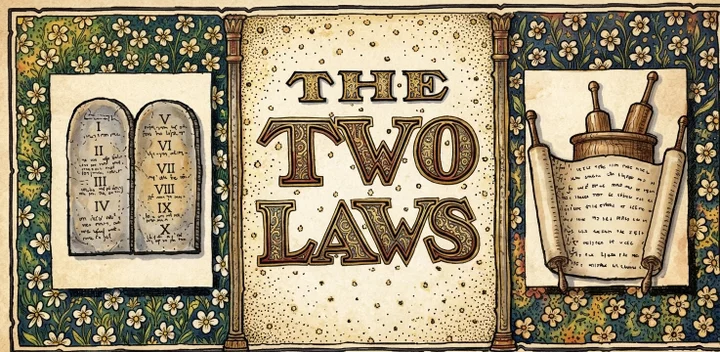
The established law is the one revealing the will of God. One law discontinued, another established,—“two laws: the one changeless and eternal, the other provisional and temporary.” And “the distinction between the two systems is broad and clear.”
E. J. HIBBARD.p. 671
[The following is Article No. 1 in the series on the Two Laws; which must be reprinted to supply subscribers whose names were received after that issue of the REVIEW was exhausted in which it was first printed.—EDITOR.]
The Bible mentions two laws—the “one changeless and eternal, the other provisional and temporary.” “There are many who try to blend these two systems, using the texts that speak of the ceremonial law to prove that the moral law has been abolished; but this is a perversion of the Scriptures. The distinction between the two systems is BROAD AND CLEAR.”—“Patriarchs and Prophets,” chap. 32, pars. 25, 6.
In the foregoing quotations we are told that “there are many who try to blend these two systems, using the texts that speak of the ceremonial law to prove that the moral law has been abolished.” Now since “the distinction between the two systems is broad and clear,” it will not be a very hard task so fully to discover this distinction that any one can easily see it. Then when any man tries to prove the abolition of the moral law by using texts that refer to the ceremonial law, it will not be difficult to see the error.
In Heb. 7:12 we read: “For the priesthood being changed, there is made of necessity a change also of the law.” Here we are informed that some law is changed, and that it is changed of necessity. Some, who try to blend these two systems, assert that this means the law of ten commandments; or, that it at least includes it. Great stress is laid on the word “necessity.” This word shows that there can be no mistake about it. The law is therefore most certainly changed. I am glad, indeed, to lay stress upon the same word. Now, as a matter of fact, when the change of one thing makes it a necessity to change another, that second thing must depend upon the first for its existence. This is evident in the matter of law, if nothing else. Take, for instance, the United States for example: If the city of Battle Creek should change its municipal laws, would that change the State or national Constitution? Or if this, or some other, State, through its legislature, should alter some law of the State, would even that alter the United States Constitution? You know full well it would not. But why?—Plainly because the United States Constitution, being the fundamental law of the nation, does not depend upon the constitutions or laws of States for its existence. The exact reverse of this being true,—the constitutions and laws of the States being required to conform to the national Constitution,—how would these be affected by a change of the Constitution of the United States?—Logically, every one of them would “of necessity” have to be changed. Therefore, the law that was changed “of necessity” when the priesthood was changed, must have depended upon the priesthood for its existence. It must have been so interwoven with it that the change of one could not be effected without the change of the other.
Since it is the change of the priesthood that causes the change of the law, it will be in order, first to consider the place that the priesthood had in the plan of God, and then its change, and the reason for it. “Every high priest taken from among men is ordained for men in things pertaining to God, that he may offer both gifts and sacrifices FOR SINS.” Heb. 5:1. It therefore must have been sin that made the priesthood necessary. Sin had separated, alienated, all men from God. Priests were ordained as mediators between the two parties. A priest, then, is a mediator. SIN caused the separation that made the priesthood a necessity. Since sin made the priesthood necessary, it must have entered before the priesthood was appointed. “Sin is the transgression of the law.” 1 John 3:4. “Where no law is, there is no transgression.” Rom. 4:15. “Sin is not imputed when there is no law.” Rom. 5:13. Since sin is the transgression of the law, the law defining it must have existed before sin. Law before sin. Sin before priesthood. Therefore the law that existed before sin could not be affected by the change of the priesthood.
There was a law by which men were made priests. “For the law maketh men high priests which have infirmity.” Heb. 7:28. All their gifts and offerings were prescribed and regulated by law. “For if he [Christ] were on earth, he should not be a priest, seeing that there are priests that offer gifts according to the law.” Heb. 8:4.
In the first five chapters of Leviticus, we find mentioned respectively: (1) burnt offerings; (2) meat offerings; (3) peace offerings; (4) sin offerings; (5) trespass offerings. In the sixth and seventh chapters there is a summary of the whole five, and a definite mention of the law that regulates them. We will notice the verses in which we find reference to each offering, and call attention to the introductory clause in each case:—
Lev. 6:9: “This is the law of the burnt offering.” Verse 14: “And this is the law of the meat offering.” Verse 25: “This is the law of the sin offering.” Lev. 7:1: “This is the law of the trespass offering.” Verse 11: “This is the law of the sacrifice of peace offerings.”
Then, after following these introductory clauses with a clear statement of the law in reference to the several offerings, we come to a final summing up of the whole matter, in Lev. 7:37, 38. One might suppose from the foregoing references that there were many independent laws, but in verses 37, 38, we find, “This is the law [not these are the laws] of the burnt offering, of the meat offering, and of the sin offering, and of the trespass offering, and of the consecrations, and of the sacrifice of the peace offerings; which the Lord commanded Moses in mount Sinai, in the day that he commanded the children of Israel to offer their oblations unto the Lord, in the wilderness of Sinai.” It was then but one law that regulated the whole system of offerings required during the existence of the Levitical priesthood.
Now one text to show the relation of this law to the law that existed before sin: “And if any one of the common people sin through ignorance, while he doeth somewhat against any of the commandments of the Lord concerning things which ought not to be done, and be guilty; or if his sin, which he hath sinned, come to his knowledge: THEN he shall bring his offering, . . . and the priest shall make an atonement for him, and it shall be forgiven him.” Lev. 4:27–31.
In sinning, what did he do?—“Somewhat against any of the commandments of the Lord concerning things which ought not to be done.” When it came to his knowledge—what then?—“The wages of sin is death.” How did he avoid the penalty?—Oh, bless the Lord! God had provided a remedy. The repentant sinner accordingly brought the offering required by law, to the priest, who was ordained according to the law, and it was offered as the law directed. Then what?—His sin was forgiven him. Cleansing goes with forgiveness, as we see in 1 John 1:9. In the case before us, the wrong was remedied, so far as the sinner’s guilt was concerned, and the Lord regarded him the same as he did before the wrong was committed.
We have now found two distinct laws,—one existing before sin entered the world, the transgression of which is sin; the other entering after sin had appeared, ordaining a priesthood and a system of offerings for sin,—the first, the law of righteousness, revealing sin; the second, the law of sacrifices, offering a remedy for sin.
“Adam and Eve, at their creation, had a knowledge of the law of God; they were acquainted with its claims upon them; its precepts were written upon their hearts. When man fell by transgression, the law was not changed, but a remedial system was established to bring him back to obedience.”—“Patriarchs and Prophets,” chap. 32, par. 1. A “remedial system” is a system of remedies. Therefore the result of our present study is found to be in harmony with the plain statement of the word and Spirit of God.
One word more: Physical law transgressed results in sickness. Physicians and nurses discover and apply remedies for the diseases thus produced. These remedies are for the purpose of removing the result of transgression. There is the same distinction between the law revealing sin and the law prescribing a remedy as there is between natural law and the physician’s prescription for the person who has transgressed it. Therefore, “the distinction . . . IS broad and clear.” E. J. HIBBARD.