NOT JUSTIFIED BY WORKS.
By Ellet Joseph Waggoner
“But you know we are not justified by the law, but by faith; no works of our own are of any effect whatever.” These are the words with which many seek to parry the force of the commandment which says: “Remember the Sabbath day, to keep it holy. Six days shalt thou labor, and do all thy work; but the seventh day is the Sabbath of the Lord thy God; in it thou shalt not do any work.” Ex. 20:8–10.
It is strange that nobody ever thinks of urging this as a reason for not keeping Sunday, even when Sunday is supposed to be enjoined by the fourth commandment; but as soon as it appears that the only day indicated in the commandment as the day to be observed is the seventh day of the week, immediately we are told that we cannot be saved by the works of the law; and that is supposed to absolve us from all necessity of keeping “the Sabbath according to the commandment.” Let us give this matter a little careful examination.
There is nothing made more clear in the Bible than that no man is justified by works, but that justification is wholly by faith. “For by grace are ye saved through faith; and that not of yourselves; it is the gift of God; not of works, lest any man should boast.” Eph. 2:8, 9. “For we ourselves also were sometimes foolish, disobedient, deceived, serving divers lusts and pleasures, living in malice and envy, hateful, and hating one another. But after that the kindness and love of God our Saviour toward man appeared, not by works of righteousness which we have done, but according to his mercy he saved us, by the washing of regeneration, and renewing of the Holy Ghost; which he shed on us abundantly through Jesus Christ our Saviour; that being justified by his grace, we should be made heirs according to the hope of eternal life.” Titus 3:3–7.
“All have sinned, and come short of the glory of God.” Rom. 3:23. “The carnal mind is enmity against God; for it is not subject to the law of God, neither indeed can be.” Rom. 8:7. “We are all as an unclean thing, and all our righteousnesses are as filthy rags.” Isa. 64:6. “Being justified freely by his grace through the redemption that is in Christ Jesus; whom God hath set forth to be a propitiation through faith in his blood, to declare his righteousness for the remission of sins that are past, through the forbearance of God.” “Therefore we conclude that a man is justified by faith without the deeds of the law.” Rom. 3:24, 25, 28.
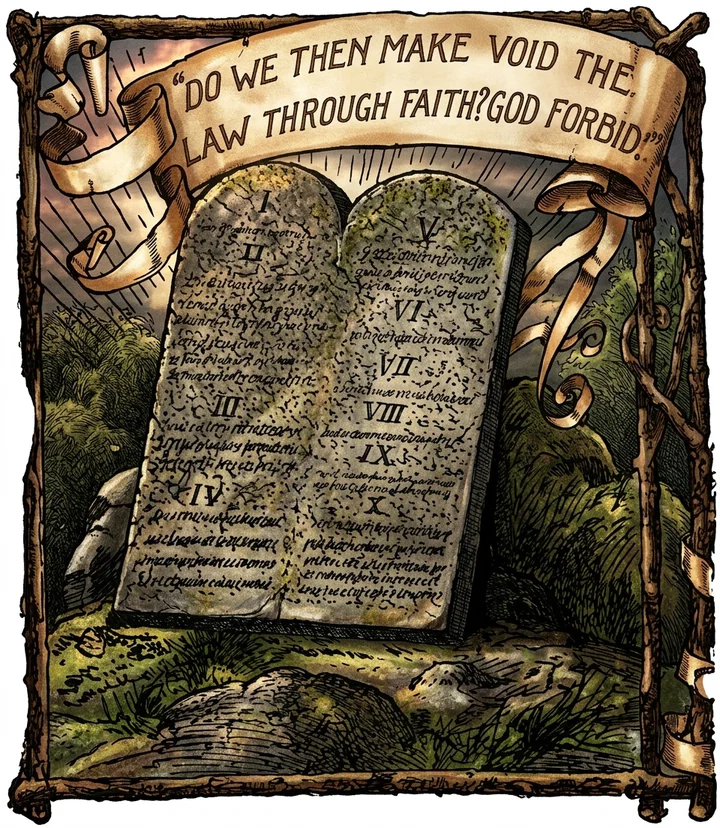
These texts show plainly that no works of man have any effect in securing his justification. But do they discredit the law?—Not by any means. “Do we then make void the law through faith? God forbid; yea, we establish the law.” Rom. 3:31. The law is the only standard of justice; because, “not the hearers of the law are just before God, but the doers of the law shall be justified.” Rom. 2:13. Christ’s righteousness is perfect obedience to the law, which was within his heart. John 15:10; Ps. 40:8. Christ dwells in the heart by faith (Eph. 3:17), and it is his presence in the heart that justifies us, as we by faith take his life instead of our own. So we are justified by faith, because faith brings Christ and his obedience into the heart and life.
Now let us read something in continuation of texts already quoted. The apostle tells us that we are not justified by works, “for we are his workmanship, created in Christ Jesus unto good works, which God hath before ordained [prepared] that we should walk in them.” Eph. 2:10. The good works come as soon as we become new creatures in Christ.
Again: “This is a faithful saying, and these things I will that thou affirm constantly, that they which have believed in God might be careful to maintain good works. These things are good and profitable.” Titus 3:8. How are we to maintain good works?—By faith, just as we received them; for we are exhorted, “As ye have therefore received Christ Jesus the Lord, so walk ye in him.” Col. 2:6.
The case, then, is simply this: The law is the standard of righteousness; but the law is spiritual, and we are carnal (Rom. 7:14); it is the perfect righteousness of the Holy Spirit, and therefore infinitely above us. Our best efforts are only violations of it. But Christ is the righteousness of God, because he is God. The law of God is therefore his very nature. He was made flesh, and dwelt among us (John 1:14), being in all things “made like unto his brethren, that he might be a merciful and faithful High Priest in things pertaining to God, to make reconciliation for the sins of the people.” Heb. 2:17. He is “the wisdom of God, and the power of God,” as well as the righteousness of God; and therefore “what the law could not do, in that itp. 3 was weak through the flesh, God sending his own Son in the likeness of sinful flesh, and for sin, condemned sin in the flesh.” What for?—“That the righteousness of the law might be fulfilled in us.” Rom. 8:3, 4.
Thus we see that, although we are not justified by the works of the law, we are by no means justified in ignoring and transgressing the law. Christ has called us unto liberty, but not that we should make that liberty an occasion to the flesh. Gal. 5:13. We find our liberty only in seeking his precepts. Ps. 119:45. “Where the Spirit of the Lord is, there is liberty” (2 Cor. 3:17), and “the law is spiritual;” therefore only in obedience to the law, which is found in Christ, is there true liberty.
In closing, let us see how the argument which is brought against the Sabbath, as noticed at the first, will work when applied to some of the other commandments besides the fourth. The idea is that since we are not justified by the works of the law, therefore we are not required or expected to keep the commandment which says, “Remember the Sabbath day, to keep it holy,” and which tells us that the seventh day is the day upon which we should rest. Now the third commandment says, “Thou shalt not take the name of the Lord thy God in vain.” Suppose I am a swearer, and some one who hears me take the name of God in vain, reminds me of that commandment. But I reply: “Ah! do you not know that we are not justified by the works of the law, but by faith? Christ has set me free from the law, and therefore I swear; I dare not keep that law, lest I be brought into bondage.” Would not my reprover be shocked at my blindness, which would justly seem to be almost, if not quite, blasphemy? and would he not tell me that Christ died for the express purpose of saving me from the sin of swearing? And if I should plead the same excuse for lying and stealing, he would tell me that faith in Christ does not warrant me in breaking the eighth and ninth commandments, but that it is for the purpose of saving me from those, and from all other sins.
We are not justified because we do not take the name of God in vain; yet no one would on that account risk his salvation by swearing. We shall not be saved simply because we do not steal; but few, if any, would expect to be saved if they were thieves. We cannot be justified by the ninth commandment; yet we have the positive statement that all liars shall perish. No one can claim admission to heaven on the ground that he has never killed anybody; but it is as certain that no one would think of basing a claim to heavenly glory on the fact that he was a murderer. So while we are not justified by the fourth commandment, we are not therefore justified in breaking it. Christ saves men to obedience.
Reader, are you one of those who have been “partial in the law”? If so, stop and ask yourself why you have any more right to disregard the fourth commandment than you have to disregard the third. “The law is holy, and the commandment holy, and just, and good.” This is true of the whole law, and not merely of a portion of it. May you therefore be one of those of whom it will be said, “Here is the patience of the saints; here are they that keep the commandments of God, and the faith of Jesus.” Rev. 14:12.
E. J. W.