A FEW days before we left New York, I visited the office of the steamer agents, and learned that, having a considerable quantity of cargo and a number of passengers for Palestine, our boat would touch at Jaffa. It happened that forty or fifty Jewish people were going to Palestine to assist in the plan for its restoration to their people, and were taking with them about seven hundred tons of agricultural machinery of various kinds.
Our trip across the Atlantic and through the Mediterranean was uneventful. On the Atlantic, we headed direct for Gibraltar, and so were considerably south of the usual steamship lines. For this reason, we saw few passing boats.
On a Sunday afternoon, we called at Port Said to discharge passengers, and just after dark, we crept back out of harbor for the night’s run to Jaffa.
Bright and early the next morning, some of the Jewish young people—there were three brides-to-be in the party—were out on the front deck, eager to catch the first glimpse of the Promised Land. But the first view of the coast south of Jaffa, was not so much of a land of promise as of a land of sand, “barren as the hills of Gilboa.”
It was about breakfast time when we reached Jaffa, and soon after we had eaten, our friends booked for Palestine were ready to go ashore. Large row-boats carried passengers and luggage across the quarter or half mile of water to the pier. Ashore, they found a detachment of soldiers gathered, with guns to protect—rather than welcome—them. The Arabs do not take kindly to the idea of other people’s coming in for permanent domicile, and a few months previous some newcomers had been killed.
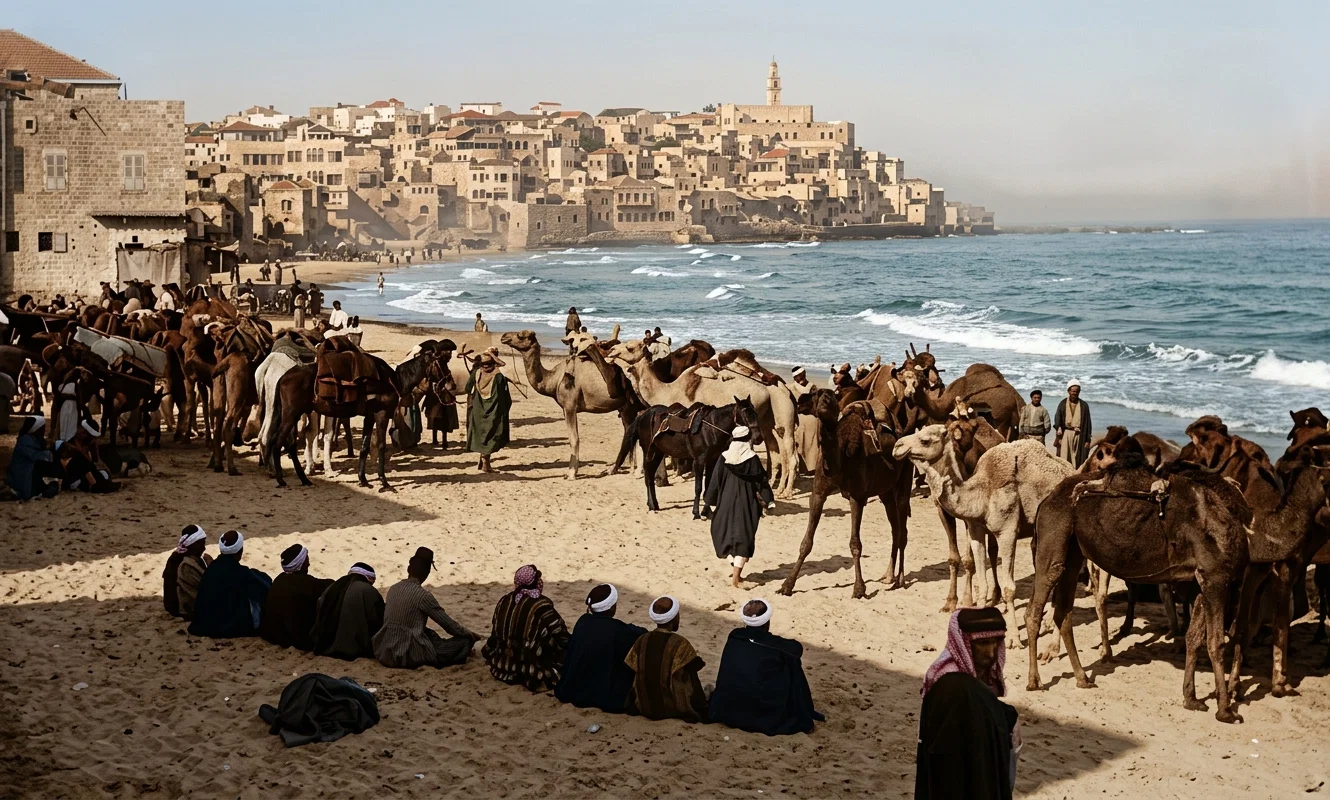
Restored with AI
Jaffa, the Ancient Port of Palestine
Jaffa is not a good port, and to add to the difficulty when we entered, not a member of our crew, from the captain down, had ever been there. Steamers cannot go close in, as the water is shallow, but must anchor out beyond a reef which shelters a little bay inside, and through which a passageway has been blasted, apparently, for the cargo boats which load and unload the steamers. We saw little evidence of tides during the two days we were there, but swells churned the little boats constantly, and made the work of unloading difficult. We had brought out several hundred tons of box material for an American fruit association operating in Palestine, and one man in a rowboat was kept busy gathering up the bundles dropped overboard in unloading, or thrown off the cargo boats as they rolled and tossed.
It was intensely interesting to watch the Arab boatmen. They are quite at home on the water, and no matter what position their boats took, they themselves were always right side up. Piles of the box material were built up four or five feet above the edge of the boats, and the oarsmen stood anywhere on their loads, in the middle or on the very edge, while the boats pitched and tossed, threatening every moment to spill their freight, both inanimate and living, into the sea. When a boat was finally loaded, it was a task for the three or four men to get it ashore. The oars were tremendous affairs, some of them eighteen or twenty feet long. Often the swells were against the boats, but the men managed skilfully, and always navigated the opening in the reef, and made harbor safely.
While unloading the machinery, a tractor, a Ford, of course, was dropped overboard. An Arab took two ropes, dived in about thirty-eight feet of water, and made the ropes fast to parts of the tractor. He went down four or five times, but did not get all of the machine. A marker was placed, and the men were to come out after we left, and finish the work.8
It was not wholly a pleasure trip for some of our lady passengers to go ashore at times. When we first got to Jaffa, the swells did not seem so bad as they were a few hours later. In the afternoon and evening they were very heavy. When a rowboat approached us, it did so carefully. One moment a big Arab would be standing in his boat and reaching up as high as possible to grasp our ladder; then when the swell came along and lifted the boat, he pushed it out from under the ladder to avoid a spill.
To make the jump from ladder to boat or boat to ladder, without the help of two or three Arabs, was all but impossible. One man stood on the ladder, helping the passenger, and two stood in the boat to insure safety.
Jaffa has perhaps fifteen or twenty thousand inhabitants, and is built on a hill. Facing the sea, the hill is quite steep, and the houses appear almost to sit one on top of another. The streets are narrow and dirty, true to the East. The railway runs in the streets, and the switching crew obligingly leaves “wagons” almost anywhere, to suit the convenience of customers. The engines we saw were very small, and used gasoline for fuel. The driver sat on one side of his cab, facing the other, and looked forward and backward, first out of one eye, then out of the other. A new use, to us, of the track, a narrow gauge, was that of making it a runway for barrels. Placing a barrel across the rails, it was a simple matter to propel it down the street a block or two, to the desired destination.
North of the city is a sandy plain of some extent, on which quite a body of Indian troops were camped at the time of our visit. North and east of the city are hills and valleys, stretching back for miles, with here and there groves and buildings breaking the monotony, and making an interesting picture of this part of the ancient land of the Hebrews.
However, the most impressive feature of Jaffa, was its setting in sacred history. “Here the materials for building both the first and the second temple, sent from Lebanon and Tyre, were landed. Here Jonah embarked for Tarshish. Here, too, Peter raised Doreas from the dead, and in the house of Simon the tanner, by the seaside, was taught by the heavenly vision that salvation was for Gentiles as well as Jews.”
To visit Egypt or the Holy Land, and realize that worthies of old lived, labored, and died there, and that in those lands the Lord chose a people, led them through the centuries, and then was compelled to forsake them, because they forsook Him, impresses the traveler with a feeling of awe and reverence, and causes him to determine to be faithful. And the time when the saints shall possess the kingdom, when Abraham, Isaac, and Jacob shall receive their inheritance, the Land of Promise, is drawing on apace. That glad day is being hastened by the work of the missionaries out in the far fields as well as by the body of believers at home. May the readers of the INSTRUCTOR be among those who find abundant entrance into the New Jerusalem.