NUMBER V

2%

NUMBER V.

THE LAW OF GOD,

As brought to view in the New Testament.
Our Lord, in his Sermon on the Mount, which may be read in the fifth, sixth and seventh chapters of Matthew, says: “Think not that I am come to destroy the law or the prophets; I am not come to destroy, but to fulfill. For verily I say unto you, till heaven and earth pass, one jot or one tittle shall in no wise pass from the law till all be fulfilled.”
The words of Jesus, “think not that I am come to destroy the law,” show that some would even think that Jesus destroyed his Father’s law, when he came to this world and died on the cross. But he here warns us against thinking so. He says he came to fulfill it. The word fulfill, here means, to obey. Jesus obeyed his Father’s law, for he says in John xv, 10, “I have kept my Father’s commandments.” We will see what the Apostle teaches that it is to fulfill this law. He says: “If ye fulfill the royal law according to the scripture, thou shalt love thy neighbor as thyself.” James ii, 8. He teaches that to fulfill the law of God, is to keep it, instead of destroying it.
The apostle James also teaches that it should be kept according to the scripture. The word scripture here refers to the ten commandments recorded in the twentieth chapter of Exodus. Jesus also declares that, “till heaven and earth pass, one jot or one tittle shall in no wise pass from the law.” As long as the world stands, there cannot be the least alteration in the law of God. Every one of the ten commandments will remain the same as God wrote them on the tables of stone.
Contrary to the teachings of Christ, the Roman Catholic Church has altered some of the commandments in the law of God, as may be seen in their “General Catechism, by Dr. James Butler.”—Here are the commandments as printed in the Catechism, page 20.
“1. I am the Lord thy God, thou shalt not have strange gods before me, &c.
  1. Thou shalt not take the name of the Lord thy God in vain.
  2. Remember that thou keep holy the Sabbath day.
  3. Honor thy father and thy mother.
  4. Thou shalt not kill.
  5. Thou shalt not commit adultery.
  6. Thou shalt not steal.
  7. Thou shalt not bear false witness against thy neighbor.
  8. Thou shalt not covet thy neighbor’s wife.
  9. Thou shalt not covet thy neighbor’s goods.—Exodus xx.”
You will see that they have left out the second commandment and called the third the second, the fourth the third, the fifth the fourth, the sixth the fifth, the seventh the sixth, the eighth the seventh, the ninth the eighth, and have divided the tenth, and made two of it to make out the ten.
God spake the commandments, and says [Ps. lxxxix, 34] that he will not alter the thing that is gone out of his lips. Yet the Catholic Church has taken the liberty to leave out the second commandment and divided the tenth.
On page 26 of this Catechism, is the following questions and answers:
“Q. Say the third commandment? A. Remember that thou keep holy the Sabbath day. Q. What is commanded by the third commandment? A. To spend the Sunday in prayer, and other religious duties.”
In the first place, they here call the fourth commandment the third, and then say that to keep Sunday, or the first day of the week, is what is required by it. But the fourth commandment requires the seventh day to be kept holy. Young friends, believe God, and keep his holy law.

NUMBER VI.

“Then one of them which was a lawyer, asked him a question, tempting him, and saying, Master, which is the great commandment in the law?—Jesus said unto him, thou shalt love the Lord thy God with all thy heart, and with all thy soul, and with all thy mind. This is the first and great commandment. And the second is like unto it: thou shalt love thy neighbor as thyself. On these two commandments hang all the law and the prophets.” Matt. xxii, 35—40.
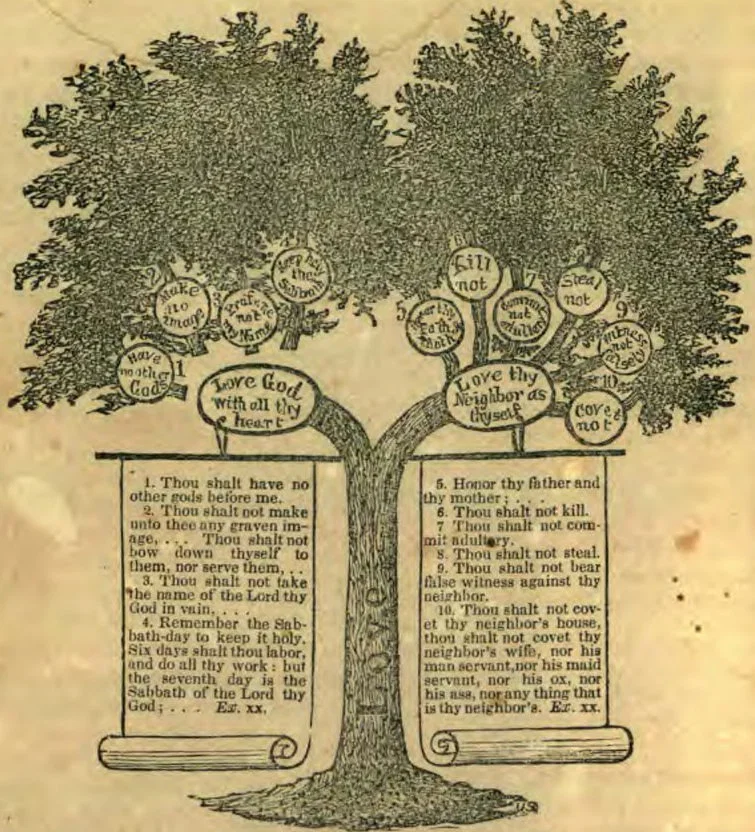
Now look at the picture of the tree with two large branches, and ten smaller ones, and the two scrolls hanging to the two large branches, containing the ten commandments. This picture illustrates the above words of our Lord. The two large branches of the tree represent the two great commandments mentioned by our Lord. The large branch, marked, “Love God with all thy heart,” represents the first great commandment. On this branch are four smaller ones. [These should be joined.] They represent the first four of the ten commandments, which were written on the first table of stone. These all show our duty to God, how we may love him supremely. The first great commandment, then, embraces the first four of the ten commandments.
The other large branch, marked, “Love thy neighbor as thyself,” represents the second great commandment mentioned by our Lord. On this branch are six smaller branches. These represent the last six commandments which were written on the second table of stone. These all show our duty to our neighbor, how we may love others as ourselves. The second great commandment, then, embraces the last six of the ten commandments.—Then we are plainly taught by our Lord that the great object of the ten commandments is, to teach us, first, supreme love to God, and, second, the same love to others that we have for ourselves.—
Our Lord says that on these two commandments hang all the law, and the prophets also. You see the ten commandments written upon the two scrolls in the picture. These two scrolls, which hang upon the two large branches, represent all the law hanging upon the two great commandments, mentioned by Jesus.
Then let it be remembered that all ten of the commandments of God now hang upon the two great commandments. Not one has fallen off.—The Sabbath commandment still hangs there with the rest.

NUMBER VII.

THE FIFTH COMMANDMENT.

“Honor thy father and thy mother, that thy days may be long upon the land which the Lord thy God giveth thee.” Ex. xx, 12.
The ten commandments were of such importance that God came down upon Mount Sinai, and spake them to the people with his own voice, and then wrote them on two tables of stone with his finger. The fifth commandment, then, which requires children to honor their parents, is as holy as the other nine, and must be strictly obeyed. God cannot love those who break this commandment. His frown is upon them for disobeying and slighting the words of his mouth.
The fifth commandment is expressly addressed to children. But very few of the youth seem to realize this, and feel the importance of honoring their parents. In fact, it has become so common for children to disobey and dishonor their father and mother, that St. Paul mentions their disobedience as a sign of the last days. In naming other sins in Tim. iii, 1—5, which are signs of the last days, he mentions “disobedience to parents.”—This is a very great sin which must be repented of, and forsaken, before those who break the fifth commandment can have the favor of God.
But there is a glorious promise to children, connected with this commandment. “Children,” says the apostle Paul, “obey your parents in the Lord, for this is right. Honor thy father and mother, (which is the first commandment with promise,) that it may be well with thee, and thou mayest live long on the earth.” Eph. vi, 1—3. The Apostle does not mean that this is the first commandment of the ten, but the first one of the number that has a promise connected with it. In fact, it is the only one of the ten that has a promise connected with it.
God knows our natures, and, in giving his righteous law, has come down to our capacity. In giving the fifth commandment to children, he has added a precious promise to encourage their young hearts to strictly obey, and thus honor their parents. But in giving the other nine commandments to those old enough to fully understand them, who do not so much need a promise to encourage them to obey, he has added no promise. This should lead children to love their kind Father in heaven, who has held out to them such an encouraging promise for those who obey.
But what is this precious promise? Answer:—“That thy days may be long upon the land which the Lord thy God giveth thee.” Or as the Apostle says: “That it may be well with thee, and thou mayest live long on the earth.”
The “land,” or “earth,” mentioned in this promise does not mean only this earth in its present state, as some suppose. For many good and obedient children live here but a short time. So you see the promise to them is to be fulfilled after the resurrection of the righteous, in the New Earth. O, what a precious promise to those who obey their parents! To live for ever in the beautiful New Earth!
Our Saviour says: “Blessed are the meek; for they shall inherit the earth.” Matt. v, 5. This is the same New Earth. “But the meek shall inherit the earth, and shall delight themselves in the abundance of peace.” Ps. xxxvii, 11. This also refers to the same New Earth. “For behold I create new heavens and a new earth.” Isa. lxvi, 17; 2 Pet. iii, 12, 13.

NUMBER VIII.

THE LIFE OF CHRIST.

We now design giving several lessons on the life of our Lord Jesus Christ. We shall not stop to explain everything relative to his life named in the New Testament; but shall mention only those things of most importance. Read the second chapter of Matthew and the second chapter of Luke. Do not neglect to do this while studying this lesson.
Jesus was born in Bethlehem of Judea, in the days of king Herod. His parents at this time had come up from Galilee, out of the city of Nazareth, to be taxed. The young child, Jesus, was laid in a manger, there being so many people assembled in Bethlehem, there was no room for him in the inn.
In the same country there were shepherds abiding in the fields, keeping watch over their flock by night. The angel of the Lord came down, and the glory of the Lord shone round about them, and they were sore afraid. And the angel said unto them, Fear not, for behold, I bring you good tidings of great joy, which shall be to all people.—For unto you is born, this day, in the city of David, a Saviour, which is Christ the Lord.
And this shall be a sign unto you; ye shall find the babe wrapped in swaddling-clothes, lying in a manger. And suddenly there was with the angel a multitude of the heavenly host praising God, and saying, Glory to God in the highest, and on earth peace, good will toward men.
When the angel had gone away into heaven, the shepherds went with haste to Bethlehem, and there they found the babe lying in the manger, as the angel told them, also his parents, Joseph and Mary. The shepherds returned glorifying and praising God for what they had heard and seen.
And when eight days were accomplished for the circumcision of the child, his name was called JESUS. There was in Jerusalem, a just and devout man, whose name was Simeon, who was waiting for the consolation of Israel. It was revealed to him by the Holy Ghost, that he should not see death, before he had seen the Lord’s Christ.—The Holy Ghost led this good man into the temple, and when the parents brought in the child, Jesus, to do for him after the custom of the law, Simeon took him in his arms, and blessed God and said: Lord now lettest thou thy servant depart in peace, according to thy word; for mine eyes have seen thy salvation, which thou hast prepared before the face of all people.
King Herod sought for the young child, Jesus, to destroy him. But the angel of the Lord appeared to Joseph in a dream, saying, Arise, and take the young child and his mother, and flee into Egypt, and be thou there till I bring thee word; for Herod will seek the young child to destroy him. Joseph obeyed the angel, and took the young child and his mother by night, and departed into Egypt.
Herod, who was mocked of the wise men, was exceeding wroth, and sent forth and slew all the children that were in Bethlehem, and in all the coasts thereof, from two years old and under.—The wicked king did this, thinking that Jesus would certainly be slain with the rest of the children. But God had sent his angel before hand to tell Joseph to flee into Egypt. There Jesus was safe with his parents, at the time Herod slew so many children.
But when Herod was dead, the angel of the Lord appeared to Joseph again in a dream while in Egypt, and said to him, Arise, and take the young child and his mother, and go into the land of Israel.
TO BE CONTINUED.