THE LAW OF GOD.
NUMBER III.
The law of God is the ten commandments.—God wonderfully distinguished his law, by speaking the words of the ten commandments, with his own voice, from Mount Sinai. He then wrote them with his own finger, in two tables of stone. Here are some texts of scripture that prove what we have just said:
“And the Lord said unto Moses, come up to me into the Mount, and be there, and I will give thee tables of stone, and a LAW, and commandments which I have written, that thou mayest teach them.” Ex. xxiv, 12.
“And he gave unto Moses, when he had made an end of communing with him upon Mount Sinai, two tables of testimony, tables of stone, written with the finger of God.” Ex. xxxi, 18.
“And he wrote upon the tables the words of the covenant, the TEN COMMANDMENTS.” Ex. xxxiv, 28.
“These words the Lord spake unto all your assembly in the Mount, out of the midst of the fire, of the cloud, and of the thick darkness, with a great voice; and he added no more; and he wrote them in two tables of stone.” Deut. v, 22.
“And Moses turned and went down from the Mount, and the two tables of the testimony were in his hand; the tables were written on both their sides; on the one side and on the other were they written.” Ex. xxii, 15.
When God was about to speak the words of the ten commandments in the hearing of all the people, who had just come out of Egypt, he told Moses to set bounds around Mount Sinai to keep the people back. God descended upon the Mount in great majesty, in flaming fire, and when he spoke his law, the whole Mount trembled, so that the people would have perished if they had come up to the Mount. After he had spoken his law, he wrote it in two tables of stone.
Remember that you read in Ex. xxxii, 15, that the two tables were “written on both their sides; on the one side and on the other were they written.”p. 5 We conclude that the first four commandments were written on the first table, and the last six commandments on the second table.
The first four commandments show our duty to God, and it seems proper to have them put by themselves on the first table. And the last six show our duty to our neighbor, and we have no doubt but that God placed them on the second table by themselves. The first table, then, shows us our duty to God, and how we may show our love to him, and the second table shows our duty to each other, how we may show our love to our neighbor.
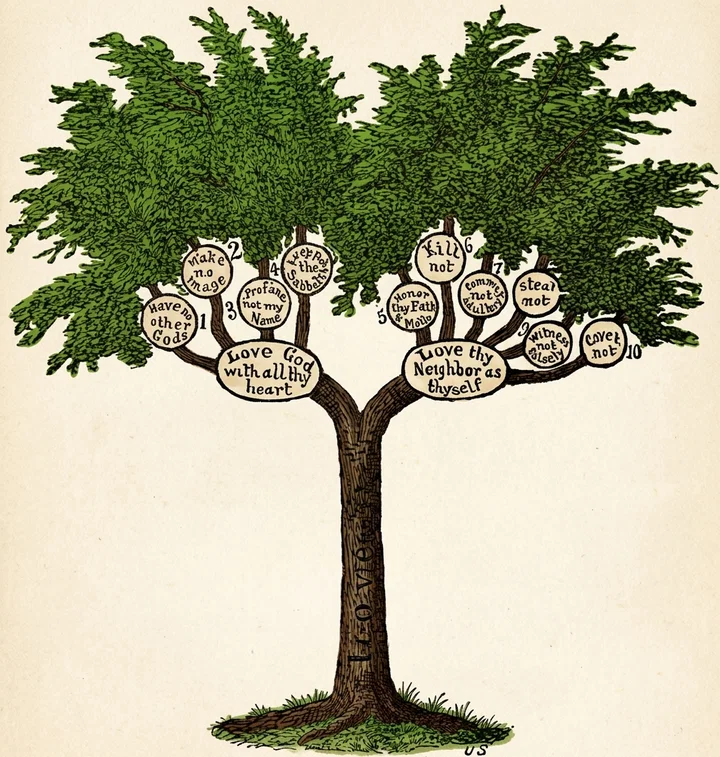
God is love. His law was given in love. And love is the fulfilling of his law, which we will here represent by the tree on the other page.
Let the body of this tree represent his law of love. You see that there are two large branches to this tree. Well, let one of these branches represent love to God, and the other, love to our neighbor.
On the first branch, which is marked, “Love God with all thy heart,” you see four small branches. These four small branches represent the first four commandments, which were written on the first table of stone. By these four commandments in the holy law of God, we may learn how to love God supremely. For if we love him with all the heart, we shall have no desire for other gods; we shall not wish to worship images; nor shall we dare to speak his holy name in vain, or break his Sabbath.
On the second branch marked, “Love thy neighbor as thyself,” you see six small branches. These six small branches represent the last six commandments, which were written on the second table of stone. By these six commandments we may learn our duty to those around us; how to love them as we love ourselves. For those who do really love others as well as themselves, will have no desire to steal, bear false witness, covet, or disobey their parents. Let those children who are tempted to disobey, and dishonor their parents, remember that if they disobey them they break the holy law of God.