NUMBER V.
THE LAW OF GOD.
Having proved that the law of God was known to men from the beginning, though not written in the book of Genesis, we now proceed to search for it in Exodus. This book gives us the history of the exode, or going out of the Israelites from Egypt. We read the first fifteen chapters and do not find the law so much as mentioned. In the sixteenth chapter it is spoken of, but not written.
The Lord, having brought his people out of Egypt, now purposes to prove them, whether they will walk in his law, or no. Verse 4. Now, if we observe carefully how he tested them, whether they would walk in his law, we shall learn what some part, at least, of the law is. Take your Bible and read this chapter carefully as far as the 30th verse, and you will see that he proves them to see if they will keep the Sabbath. So we know that the Sabbath commandment was a part of the law of God, and this proving them took place a month before the law was spoken from Mt. Sinai.
They were in a desert place and wanted food to live upon. God gave them bread from heaven; but in giving it, he did not choose to give it in such a way that they need not labor on any day of the week: they must gather it; and they could not lay up a store of manna for a month, a week, or even another day, (except the Sabbath,) and thus be released from daily labor; for it would spoil in one night; but on the sixth day enough might be gathered and kept for the Sabbath. This arrangement gave them opportunity to labor on six days, prepare for the Sabbath, and keep it when it came. Thus he proved them.
Out of all his law, God selected the Sabbath commandment as a test of obedience; and who could choose a better one for that purpose? None could be better calculated to prove their love to him.
Suppose your father, wishing to test your obedience and love to him, should command you not to kill your brother: you would obey him; but who would know that you did so out of love for your father? You love your brother, and yourself too well to disobey that command. But suppose he requires you to leave some business of your own, with which you are highly pleased, inp. 69 order to serve him. If you do it cheerfully, you know, and your father knows, that you do it to please him.
Thus we see the wisdom of God in choosing the Sabbath to prove his ancient people, before giving them the land of Canaan; and if he proves his people of this last generation by the same test, before giving them the promised inheritance, no one can justly complain that his ways are not equal.
QUESTIONS.—What was proved in your last lesson? In what book is the law not written? Where do we next search for it? How many chapters do we read and not find the law mentioned? In which chapter is it first spoken of? What does the Lord purpose to do concerning his people? If we observe carefully how he tested them, what shall we learn? What does he prove them with? What do we know from this? How long was this before the law was spoken from Sinai? What did the arrangement concerning the manna give them opportunity to do? What part of his law did God select as a test of obedience? What do we see in this choice? If He now uses the same test, who can justly complain?
NUMBER VI.
FROM what has been already seen, we may learn an important fact which we shall do well to remember; and that is, that the Sabbath commandment is the first one revealed in the Bible, as being a part of the law of God.
We now pass on to the twentieth chapter of Exodus. Here we find the law of God. It consists of ten commandments, and ends at the close of the seventeenth verse. God spoke them all to all Israel with his own voice, when he came down upon the top of Mount Sinai in fire, and the smoke thereof ascended as the smoke of a furnace, and the whole mount quaked greatly. See Gen. xix, 16, and onward. And He wrote them in two tables of stone.
These ten precepts are a whole, finished code of laws. That the Lord wished us to understand it so, is evident from the Scriptures. In Deut. iv, 13, Moses says, And he declared unto you his covenant, which he commanded you to perform, even ten commandments; and he wrote them upon two tables of stone. Also in Chap. v, 22, he says, These words the Lord spake unto all your assembly in the mount, out of the midst of the fire, and of the thick darkness, with a great voice: and he added no more; and he wrote them in two tables of stone, and delivered them unto me. These scriptures show that these ten precepts are a whole law; it was perfectly finished; therefore he added no more.
In these commandments are contained all the great principles of God's government. The principles of all moral duties are summed up in them. These principles or rules can be carried out more in detail, as they are in other parts of the Bible, but nothing can be added to them which will make them better. They are right altogether. In the language of inspiration by David, The law of the Lord is perfect. Ps. xix, 7. It is the perfect law of liberty of which the Apostle speaks. James i, 25. The person that is not condemned by it, enjoys the largest liberty; and whoever tells you that you are at liberty to break one of its precepts, knowing what he does, is himself the servant of corruption. 2 Pet. ii, 19; Matt. v, 19.
QUESTIONS.—What fact may be learned from the testimony already examined? In what chapter do we find the law? Of what does it consist? Who spoke them? From what mountain? What did he do besides speaking them? What are these ten precepts? Repeat Deut. iv, 13. Chapter v, 22. What do these scriptures prove? What are contained in the ten commandments? What can be added to them which will improve them? What is the language of inspiration concerning this law? Will you try to keep it?
NUMBER VII.
THE ten commandments are ten rules of action by which it is our duty to live. If all men lived by these rules, all would do right and all would be happy. God has taught us, by these ten laws, that there are ten ways in which we may sin against him. Perhaps you inquire, Are there only ten ways in which we can sin? Yes, there are a great variety of wrong actions, and affections, but there are ten classes or kinds of them.
To explain it, we will take ten classes or kinds of trees; as oak, ash, pine, elm, &c. In each class there are a number of varieties, as white oak, red oak, yellow oak, black oak, &c., white ash, black ash, yellow ash, &c.; some classes having a greater, and some a less number of varieties. Now if you are forbidden to cut down an oak in the forest, you know that all kinds of oak are meant; and so of every class of trees.
To apply this to the law of God, we will take the eighth commandment which says, Thou shalt not steal. This means that we must not take our neighbor's property wrongfully; and there are many ways in which we can do this. If I sell a quantity of wheat by the bushel, and take a measure that I know is a little too small and measure it by that, and my neighbor pays me the money agreed upon, perhaps you would say that I had not stolen his wheat or his money; but have I notp. 70 violated the great principle of right which God has given to guard our property? Have I not taken that which belongs to my neighbor? We might mention many cases like this, and show a great many ways of breaking this commandment; and also show how the other commandments may be broken in many ways, but enough has been said to give you an idea of much more that might be said, proving that the Psalmist was right when he said, Thy commandment is exceeding broad. Ps. cxix, 96.
We have been talking about trees, and have seen that ten classes may include a great variety of trees; and now we say that one word will express all sorts. That word is, tree. So the law of God forbids every wrong action, and teaches every duty in ten precepts; and these duties may all be expressed in one word, and that is, love. For if we love God with all our hearts, and our neighbor as ourselves, it is evident that we should keep all the commandments. Thus we see the meaning of Paul when he says, Love worketh no ill to his neighbor; therefore love is the fulfilling of the law. Rom. xiii, 10.
QUESTIONS.—What are the ten commandments? What would be the case if all lived by these rules? In how many ways can we sin? Are there only ten wrong actions? How many? What is meant then by ten? To explain this, what is taken? When we say oak, what do we mean? To apply this figure to the law, which commandment is taken? What does it say? Are there more ways than one in which we can take property wrongfully? What can you say of the other commandments? What does the Psalmist say of them? There are many classes of trees, and many varieties in a class, but what word expresses every kind? What word expresses all our duties? If we love God and our neighbor as we ought, what is evident? What says Paul in Rom. xiii, 10?
NUMBER VIII.
LOVE is so abundant in our heavenly Father that an Apostle has said, that “God is love.” 1 John iv, 8, 16. Therefore his law is a law of love, for it must be like him. It comes from the fountain of love, and it requires us to be like God, that is, it requires us to love. Paul says to Timothy, The end of the commandment is charity out of a pure heart. 1 Tim. i, 5. Charity is love. The end or design of all the commandments of God is to teach us to love. Then if we keep them rightly, we shall be full of love; and God will love us. He that dwelleth in love dwelleth in God and God in him. 1 John iv, 16. He that loveth not, knoweth not God. Verse 8. And hereby we do know that we know him, if we keep his commandments. He that saith, I know him, and keepeth not his commandments, is a liar, and the truth is not in him. Chap. ii, 3, 4. For this is the love of God, that we keep his commandments; and his commandments are not grievous. Chap. v, 3.
From scriptures like these we learn three things. 1. That God is full of love. 2. That the design of his law is to teach us to love. 3. That we cannot love as we ought unless we keep it.
We will next consider the objects of our love. Whom ought we to love? It is evident that God, our kind Creator and Preserver—the Giver of every good and perfect gift, should be the first object of our love. In the second place, we should love those whom God has created—our fellow men. Jesus said, Thou shalt love the Lord thy God with all thy heart, and with all thy soul, and with all thy mind. This is the first and great commandment. And the second is like unto it, Thou shalt love thy neighbor as thyself. On these two commandments hang all the law and the prophets. Matt. xxii, 37–40.
All the teaching of the ten commandments is love; but there are two directions in which our love should flow—towards God, and towards men; therefore, the commandments are divided into two classes, and were written on two tables of stone. Of the first class there are four commandments. They teach us to have no gods but the Lord, to make no image to worship, to profane not the name of God, and to remember the day of his rest, to keep it holy. These teach us to love God with all our heart. Of the second class there are six commandments. They teach us to honor our parents, not to kill, not to commit adultery, not to steal, not to bear false witness, and not to covet what belongs to our neighbor. These teach us to love our neighbor as ourself.
Now we cannot love God and our fellow creatures as we ought, and break one of the ten commandments; for it is evident that Jesus, when he spoke of all the law as hanging upon the two directions of our love, meant that not less than ten commandments hang there.
QUESTIONS.—What has an Apostle said? What is God's law? It comes from what? What does it require us to do? What says Paul to Timothy? What is charity? What is the design of all the commandments? What is said in 1 John iv, 16? In verse 8? In chapter ii? In chapter v? Can we love God as we ought and not keep his law? Who should be the first object of our love? The second? What did Jesus say in Matt. xxii? In how many directions should our love flow? Into what are the commandments divided? How were they written? How many are of the first class? What are we taught by these? How many of the second class? What do these teach us? Can we love God and man as we ought and break one of the ten commandments?p. 71
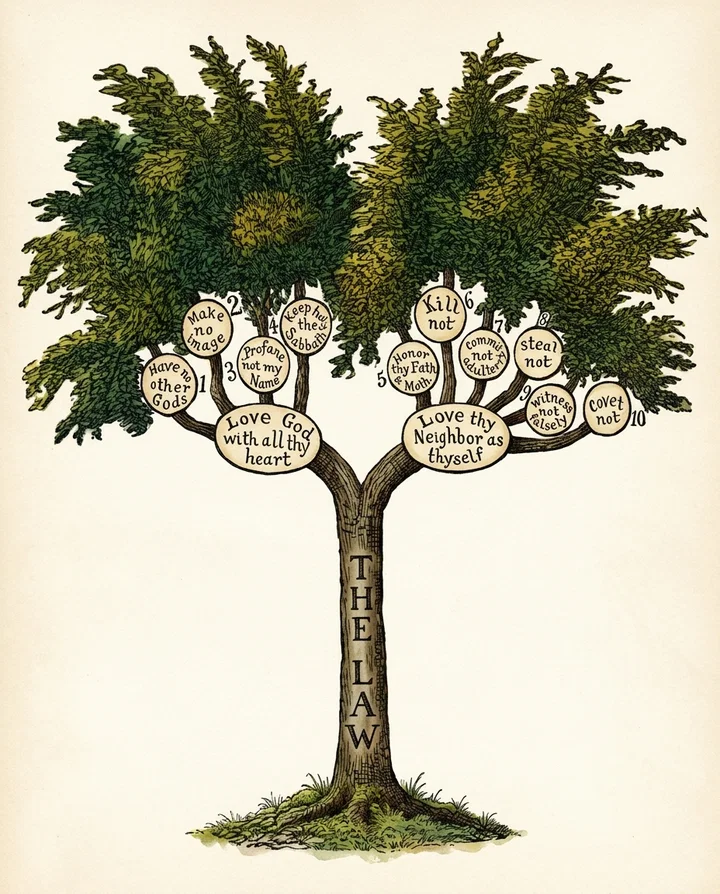
Now let us see what a beautiful tree is produced by obedience to the law of God. The name of the tree is Love; it is deep-rooted in God, the source of love. Its body is straight and its bark is smooth. Towards the top it is divided into two large branches. The name of the first is Love to God; the name of the second is Love to men.
The branch called Love to God parts again into four branches, called, Have no false Gods, Make no image, Profane not God's name, and Keep holy the Creator's Rest-day.
The branch called Love to men bears six principal branches which are named as follows:—Honor parents, Kill not, Commit not adultery, Steal not, Witness not falsely, and Covet not.
Thus there are ten principal branches supported by the two great ones, and the ten branch out again into all the various duties of life. The leaves cover the whole as a robe of righteousness, and the fruit is the fruit of the Spirit, which is love, joy, peace, long-suffering, gentleness, goodness, faith, meekness, temperance: against such there is no law. Gal. v, 22. These and many more of the kind, are the “peaceable fruits of righteousness,” or right doing.
It is said in the Proverbs, that The fruit of the righteous is a tree of life. Prov. xi, 30. The tree which we have been examining is a tree of love. But love fulfills the law; that is, keeps all its precepts, and thus becomes a tree of life; for Christ said, If thou wilt enter into life, keep the commandments. Matt. xix, 17. And again, Blessed are they that do his commandments, that they may have right to the tree of life, and may enter in through the gates into the city. Rev. xxii, 14.
We might describe the tree of Hatred, breaking all the commandments, and bringing forth fruit unto death; [See Rom. vi, 20–33;] but we turn from the disagreeable picture, and say, in the language of an Apostle, We are persuaded better things of you, things that accompany salvation. Heb. vi, 9.
QUESTIONS.—What object is used in this lesson to illustrate obedience? What is its name? How is it divided towards the top? What is the name of the first branch? Of the second? How many branches spring from Love to God? What are they called? How many from Love to men? What are their names? What upholds these ten branches? What grow out of the ten? What is the fruit of this tree? What is said in Proverbs? What is the tree we have been examining? What does love do? What does it become? What does Christ say in Matt. xix, 17? In Rev. xxii, 14? What is the fruit of breaking the commandments? Will you choose life, or death?