A SERMON FOR CHILDREN.
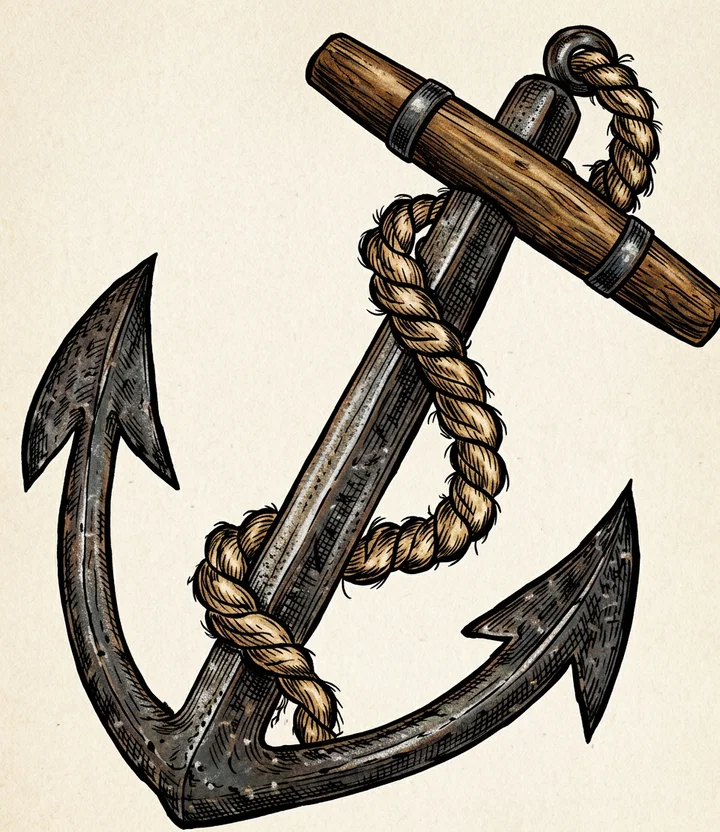
An anchor is an instrument which sailors use for fastening their ships, when no other means can be had for securing them. This way of securing vessels is of most importance when storms arise and the ship is drifted on some dangerous coast. Then as the massive anchor, firmly attached to the ship by the great cable, is thrown out and burys itself in the ground, the weary mariner feels that he is safe. It is not my intention however to talk to you at this time about sailing on the ocean, or casting anchor on her coasts; but to speak of the Christian's anchor. Christian voyagers on board Zion's ship, are poorly fitted out for their trip unless they have an anchor, which may be cast into good anchor-ground when storms arise and threaten to dash their bark in pieces on the perilous coast.
That the Christian has an anchor is clearly set forth by Paul. “Which hope we have as an anchor of the soul, both sure and steadfast, and which entereth into that within the veil.” (Heb. vi, 19.) Thus we learn the true Christian has an anchor fastened in firm anchor-ground that will hold, for it centers in Christ. It is an anchor too that will never fail. It is made of two immutable things, (Heb. vi, 17.) These things are,
1st. God’s Word of promise to Abraham; and
2nd. His oath which was given to confirm that promise.
We shall readily see by looking at this matter a little what the promise to Abraham is. Paul tells us [Rom. iv, 13] that this promise was that he should be “heir of the world,” and that God made it sure to Abraham by an oath. He was not to have it in this life, but was “after” to receive it for an inheritance. While he was a sojourner here, as we are now, he “looked for a city which hath foundations, whose builder and maker is God.” (Heb. xi, 5, 6.) But Peter tells us [2 Pet. iii, 13] that it is the New Earth which is to be the inheritance of the saints; and John shows us [Rev. xxi, 2] that when the earth is renewed and the saints live there, the holy city, the New Jerusalem will be located in it.
If this inheritance spoken of in the promise had been given to Abraham, God’s better plan could not have taken effect: “that they without us should not be made perfect.” (Heb. xi, 39, 40.) Neither could Paul stand and be “judged for the hope of the promise.” But he did thus stand, and considered that the promise he was contemplating involved the resurrection of the dead. (See Acts xxvi, 6-8.) We learn then from this short investigation that the Christian’s anchor is the hope of a future inheritance, which the Lord has promised to all that obey him.
This hope holds God’s people in their dangers as an anchor holds the ship in the storm. When the attractions and pleasures of the world would draw us away from the Lord, the glories of the better land eclipse them all, and serve as an anchor to keep us from making shipwreck of our faith.
It was this anchor that kept Moses in Pharaoh’s palace. He choose rather to suffer affliction with the people of God, than to enjoy the pleasures of sin for a season. He might have had a bountiful share in the treasures of Egypt—been called the son of Pharaoh’s daughter, and lived deliciously in king’s courts. But he chose rather to forego the present enjoyments of this world, and enjoy the kingdom which would a thousand-fold eclipse the splendor of earth’s most glorious kingdoms.
Paul also while suffering with the people of God, “thrice beaten with rods,” “five times receiving forty stripes save one,” and in all manner of perils, could say, “Our light affliction which is but for a moment worketh for us a far more exceeding and eternal weight of glory.” His anchor held him.
Cannot we, dear young friends lay aside every desire for worldly pleasure, although it may be grievous, and in the language of the poet say:
“Come joy or come sorrow, whate’er may befall, An hour with my God will make up for them all.”
Battle Creek, Mich. J. N. LOUGHBOROUGH.