For the Instructor,

8%

Review and Herald Office · Battle Creek, Mich. · Apr 1859

FromThe Youth’s Instructor, Vol. 7, No. 4.

Read the full edition

For the Instructor,

For the Instructor,

INCIDENTS OF MY PAST LIFE. No. 4.
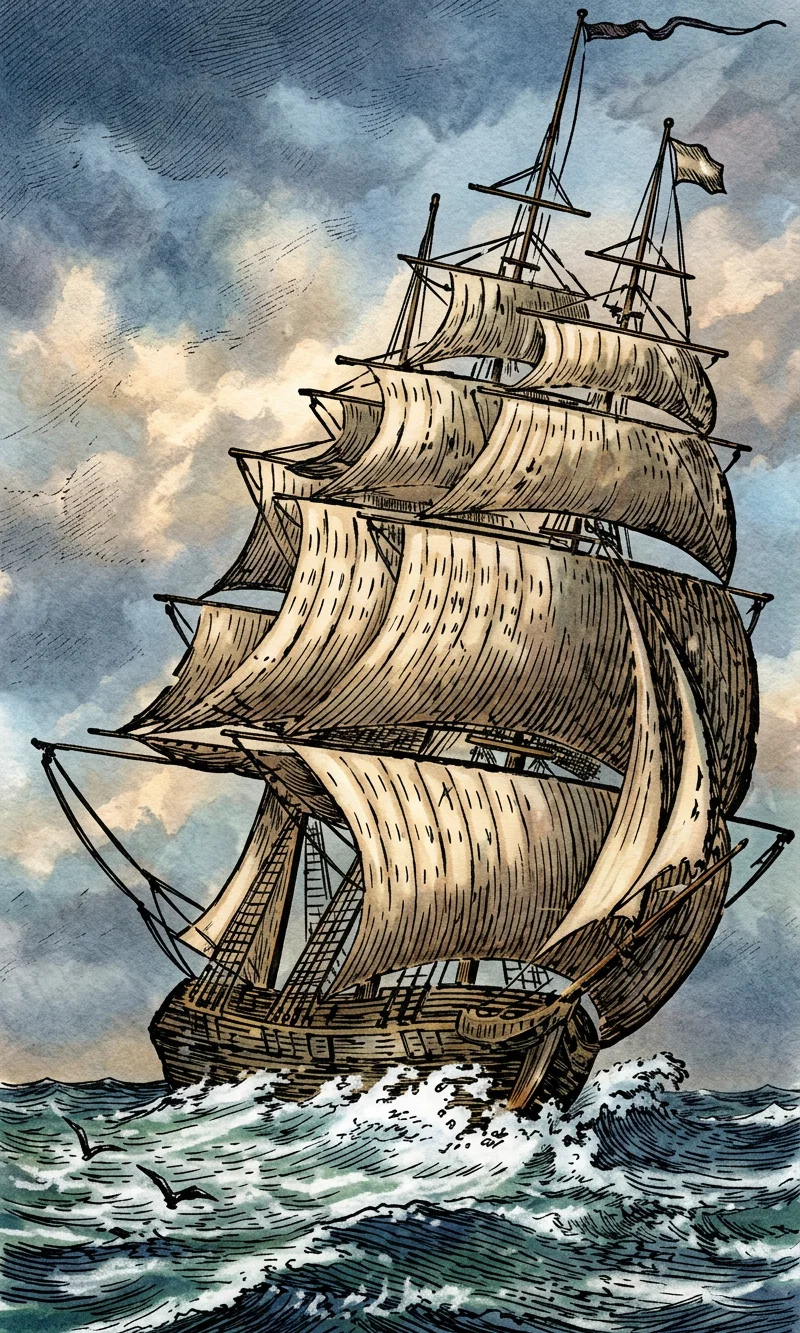
PARTING THE CABLE—TAKEN BY PRIVATEERS—LITTLE BOX—SHIP CONDEMNED, &c.
Restored with AI
After repairing damages in Ireland we sailed again on our Russian voyage, and in a few days we fell in with & joined an English convoy of two or three hundred sail of merchant vessels bound into the Baltic sea, convoyed by British ships of war to protect them from their enemies. On reaching a difficult place called the “Mooner passage,” a violent gale overtook us which in spite of our efforts was driving us on a dismal, shelterless shore. With the increasing fury of the gale and darkness of the night, our condition became more and more alarming, until finally our Commodore hoisted the “lighted lantern,” a signal for all the fleet to anchor without delay. The long wished for morning at length came which revealed to us our alarming position. All that were provided with cables were contending with the boisterous seas driven against us by the furious gale. It seemed almost a miracle to us that our cables and anchors still held. While watching one after another as they parted their cables and were drifting towards the rocks to be dashed in pieces, our own cable broke! With all haste we crowded what sail we dared on the ship, and she being a fast sailor we found by the next day that we had gained some distance in the offing. Here a council was called which decided that we should make sail from the convoy and take a lone chance through the sound, by the coast of Denmark.
Not many hours from this, while we were congratulating ourselves respecting our narrow escape from shipwreck, and out of reach of the Commodore’s guns, two suspicious looking vessels were endeavoring to cut us off from the shore. Their cannon balls soon began to fall around us, and it became advisable for us to round too and let them come aboard. They proved to be two Danish privateers, who captured and took us to Copenhagen, where ship and cargo were finally condemned, in accordance with Bonaparte’s decrees, because of our intercourse with the English.
In the course of a few weeks we were all called to the court house to give testimony respecting our voyage. Previous to this, our supercargo and part owner had promised us a handsome reward if we would testify that our voyage was direct from New York to Copenhagen, and that we had no intercourse with the English. To this proposition we were not all agreed. We were finally examined separately, my turn coming first. I suppose they first called me into court because I was the only youth among the sailors. One of the three judges asked me in English if I understood the nature of an oath. After answering in the affirmative he bid me look at a box near by, (about 15 inches long and 8 high.) and said, that box contains a machine to cut off the two fore-fingers and thumb of every one who swears falsely here. Now, said he, hold up your two fore-fingers & thumb on your right hand. In this manner I was sworn to tell the truth, and regardless of any consideration I testified to the facts concerning our voyage. Afterwards when we were permitted to go aboard it was clear enough that the “little box” had brought out the truthful testimony from all; viz., that we had been wrecked by running against an island of ice fourteen days from New York; refitted in Ireland, after which we joined the British convoy, and were captured by the privateers. After this, some of our crew as they were returning from a walk where they had been viewing the prison, said that some of the prisoners thrust their hands through the gratings to show them that they had lost the two fore-fingers and thumb of their right hand. They were a crew of Dutchmen that were likewise taken and had sworn falsely. We now felt thankful for another narrow escape by telling the truth.
“We want the truth on every point, We want it too, to practice by.”
With the condemnation of our ship and cargo, and loss of our wages, in company with a strange people who had stripped us of all but our clothing, ended our Russian voyage. But before Winter set in I obtained a birth on board a Danish brig bound to Pillau, in Prussia, where we arrived after a tedious passage, our vessel leaking so badly that it was with difficulty we kept her from sinking until we reached the wharf. In this extremity I obtained a berth on an American brig from Russia, bound to Belfast, Ireland. But I must close now.
Dear Youth: By reading the foregoing sketch you will at once see how soon troubles came after our cable parted from the anchor. This will illustrate the perilous condition of those who while on “the voyage of life” to the port of eternal rest, suffer their cable to part from the heavenly anchor. This cable is faith, and the anchor to which it is secured is hope. As the strength of the mariner’s cable is tried by storms and tempests, so the christian’s cable, (faith,) is proved by the various trials and commotions of life. Therefore we should watch and pray and be sure that our cable is firmly fastened to the blessed hope, which we have as an “anchor of the soul both SURE and STEADFAST.” JOSEPH BATES.
Leslie, Mich.