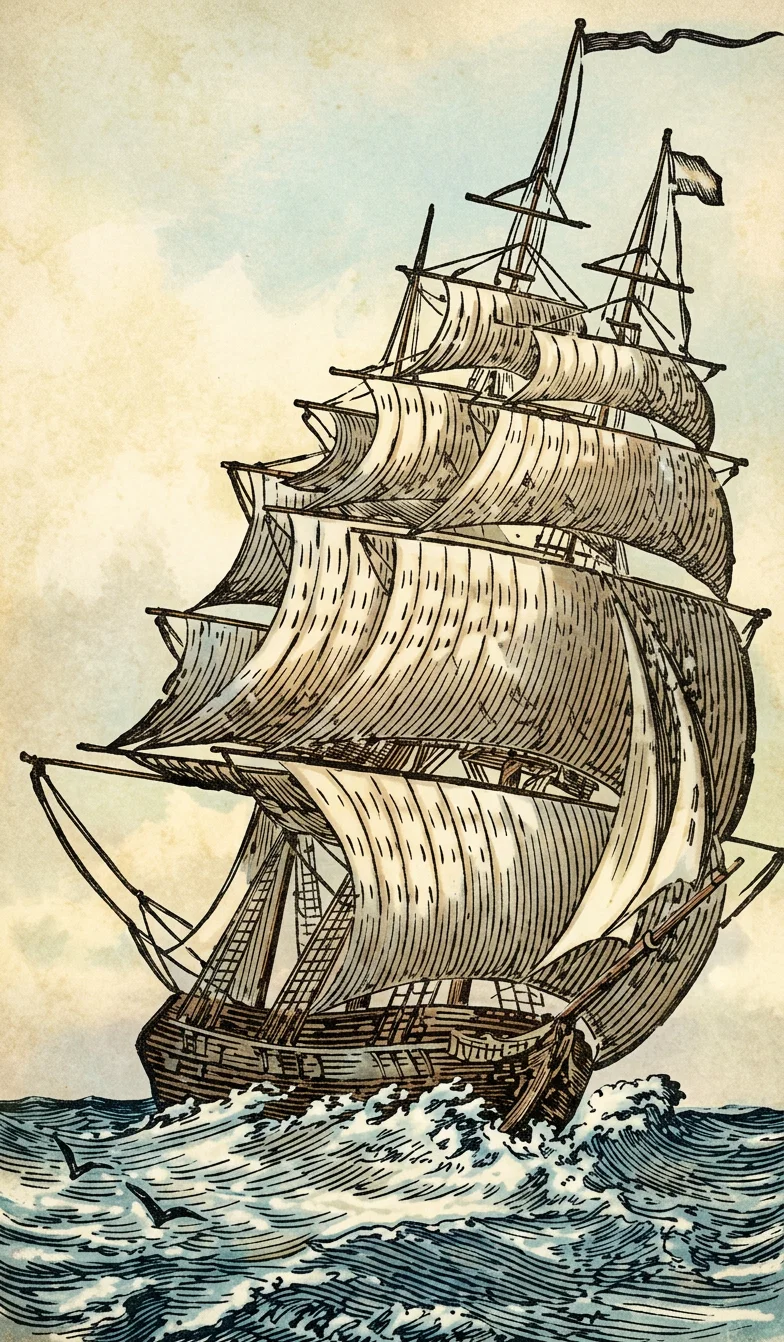
Proceeding on another voyage from New York to Archangel, in Russia, about the middle of May, in the afternoon, we discovered a number of islands of ice, many of them appearing like large cities. This was an unmistakable sign that we were nearing the banks of New Foundland, about one thousand miles on the mariner’s track from Boston to Liverpool. These large masses, or islands of ice, are driven by wind and current from the ice-bound regions of the North, and strike the bottom more than three hundred feet from the surface of the sea, and some seasons they are from two to three months dissolving and tumbling to pieces, which lightens them of their prodigious burdens, and thereby are driven onward over this deep water into the fathomless part of the ocean, and are soon dissolved in warm sea water.
A strong westerly gale was wafting us rapidly in our onward course, and as the night set in we were past this cluster. The fog then became so dense that it was impossible to see ten feet before us. About this time while one W. Palmer was steering the ship, he overheard the chief mate expostulating with the captain, desiring him to round the ship to, and lay by until morning light. The captain deemed we were past all the ice, and said the ship must continue to run, and have a good lookout ahead. Midnight came, and we were relieved from our post by the captain’s watch, to retire below for four hours. In about an hour from this we were aroused by the dreadful cry from the helmsman, “AN ISLAND OF ICE!” The next moment came the dreadful crash! When I came to my senses from the blow I received from being tossed from one side of the forecastle to the other, I found myself fast clinched with Palmer. The rest of the watch had made their escape on deck, and shut down21the scuttle. After several unsuccessful attempts to find the ladder to reach the scuttle, we gave up in despair. We placed our arms around each other’s necks, and gave up to die. Amid the creaking and rending of the ship with her grappled foe, we could once in a while hear some of the screams and cries of some of our wretched companions on the deck above us, begging God for mercy, which only augmented our desperate feelings. Thoughts came rushing like the light that seemed to choke, and for a few moments block up all way to utterance.
O, the dreadful thought! here to yield up my account and die, and sink with the wretched ship to the bottom of the ocean, so far from home and friends, without the least preparation, or hope of heaven and eternal life, only to be numbered with the damned and forever banished from the presence of the Lord. It seemed that something must give way to vent my feelings of unutterable anguish!
In this agonizing moment the scuttle was thrown open, with a cry, “Is there any one below?” In a moment we were both on deck. I stood for a moment surveying our position; the ship’s bow partly under a shelf of the ice, everything gone but her stem. All her square sails filled with the wind, and a heavy sea rushing her onward in closer connection with her unyielding antagonist. Without some immediate change it was evident that our destiny, and hers, would be sealed up in a few moments.
With some difficulty I made my way to the quarter deck where the captain and second mate were on their knees begging God for mercy. The chief mate with as many as could rally around him, were making fruitless efforts to hoist the long boat, which could not have been kept from dashing against the ice for two moments. Amid the crash of matter and cry of others, my attention was arrested by the captain’s crying out, “What are you going to do with me, Palmer?” Said P., “I am going to heave you overboard!” “For God’s sake let me alone, said he, for we shall all be in eternity in less than five minutes!” Said P., with a dreadful oath, “I don’t care for that, you have been the cause of all this! it will be some satisfaction to me to see you go first!” I laid fast hold of him, and entreated him to let go of the captain and go with me and try the pump. He readily yielded to my request; but to our utter astonishment the pump sucked. This unexpected good news arrested the attention of the chief mate, who immediately turned from his fruitless labor, and after a moment’s survey of the ship’s crashing position, cried out with a stentorian shout, “Let go the top gallant and the top-sail halyards! let go the tacks and sheets! haul up the courses! clew down and clew up the topsails!” Perhaps orders were never obeyed in a more prompt and instantaneous manner. The wind thrown out of the sails relieved the ship immediately, and like a lever sliding from under a rock, she broke away from her disastrous position, and settled down upon an even keel broadside to the ice.
We now saw that our strong built and gallant ship was a perfect wreck forward of her fore-mast, and that mast, to all appearances, about to go too; but what we most feared was, the ship’s yards and mast coming in contact with the ice, in which case the heavy sea on her other side would rush over her deck, and sink us in a few moments. While anxiously waiting for this, we saw that the sea which passed by our stern bounded against the western side of the ice, and rushed back impetuously against the ship, and thus prevented her coming in contact with the ice, and also moved her onward towards the southern extremity of the island which was so high that we failed to see the top of it from the mast head.
In this state of suspense we were unable to devise any way for our escape, other than that God in his providence was manifesting to us, as above described. Praise his holy name! “His ways are past finding out.” About four o’clock in the morning while all hands were intensely engaged in clearing away the wreck, a shout was raised, “Yonder is the eastern horizon, and it’s daylight!” This was indication enough that we were just passing from the western side, beyond the southern extremity of the ice, where the ship’s course could be changed by human skill. “Hard up your helm,” cried the captain, “and keep the ship before the wind! Secure the fore-mast! clear away the wreck!” Suffice it to say that fourteen days brought us safely into the river Shannon, in Ireland, where we refitted for our Russian voyage.
“They that go down to the sea in ships, that do business in great waters: these see the works of the Lord, and his wonders in the deep. . . . Their soul is melted because of trouble, . . . then they cry unto the Lord in their trouble, and he bringeth them out their distresses. . . . Oh that men would praise the Lord for his goodness, and for his wonderful works to the children of men.” Ps. cvii.
Dear young friends, whatever be your calling here, “Seek ye first the kingdom of God, and his righteousness,” [Matt. vi, 33.] and get your feet planted on board the gospel ship. The owner of this majestic homeward-bound vessel, shows the utmost care for every mariner on board; even to the numbering of the hairs of their heads. He not only pays the highest wages, but has promised every one who faithfully performs their duty an exceeding great reward. That all the perils of this voyage may be passed in safety. he has commanded his holy ones [Heb. i, 14] to attend and watch over this precious company, who fail not to see through all the mist and fogs, and give warning of all the dangers in the pathway. Moreover he has invested his dear Son with all power, and given him for a Commander and skillful Pilot to convey this good ship and her company into her destined haven. Then he will clothe them with immortality, and give them the earth made new for an everlasting inheritance; and make them kings and priests unto God, to “reign on the earth.”