INCIDENTS IN MY PAST LIFE.—No. 10.
Reconciliation—Full allowance of bread granted—Cutting a hole through the ship—Perilous adventure of a Narragansett Indian—Hole finished—Eighteen prisoners escape—Singular device to keep the number good.
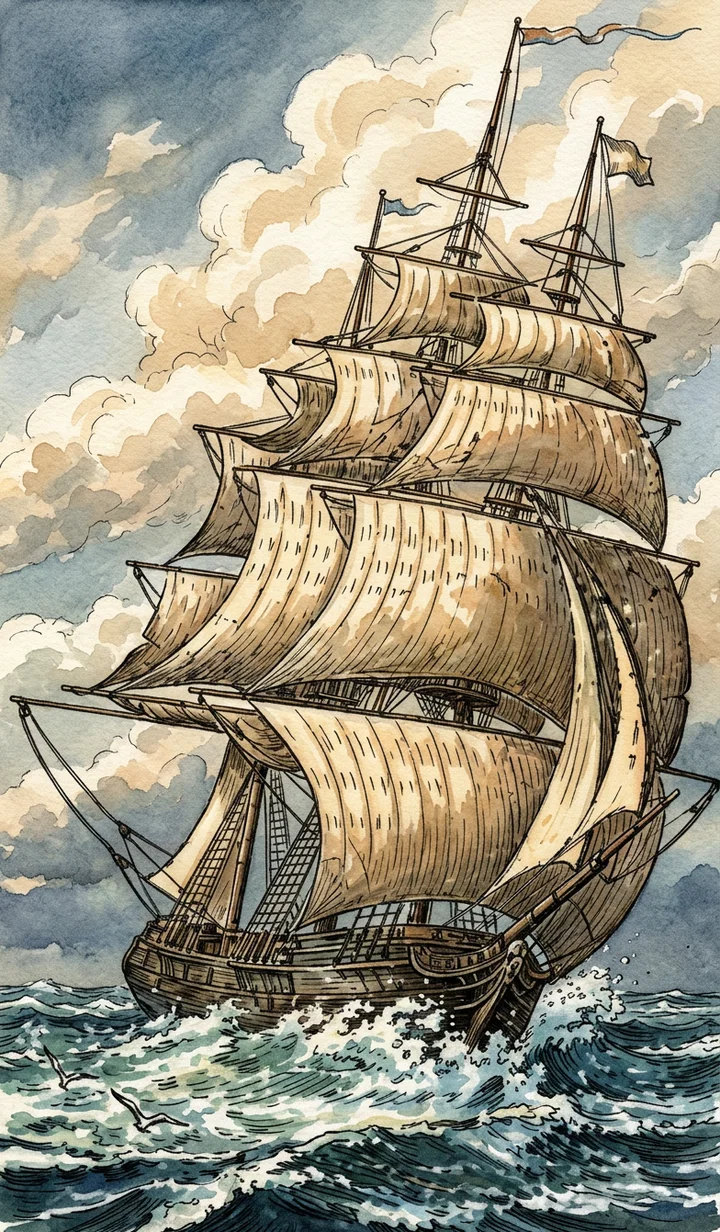
The welcome fresh air, and morning light came suddenly upon us, by an order from the commander to open our port-holes, unbar the hatchways, and call the prisoners up to get their bread. In a few moments it was clearly understood that our enemies had capitulated by yielding to our terms, and were now ready to make peace by serving us with our full allowance of bread.
While one from each mess of ten was up getting their three days’ allowance of brown loaves, others were up to the tank filling their tin cans with water, so that in a short space of time a great and wonderful change had taken place in our midst. On most amicable terms of peace with all our keepers, grouped in messes of ten, with three days’ allowance of bread, and cans filled with water, we ate and drank, laughed and shouted immoderately over our great feast, and vanquished foe. The wonder was that we did not kill ourselves with over-eating and drinking.
The commissary, on hearing the state of things in our midst, sent orders from the shore, to the commander to serve out our bread forthwith.
Our keepers were in the habit of examining the inside of our prison every evening before we were ordered up to be counted down, to ascertain whether we were cutting through the ship to gain our liberty. We observed that they seldom stopped at a certain place on the lower deck, but passed it with a slight examination. On examining this place, a number of us decided to cut a hole here if we could effect it without detection by the soldier who was stationed but a few inches above where we must come out and yet have room above water.
Having nothing better than a common table knife fitted with teeth, after some time we sawed out a heavy three-inch oak plank, which afterwards served us successfully for a cover when our keepers were approaching. We now began to demolish a very heavy oak timber, splinter by splinter. Even this had to be done with great caution, that the soldier might not hear us on the outside. While one was at work in his turn, some others were watching that our keepers should not approach and find the hole uncovered. About forty were engaged in this work. Before the heavy timber was splintered out, one of our number obtained the cook’s iron poker. This was a great help to pry off small splinters around the heavy iron bolts. In this way, after laboring between thirty and forty days, we reached the copper on the ship’s bottom some two to three feet from the top of our cover, on an angle of about 25° downward. By working the poker through the copper, on the upper side of the hole, we learned to our joy that it came out beneath the stage where the soldier stood. Then on opening the lower side of the hole the water flowed in some, but not in sufficient quantities to sink the ship for some time, unless by change of wind and weather, she became more unsteady in her motion, and rolled the hole under water, in which case we should doubtless have been left to share her fate. The commander had before this, stated that if by any means the ship caught fire from our lights in the night, he would throw the keys of our hatchways overboard, and leave the ship and us to burn and perish together. Hence we had chosen officers to extinguish every light at 10 P. M.
Sunday P. M., while I was at work in my turn enlarging the hole in the copper, a shout of hundreds of voices from the outside so alarmed me for fear that we were discovered, that in my hurry to cover up the hole the poker slipped from my hands through the hole into the sea. The hole covered, we made our way with the rushing crowd, up the long stairway to the upper deck, to learn the cause of the shouting. The circumstances were these: Another ship like our own, containing American prisoners, was moored about one eighth of a mile from us. People from the country in their boats were visiting the prison ships, as was their custom on Sundays, to see what looking creatures American prisoners were. Soldiers with loaded muskets, about twenty feet apart, on the lower and upper stages outside of the ship, were guarding the prisoners’ escape. One of the countrymen’s boats rowed by one man, lay fastened to the lower stage, at the foot of the main gangway ladder, where also one of these soldiers was on guard. A tall, athletic Narragansett Indian, who like the rest of his countrymenp. 78 was ready to risk his life for liberty, caught sight of the boat, and watching the English officers who were walking the quarter deck, as they turned their backs to walk aft he bolted down the gangway ladder, clinched the soldier, musket and all, and crowded him under the thwarts, cleared the boat, grasped the two oars, and with the man (who most likely would have shot him before he could clear himself) under his feet, he shaped his course for the opposite unguarded shore, about two miles distant!
The soldiers seeing their comrade with all his ammunition, snatched from his post, and stowed away in such a summary manner, and moving out of their sight like a streak over the water by the giant power of this North American Indian, were either so stunned with amazement at the scene before them, or it may be with fear of another Indian after them, that they failed to hit him with their shot. Well-manned boats with sailors and soldiers were soon dashing after him, firing and hallooing to bring him too; all of which seemed only to animate and nerve him to ply his oars with herculean strength.
When his fellow-prisoners saw him moving away from his pursuers in such a giant-like manner, they shouted, and gave him three cheers. The prisoners on board our ship followed with three more. This was the noise which I had heard while working at the hole. The officers were so exasperated at this, that they declared if we did not cease this cheering and noise they would lock us down below. We therefore stifled our voices, that we might be permitted to see the poor Indian make his escape.
Before reaching the shore his pursuers gained on him so that they shot him in his arm (as we were told), which made it difficult to ply the oar; nevertheless he reached the shore, sprang from the boat, and cleared himself from all his pursuers, and was soon out of the reach of all their musket balls. Rising to our sight upon an inclined plain, he rushed on, bounding over hedges and ditches like a chased deer, and without doubt would have been out of sight of his pursuers in a few hours, and gained his liberty, had not the people in the country rushed upon him from various quarters, and delivered him up to his pursuers, who brought him back and for some days locked him up in the dungeon. Poor Indian! he deserved a better fate.
The prisoners now understood that the hole was completed, and a great many were preparing to make their escape. The committee men decided that those who had labored to cut the hole should have the privilege of going first. They also selected four judicious and careful men, who could not swim, to take charge of the hole and help all out that wished to go.
With some difficulty we at length obtained some tarred canvass, with which we made ourselves small bags, just large enough to pack our jacket, shirt and shoes in, then a stout string about ten feet long fastened to the end, and the other end made with a loop to pass around the neck. With hat and pants on, and bag in one hand and the other fast hold of our fellow, we took our rank and file for a desperate effort for liberty. At the given signal, (10 P. M.,) every light was extinguished, and the men for liberty were in their stations.
Soldiers, as already described, above and below were on guard all around the ship with loaded muskets. Our landing place, if we reached it, about half a mile distant, with a continued line of soldiers just above high-water mark. The heads of those who passed out, came only a few inches from the soldier’s feet, i. e., a grating stage between.
A company of good singers stationed themselves at the after port-hole where the soldier stood that was next to the one over the hole. Their interesting sailor, and war songs took the attention of the two soldiers some, and a glass of strong drink now and then drew them to the port-hole, while those inside made believe drink. While this was working, the committee were putting the prisoners through feet foremost, and as their bag string began to draw, they slipped that out also, being thus assured that they were shaping their course for the shore. In the mean time when the ship’s bell was struck, denoting the lapse of another half hour, the soldiers’ loud cry would resound, All’s well! The soldier that troubled us the most, would take his station over the hole and shout, All’s well! Then when he stepped forward to hear the sailors’ song, the committee would put a few more through, and he would step back and cry again, All’s well!! It surely was most cheering to our friends while struggling for liberty in the watery element, to hear behind and before them the peace and safety cry, All’s well!
Midnight came; the watch was changed, the cheering music had ceased. The stillness that reigned without and within, retarded our work. At length it was whispered along the ranks that the few that had passed out during the stillness had caused great uneasiness with the soldiers, and they judged it best for no more to attempt to leave for fear of detection. It was also near daylight, and we had better retire quietly to our hammocks.
Edmond Allen and myself, of New Bedford, covenanted to go, and keep together. We had been hold of each other during the night, and had advanced near the hole when it was thought best for no more to go. In the morning the cover was off, and E. A. was among the missing.
The committee reported seventeen, and E. A. made eighteen that had passed out during the night.
The prisoners were greatly elated at the last night’s successful movement, and took measures to keep the hole undiscovered for another attempt at 10 P. M.
We were confined between two decks, with no communication after we were counted down at night and locked up. During the day some tools were obtained, and a scuttle was cut through the upperp. 79 deck and covered up undiscovered. Word was then circulated among the prisoners to go up from the upper deck as soon as the soldiers ordered the prisoners up to be counted down for the night. But those on the lower deck were to move tardily, so that those on the upper deck might be counted down before the lower deck was cleared. This was done, and eighteen that had just been counted, slipped through the scuttle unperceived by the soldiers mingled with the crowd up the lower deck ladder, and were counted over again. At 10 P. M. the lights were again extinguished, and the ranks formed for another attempt to escape. JOSEPH BATES.
Burns, Mich., September, 1859.