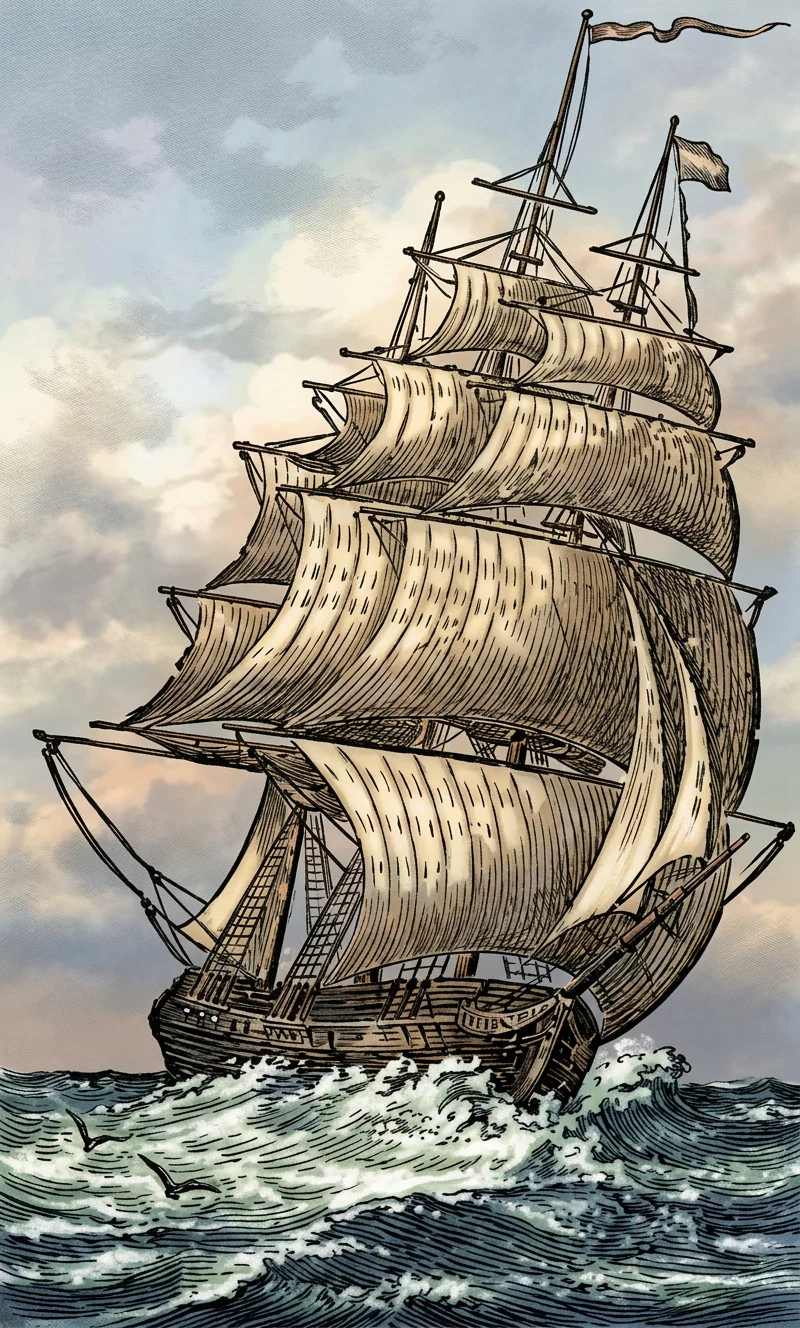
THE winter rendezvous of the Mediterranean British squadron was in the isle of Minorca, harbor of Port Mahon. Sailing after the middle of the seventh month is dangerous. See St. Paul's testimony, Acts xxvii, 9, 10.
While endeavoring to escape the vigilance of our pursuers, after we stepped out of the Spaniard's market boat (see No. 6,) away beyond the city, at the base of a rocky mountain we discovered a wooden door which we opened, and away in the distance it appeared quite light. We ventured on through this subterranean passage till we came to a large open space where the light was shining down through a small hole wrought from the top of the mountain, down through the dome. This subterranean passage continued on in a winding direction which we attempted to explore as far as we dared to for the want of light to return to the center. On both sides of this main road we discovered similar passages all beyond our exploration. Afterwards we were told that this mountain had been excavated in past ages for the purpose of sheltering a besieged army. In the center or light place was a large house chiseled out of a rock, with door way and window frames, designed undoubtedly for the officers of the besieged, and rallying place of the army.
After a close survey of this wonderful place, we became satisfied that we had now found a secure retreat from our pursuers, where we could breathe and talk aloud without fear of being heard, or seized by any of the subjects of King George III. But alas, our joy soon vanished when we thought53again that there was nothing here to eat. When we ventured to a farm house to seek for bread, the people eyed us with suspicion, and fearing they would seize us, and hand us over to our pursuers, we avoided them, until we became satisfied that it was in vain to escape from this place, and so returned to the ship. The stone of this mountain is a kind of sand-stone, much harder than chalk, called “holy stone,” which is abundant on the island, and made use of by the British squadron to scour or holy-stone the decks with every morning, to make them white and clean.
In the mild seasons, the sailor's uniform was white duck frocks and trowsers, and straw hats. The discipline was, to muster all hands at nine o'clock in the morning, and if our dress was reported soiled or unclean, then all such were doomed to have their names put on the “black list,” and required to do all kinds of scouring brass, iron, and filthy work, in addition to their stationed duty, depriving them of their allotted time for rest and sleep in their morning watch below. There was no punishment more dreaded and disgraceful to which we were daily liable.
If sufficient changes of dress had been allowed us, and sufficient time to wash and dry the same, it would have been a great pleasure, and also a benefit to us to have appeared daily with unsoiled white dresses on, notwithstanding the dirty work we had to perform. I do not remember of ever being allowed more than three suits at one time to make changes, and then only one day in the week to cleanse them, viz. about two hours before daylight once a week, all hands (about 700) called on the upper decks to wash and scrub clothes. Not more than three quarters of these could be accommodated to do this work for themselves at a time; but no matter, when daylight came at the expiration of the two hours, all washed clothes were ordered to be hung on the clothes-lines immediately. Some would say, I have not been able to get water nor a place to wash mine yet. “I can't help that! clear out your clothes, and begin to holy-stone and wash the decks.” Orders were most strict that whoever should be found drying his clothes at any other but this time in the washday should be punished. To avoid detection and punishment, I have scrubbed my trowsers early in the morning, and put them on and dried them. Not liking this method, I ventured at one time to hang up my wet trowsers in a concealed place behind the main top sail; but the sail was ordered to be furled in a hurry, and the lieutenant discovered them. The maintop men (about fifty) were immediately ordered from their dinner hour to appear on the quarter deck. “All here Sir,” said the under officer that mustered us, “Very well, whose trowsers are these found hanging in the maintop?” When I stepped forward from the ranks, and said, “They are mine, Sir.” “Yours, are they? you ———!” and when he had finished cursing me he asked me how they came there? “I hung them there to dry, Sir.” “You ——— see how I will hang you, directly. Go down to your dinner, the rest of you,” said he, “and call the chief boatswain's mate up here.” Up he came in great haste from his dinner. “Have you got a rope's end in your pocket?” He began to feel and said, “No Sir.” “Then away down below directly and get one and give that fellow there one of the ——— floggings he ever had.” “Yes, Sir, bare a hand.”
Thus far, I had escaped all his threats of punishment from my first introduction into the ship. I had often applied for more clothes to enable me to muster with a clean dress, but had been refused. I expected now, according to his threats, that he would wreak his vengeance on me by having the flesh cut off my back for attempting to have a clean dress, when he knew I could not have it without venturing some way as I had done. While thoughts of the unjustness of this matter were rapidly passing through my mind, he cried out, “Where is that fellow with the rope? why don't he hurry up here?” At this instant he was heard rushing up from below. The lieutenant stopped short and turned to me saying, “If you don't want one of the ——— floggings you ever had, do you run.” I looked at him to see if he was in earnest. The under officer, who seemed to feel the injustice of my case, repeated, “Run!” The lieutenant cried to the man with the rope, “Give it to him!” “Aye, aye, Sir.” I bounded forward, and by the time he reached the head of the ship, I was over the bow getting a position to receive him near down by the water, on the ship's bobstays. He saw at a glance it would require his utmost skill to perform his pleasing task there. He therefore commanded me to come up to him. “No,” said I, “if you want me, come here.”
In this position, the Devil, the enemy of all right and just motives, tempted me to seek a summary redress of my grievances, viz. if he followed me and persisted in inflicting on me the threatened punishment, to grasp him and plunge into the water. Of the many that stood above looking on, none spake to me that I remember but my pursuer. To the best of my memory I remained in this position more than an hour. To the wonder of myself and others, the lieutenant issued no orders respecting me, neither questioned me afterwards, only the next morning I learned that I was numbered with the black list men for about six months. Thanks to the Father of all mercies for delivering me from premeditated destruction by his overruling providence in that trying hour.
Ships belonging to the blockading squadron in54the Mediterranean sea were generally relieved and returned to England at the expiration of three years; then the sailors were paid their wages, and twenty-four hours' liberty given them to spend their money on shore. As the Rodney was now on her third year out, my strong hope of freedom from the British yoke would often cheer me while looking forward to that one day's liberty in the which I was resolving to put forth every energy of my being to gain my freedom. About this time the fleet encountered a most dreadful storm in the gulf of Lyons. For a while it was doubted whether any of us would ever see the rising of another sun. These huge ships would rise like mountains on the top of the coming sea, and suddenly tumble again into the trough of the same with such a dreadful crash that it seemed almost impossible they could ever rise again. They became unmanageable, and the mariners were at their wit's end. See the Psalmist's description, Psa. cvii., 23-30.
On our arrival at Port Mahon in the island of Minorca, ten ships were reported much damaged. The Rodney was so badly damaged that the commander was ordered to get her ready to proceed to England. Joyful sound to us all! “Homeward bound! Twenty-four hour's liberty!” was the joyous sound. All hearts glad. One evening after dark, just before the Rodney's departure for England, some fifty of us were called out by name and ordered to get our baggage ready and get into the boats. “What's the matter? Where are we going?” “On board the Swiftshore 74.” “What, that ship that has just arrived for a three year's station?” “Yes.” A sad disappointment indeed; but what was still worse, I began to learn that I was doomed to drag out a miserable existence in the British navy. Once more I was among strangers, but well known as one who had attempted to escape from the service of King George III.
The Swiftshore was soon under way for her station off Toulon. A few days after we sailed, a friend of my father's arrived from the United States bringing documents to prove my citizenship and a demand for my release from the British Government. JOSEPH BATES.