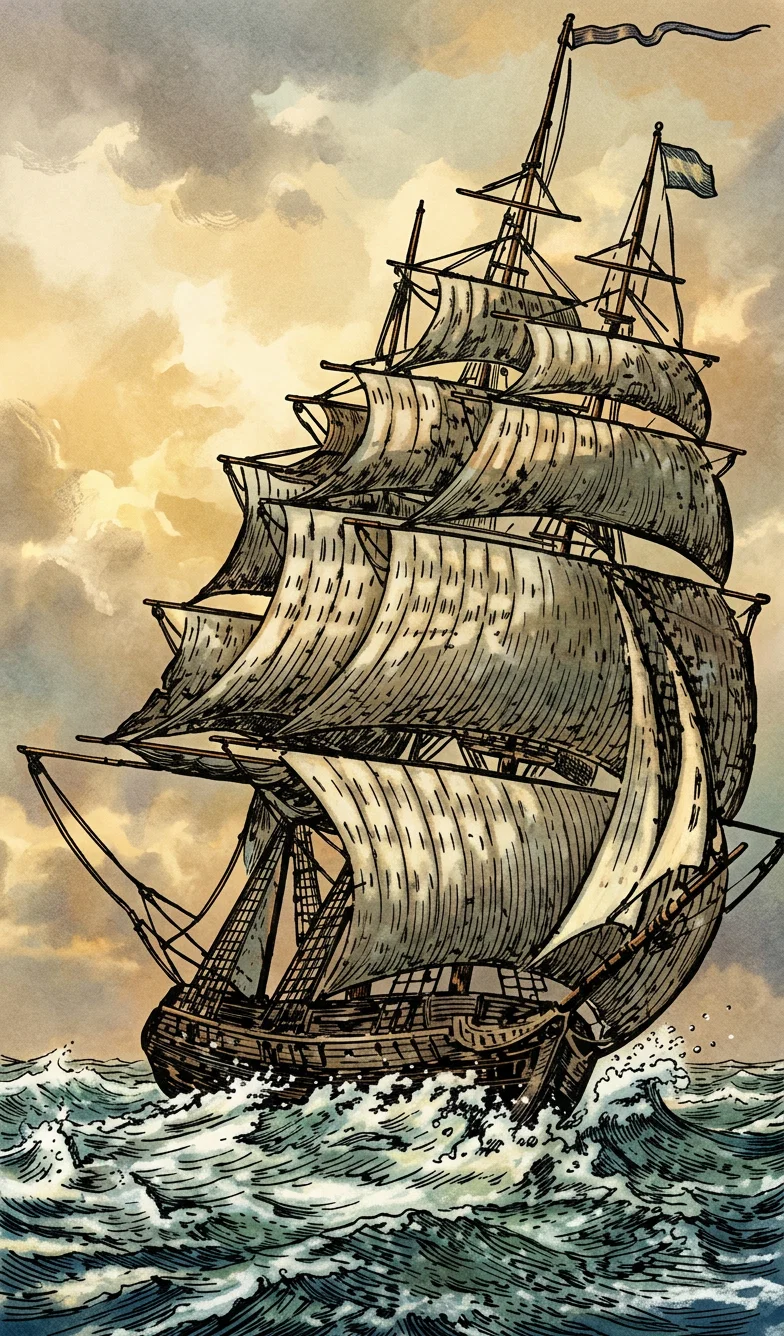
A drowning man saved—Night signals for immediate relief—British fleet of prison-ships in commotion—Another hole cut, and discovered—A letter from the eighteen escaped—Measures taken by the United States government to clothe their prisoners—Prisoners sent to Dartmoor—Cheering news of peace.
Restored with AI
On taking our stations at 10 P. M., it was whispered along our ranks that two men, not of our number, were waiting at the hole, insisting that they would go first or they would raise a cry and prevent any one from going. They had been drinking, and would not be reasoned with. It was finally settled to let them go. The first was put through very quietly, saying to his drinking companion, I will hold on to the ship's rudder-rings until you come. The second man, being not much of a swimmer, sank like a log, and rose up under the stage, splashing and struggling for life. Said the soldier to his next companion, Here's a porpoise. Put your bayonet into him, replied he. I will, said the first, if he comes up again. We were by this time all listening with almost breathless attention, fearing our chance for liberty was about gone. Up he came again. We heard the rush, and then the cry, Dont kill me! I'm a prisoner. Prisoner! prisoner! where did you come from? Out of a hole in the ship. The soldier cried, Here's a prisoner overboard! Prisoners are getting out of the ship! Prisoners are getting out of the ship! was the quick response of all the watchmen. All hands came rushing on the deck. In a few moments our vigilant commander came running from his bed, frantically enquiring, Where? and hearing the sound outside, he rushed down the accommodation ladder, crying out, How many have gone? One of the prisoners, who felt disposed to quicken our chief Captain's speed, put his face to the grating hole, and cried out, About forty, I guess.
In quick succession, the night signals of distress brought well-manned boats to pick them up. Where shall we pull? Here, there, all around. Do you find any? No sir, no sir.
Orders were now given to land a body of men, and surround Gelingham forest, where they supposed the “forty” must have escaped, explore it in the morning, and take them on board. We were much amused to see what full credit the commander gave to the prisoner's “guess.”
After making these arrangements, they got the drowning man on deck and demanded of him to state the facts; but he was so far gone with the large draughts of salt water which he had swallowed, somewhat mixed up with his rum, and the dreadful fear of being harpooned with a soldier's bayonet, that he failed to satisfy them, only that there was a hole in the ship, from which he passed out. One of the boats at length found it, pushed a long iron rod inside, and remained there until morning.
When we were permitted to come on deck in the morning, poor Johnson was lying, tied to a stake, floating in the water, near the beach. All that we could learn was, that the string of his bag was fast around his left wrist, below which, his hand was nearly cut off. Some of his friends knew that he had a sharp knife in the pocket of his pants, which was missing when found floating near the shore. Fastening his bag on his wrist instead of his neck, was doubtless a great hindrance to his getting away from the boats. In attempting to cut this string, we supposed he cut his wrist, and thus bled to death by the time he reached the shore.
We were kept on deck all day, without food, mustered by name, and strictly examined, to see if we answered to our original descriptions. When it was clearly ascertained that eighteen living men had escaped the night previous to the discovery of the hole, and the full number of prisoners still reported on board, the British officers were arrested for making a false report, but released again on our president's declaring how the affair was managed. See No. 10.
The following day, the king's carpenters, from Chatham, were sent on board with their tools and a heavy stick of timber to plug up the hole. While they were busy, cutting and pounding in our midst, some of the prisoners picked up a few of their loose tools and began, the opposite side of the ship, to cut out another hole, equally as good as the first, and finished it before the carpenters had closed up the other. The soldiers outside ascribed the noise to the king's carpenters.
That night, a number of us stationed ourselves at this hole to watch for an opportunity to escape, and remained there until about four o'clock in the morning. The copper being cut off in a great hurry, ragged and sharp points were left. To prevent these points from mangling our flesh, we fastened a wollen blanket to the lower side to slip out on. Besides the vigilant guard, a boat was pulling around the ship during the night, with one man in the center, sounding the side of the ship, under the lower stage, with a long iron rod. The rod continued to strike on each side of the hole during the night but failed to find the place they were punching for.
Before daylight, one of our number ventured to slip out, just after the boat passed, to ascertain whether the night was light, or dark enough to escape detection by swimming astern of the ship before the boat could get round. After pulling him in, he said the night was clear and he could see a great distance on the water. We therefore concluded to wait until the following night. By negligence of our committee, the blanket was left with the end floating86in the water. This was discovered by the boatmen soon after daylight. Here's another hole, on this side of the ship! and in came the iron rod, blasting all our hopes of escape from this quarter. To repair these damages, a portion of food was deducted from our daily allowance, and continued for some time.
Our boasting commander began to be sorely troubled for the safety of himself and family. It seemed almost certain that these audacious, daring Yankees would yet sink their prison-ships or gain their liberty. I was told that he declared he would sooner take charge of 6000 French prisoners than 600 Yankees.
After all their search for the eighteen who had escaped, a letter came from London, directed to the Commander of the Crown Prince's prison-ship, informing him of the happy escape of every one of them, and of their safe travel, seventy miles, to the city of London; and that it would be useless for him to trouble himself about them, for they were on the eve of sailing on a foreign voyage. They gave him to understand that they should remember his unkind treatment.
From this, the British government began to talk of sending us all to Dartmoor prison, a dreary waste, some fifteen miles inland from Old Plymouth harbor, where we should find some trouble in getting outside the massy stone walls and dungeons that were so strongly fortified.
In 1814 the American prisoners continued to pour in from Halifax, the West India Islands, and other parts of the world. Their state was miserable indeed for want of proper and decent clothing, especially the soldiers. It was distressing to see them in their tattered rags, many of them having their dirty woollen blanket wrapped around them to shield them from the cold storms. Statements were sent to the United States which at length aroused the government to take measures to provide their prisoners with suitable clothing.
Mr. Beasly, acting agent for the U. S. in London, was empowered to attend to this matter for his suffering countrymen. He sent a London Jew with his boxes of ready-made or basted clothing, and a stripling of a clerk to deal them out to us according to his judgment; so that some who were not needy got supplied with a whole suit, while others were turned away who were much in want. The prisoners remonstrated with Mr. B. by letter, but he justified his agent, and paid little or no attention to our grievances.
After remaining a prisoner over a year, the British government condescended to pay us our small pittance of wages, which enabled me to furnish myself with clothing and some extra food as long as it lasted. My father was favored with an opportunity to send to an agent in London to furnish me with means from time to time. The agent sent me twenty dollars, which were most gladly received. Soon after this the American prisoners were sent off to Dartmoor, and I heard no more from him.
It was in the summer of 1814, that we were sent in large drafts by sea to Plymouth, and from thence to Dartmoor. Soon we numbered, as we were told, 6000. The double stone walls, about fourteen feet high, broad enough for hundreds of soldiers to walk on guard, formed a half moon, with three separate yards containing seven massy stone buildings, capable of holding from fifteen to eighteen hundred men each. The center one was appropriated to the colored prisoners.
These buildings were located on the slope of a hill, fronting the east, affording us a prospect of the rising sun; but it was shut out from our view long before sunset. A large number of similar buildings lay above us, on the west, separated by heavy iron palings, occupied for barracks, store and dwelling-houses for our keepers, and a hospital. On these three sides, one of the most dreary wastes, studded with ledges of rocks and low shrubs, met our view, as far as the eye could reach. Surely it was rightly named Dartmoor.
The prisons were three story, with a flight of stone steps at each end, open in the center. There was one iron-grated port-hole on each gable end. We were guarded by a barrack of 600 soldiers, counted out in the morning and driven in at sunset. It was quite a sight when the sun shone, to see those who desired to keep themselves decent, seated in groups about the yard, clearing their blankets and beds from vermin. On hearing of a fresh arrival, the prisoners would crowd up to the gates and make a lane for all to pass through; and as they passed along, some of them would recognize their friends. Halloo! Sam. Where did you come from? Marblehead! Any more left? No, I was the last one. In this way all were recognized. It was often stated that nearly all the Marblehead sailors were prisoners.
During the winter, agent Beasley's men appeared again to supply us with clothing, which was done much more to our satisfaction.
Religious meetings were held in the colored prison about every Sunday, and some professed to be converted and were baptized in a small pool of water in the yard, supplied from a reservoir on the hill, which was generally used by the prisoners in washing their clothes.
December, 1814, brought us the cheering intelligence that a treaty of peace between the United States and Great Britain was signed by the Plenipotentiaries at Ghent, on the continent of Europe. Those who were never doomed to imprisonment in this dark and most dreary spot can appreciate nothing respecting our feelings. Yet we were held in suspense while a Frigate was dispatched across the ocean to obtain President Madison's signature. In February 1815 she returned with the treaty ratified. Shoutings of rapturous joy rang through our gloomy dungeons, such as most likely will never be heard there again. What! about to be liberated, go to our native country, and gather around the paternal fireside87once more! Yes, this hope was in us, and it seemed sometimes as though we were almost there.
It was supposed that there were about two hundred of us in Dartmoor who came there from the British Navy. This was a tacit acknowledgement on their part, of our impressment. Some of these had served them from twenty to thirty years. As we had not taken arms against them, we sent up a respectful petition to the British Parliament, asking a mitigation of our sufferings or an honorable release. This was strongly objected to by the noble lords, on the ground that they had trained us in their naval tactics, and if we were liberated before the close of the war, we would, as a matter of course, enter the United States Navy and teach them how we learned to fight. That, said they, will be putting sticks into their hands, wherewith to break our heads.