VOYAGE TO IRELAND—IMPRESSED INTO THE BRITISH SERVICE—ATTEMPT TO ESCAPE—IMPRISONMENT
By Joseph Bates
INCIDENTS OF MY YOUTH. No. 5.
VOYAGE TO IRELAND—IMPRESSED INTO THE BRITISH SERVICE—ATTEMPT TO ESCAPE—IMPRISONMENT.
Restored with AI
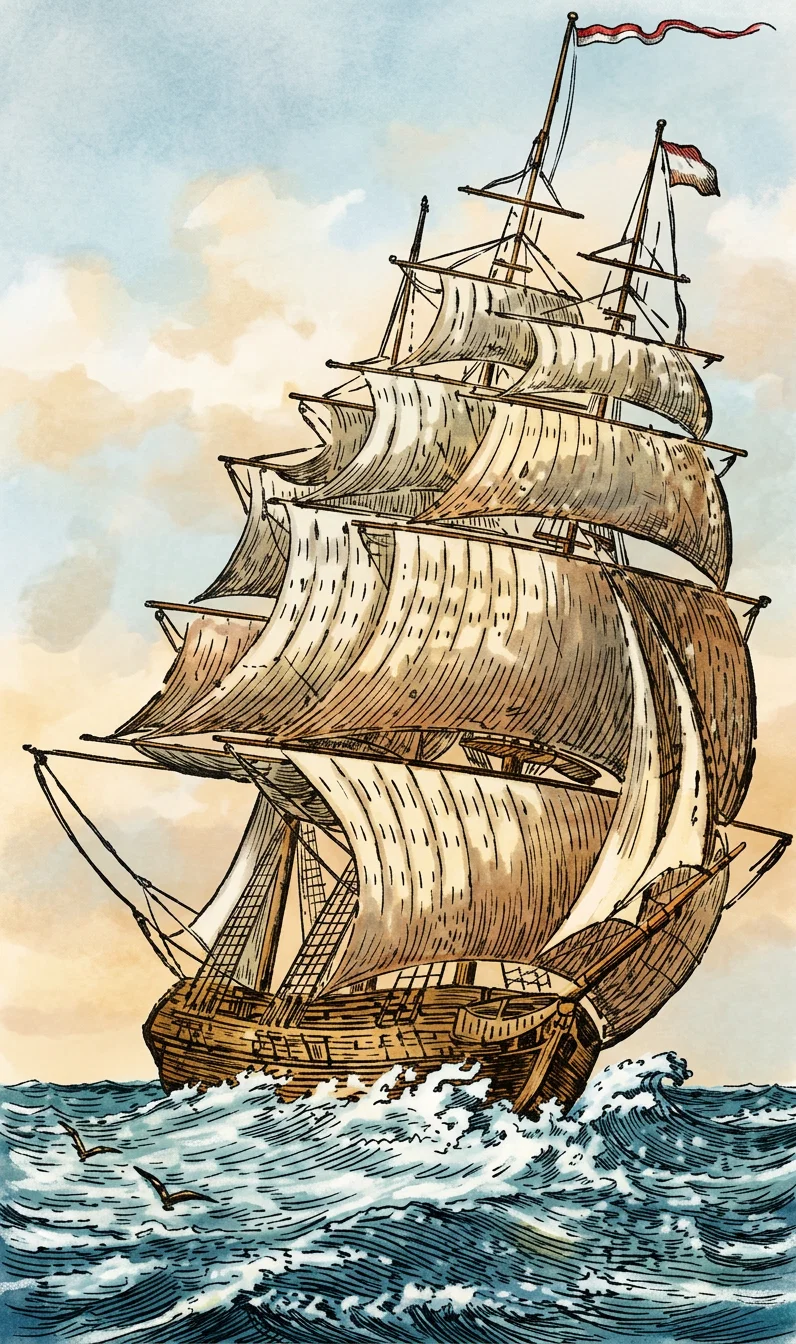
Our voyage from Prussia to Ireland was replete with trials and suffering. It was a Winter passage down the Baltic Sea, and through the winding passages of the Highlands of Scotland, under a cruel, drunken, parsimonious captain, who denied us enough of the most common food allowed to sailors. And when through his neglect to furnish such, we were in a famishing condition and almost exhausted with pumping to keep us from sinking, he would swear and threaten us with severer usage if we failed to comply with his wishes. Finally after putting into an Island and furnishing a fresh supply of provisions, we sailed again for Belfast, in Ireland, where the voyage ended. From thence two of us crossed the Irish Channel to Liverpool, to seek a voyage to America. A few days after our arrival “a press-gang” (an officer and twelve men) entered our boarding house in the evening and asked to what country we belonged. We produced our American protections which proved us to be citizens of the United States. Protections and arguments would not satisfy them. They seized and dragged us to the “rendezvous,” a place of close confinement. In the morning we were examined before a naval Lieutenant, and ordered to join the British Navy. To prevent our escape, four stout men seized us, and the Lieutenant with his drawn sword going before, we were conducted through the middle of one of the principal streets of Liverpool like condemned criminals ordered to the gallows. When we reached the river side, a boat well manned with men was in readiness, and conveyed us on board the Princess, of the Royal Navy. Here we were measured, and a minute description of our persons taken and then confined in the prison room on the lower deck, with about sixty others who claimed to be Americans, and impressed in like manner as ourselves. This eventful epoch occurred April 27th, 1810.
One feeling seemed to pervade the minds of all who claimed to be Americans; viz., that we were unlawfully seized, without any provocation on our part, hence any way by which we could regain our liberty would be justifiable. In a few days the greater portion of the officers and crew took one of their dead on shore to be buried. It was then suggested by some that this was a favorable time for us to break the iron bars and bolts in the porthole and make our escape by swimming in the strong current that was rushing by us. In breaking the bars we succeeded beyond our expectation, and when all ready to cast ourselves overboard, one after another, the boats came along side with the officers, and our open place was discovered. For this they began by taking one after another and whipping them on their naked backs in a most inhuman manner. This dreadful work was in progress for several hours, and closed about nine o’clock at night, intending to finish next day. But they did not have time to carry out their cruel work, for orders were given to tranship us all on board a Frigate near by, that was weighing her anchors to put to sea. In a few days we came to Plymouth, where we were re-examined, and all such as were pronounced in good condition for service in the British Navy were transferred to one of their largest sized stationary ships, called the “Saint Salvador Del Mondo.” On this monstrous floating castle were fifteen hundred persons in the same condition as myself.
Here, in conversation with a young man from Massachusetts, we agreed to try to make our escape if we perished in the attempt. We prepared us a rope and closely watched the soldiers and sailors on guard till they were being relieved from their posts at midnight. We then raised the “hanging port” about eighteen inches, and put the “tackle fall” in the hands of a friend in the secret, to lower it down when we were beyond the reach of the musket balls. Our rope and blanket, about thirty feet long, reached the water. Forbes, my companion, whispered, “Will you follow?” I replied, “Yes.” By the time he reached the water I was slipping down after him, when the alarm ran through the ship, “A man overboard.” Our friend dropt the “port” for fear of being detected, which left me exposed to the fire of the sentinels. But I was soon in the water, and swam to a hiding place under the “accommodation ladder” by the time the boats were manned, with lanterns, to hunt us out. We watched for an opportunity to take an opposite direction from our pursuers, who were repeatedly hailed from the ship to know if they had found any one. We had about three miles to swim with our clothes on except our jacket and shoes; these I had fastened on the back of my neck to screen me from a chance shot from the ship. An officer with men and lanterns descended the “accommodation ladder,” and sliding his hand over the “slat” he touched my hand, and immediately shouted, “Here is one of them! Come out of that, you sir! Here is another! Come out, you sir!” We swam round to them and were drawn upon the stage. “Who are you?” demanded the officer. “An American.” “How dare you undertake to swim away from the ship? Did you not know that you were liable to be shot?” I answered that I was not a subject of King George, and had done this to gain my liberty. “Bring them up here!” was the order from the ship. After another examination we were put into close confinement with a number of criminals awaiting their punishment.
DEAR YOUNG FRIENDS: I never fully realized the oppressive nature of bondage nor the value of freedom before. Since that time God in great mercy enabled me to see that I was in willing bondage to the most cruel tyrant that ever lived, and that there was but one way to escape his power, and that by believing on the name of the only begotten Son of God.—My prayer also is that no consideration may prevent you from fleeing from the murderous power of the Devil. [John viii, 44.] and by faith laying hold of the Son of the living God for freedom. “For if the Son makes you free, then are you free indeed.”