INCIDENTS IN MY PAST LIFE.—No. 23.
BY ELD. JOSEPH BATES.
WHILE at Ensenado our communications for business with Buenos Ayres required us to cross the Pampas, or vast prairies lying on the south of that province. To do this, and also protect ourselves from highway robbers, we united in bands and armed ourselves for defense. Our way was first about twenty miles across the prairie, and then twenty miles further over the “loomas,” or high lands, to the city. Once out on this vast prairie without a guide, is next to being on the vast ocean without a compass. Not a tree, nor a shrub, nor anything but reeds and tall wild grass to be seen as far as the eye can extend. About the only thing to attract attention and relieve the mind while passing through the deep and dangerous muddy reed bogs,—and still miry marshes, fording creeks and running streams,—was occasionally flocks of sheep, herds of swine, horned cattle, and horses, all quietly feeding in their own organized order. On the two last mentioned might be seen large and small birds quietly perching on their backs, having no other resting place. Mounted on our hired, half-wild horses, stationing our well-paid postillion ahead, we thus passed over this twenty-mile prairie rank and file, following in the cattle’s miry mud tracks, part of the time our arms around the horses’ necks, fearing lest we should be thrown into a mud-hole among the reeds, or left to swim in the stream.
After some four hours’ journeying the “loomas” would appear ahead, then a farm house, and then the half-way home, or tavern for dinner, and change of horses. Soon a herd of one hundred or more horses were driven out from the prairies into a “carrall,” or yard, and set going with full speed around the yard, while the men with their lassos, or long hide ropes with a noose at the end, in a most dextrous manner would throw their noose over their heads and bring them up to the post, then, wild or not, they were held until the rider mounted, when they would start rank and file again after the postillion, and soon follow the leading horse without turning, as they had learned to go with the herds on the prairie. The same order is observed on returning back to Ensenado. During our stay here the numerous arrivals from the United States overstocked the market, and opened the way for me to purchase a cargo for the Pacific on reasonable terms. The Chatsworth was now loaded and cleared for Lima, in Peru.
As I had resolved on my previous voyage never more to use ardent spirits only for medicinal purposes, so now on leaving Buenos Ayres, I also resolved that I would never drink another glass of wine. In this work of reform I found myself entirely alone, and exposed to the jeering remarks of those with whom I afterwards became associated, especially when I declined drinking with them. Yet after all their comments, that it was not improper or dangerous to drink moderately, &c., they were constrained to admit that my course was perfectly safe!
Passing from the northern into the southern hemisphere, one is struck with the remarkable change in the starry heavens. Before reaching the equator the well-known north star is apparently setting in the northern horizon, and a great portion of the well-known stars in the northern hemisphere are receding from the mariner’s view. But this loss is supplied by the splendid, new and varied scenery in the southern heavens as he sails onward towards the southern polar regions. Here away in the south-western heavens, in the track of the milky way, every star-light night can be seenp. 82 two small stationary white clouds, called by sailors the “Magallamic clouds.” Ferguson says, “By the aid of the telescope they appear to be a mixture of small clouds and stars.” But the most remarkable of all the cloudy stars he says, “is that in the middle of Orion’s sword, where seven stars (three of which are very close together) seem to shine through a cloud. It looks like a gap in the sky, through which one may see as it were a part of a much brighter region. Although most of these spaces are but a few minutes of a degree in breadth, yet since they are among the fixed stars they must be spaces larger than what is occupied by our solar system; and in which there seems to be a perpetual, uninterrupted day among numberless worlds which no human art ever can discover.”
This gap or place in the sky is undoubtedly the same that is spoken of in the Scriptures. See John i, 51; Rev. xix, 11. The center of this constellation (Orion) is midway between the poles of heaven, and directly over the equator of the earth, and comes to the meridian about the twenty-third of January, at 9 o’clock in the evening. Inspiration testifies that “the worlds were framed by the word of God.” Heb. xi, 3. “He hangeth the earth upon nothing.” “By his Spirit he hath garnished the heavens.” Job xxvi, 7, 13.
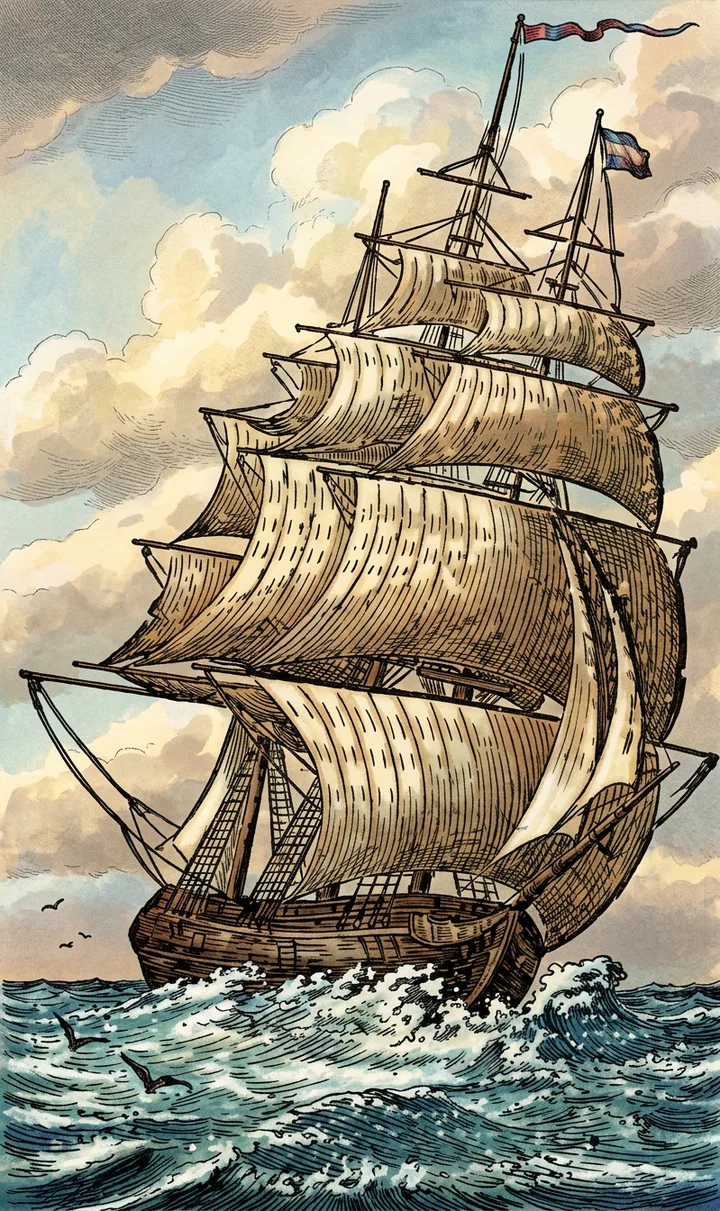
On our passage from Buenos Ayres towards Cape Horn, we arrived in the vicinity of Falkland Islands between three and four hundred miles north-east of the Cape. Here we endeavored to make a harbor during a storm by beating up into Falkland Sound, but the increasing gale obliged us to bear up and continue our southern course. On arriving off Cape Horn, about July and August, the coldest and most stormy season of the year, for about thirty days we were contending with prevailing westerly gales, and floating islands of ice from the polar regions, trying (as sailors say) to double Cape Horn. While lying to under a balanced reefed try-sail off the Cape in a heavy westerly gale, a heavy cross sea boarded us on our larboard side which stove in our bulwarks and stantions, and ripped up the plankshire, and washed them up against the mast from near the windlass to the cabin gangway. In this exposed and perilous condition, liable to be filled with water and sink immediately, we set the close-reefed main top-sail and put the vessel before the wind; and to keep her still more steady we packed on also a reefed fore-sail which increased her speed so furiously that it prevented her from rolling the open space under water only occasionally. Fortunately we had a new main-hatch tarpaulin at hand. With strips of this all hands were now engaged as opportunity offered to get it over the open spaces, and drive a nail to secure it, and rush back to our holding-on places until the ship rolled again to leeward. In about two hours we secured in this way, temporally, the open space—took in our main top-sail and fore-sail, and hove to again on the same tack under a balanced reefed try-sail or strain-sail. Then after pumping out the water and clearing away the wreck we had time to reflect on our narrow escape from utter destruction, and how God in kindness had opened the way for us to save ourselves in this trying hour. After the gale abated next day, we repaired damages more thoroughly, and at the expiration of some thirty days’ struggling off Cape Horn against westerly gales and driving snow-storms, we were enabled to double the Cape and shape our course for the island of Juan Fernandez, some fourteen hundred miles north of us. The westerly winds were now in our favor, so that in a few days we changed our climate and were passing along in sight of this far-famed island, once the whole world to Robinson Crusoe. After sailing north some twenty-six hundred miles from the stormy Cape, the towering mountains of Peru could be distinctly seen, though some eighty miles distant from the coast. Passing onward we cast our anchor in the spacious bay of Callao, about six miles west of the celebrated city of Lima. North American produce was in good demand. Some of my first sales of flour were over thirty dollars per barrel. A few cargoes arriving soon after us, reduced the price to thirty dollars. Here I chartered the Chatsworth to a Spanish merchant for a voyage to Pisco, some one hundred miles further south, with the privilege of disposing of my cargo and returning with his.
Soon after our arrival here, the chief mate and two of the men went up to the village (about three miles from the harbor) to procure beef and vegetables for dinner. The men soon returned with the statement that the patriot soldiers had descended from the mountains, and besieged the village, and pillaged the store where some of our cargo was exposed for sale, and had driven the mate out on one side of the village to shoot him, and also declared that they were coming down to take our vessel and dispose of me because of the Spanish merchant we had brought there from Lima. The mate soon appeared on the beach. After the boat brought him on board he said that the soldiers on learning that he was the mate of the Chatsworth, drove him on one side of the village to shoot him. On arriving at the place one of the soldiers persuaded the others not to kill him. They then concluded to let him go, but beat him most unmercifully with their swords. We made preparations to defend ourselves, but our enemies thought best not to expose themselves within reach of our cannon balls. Notwithstanding our opposing foes who continued to threaten us, we disposed of all our cargo here at better prices than was offered at Callao, and returned to Callao with the Spanish merchant’s cargo.
While at Callao a whale made his appearance in the bay. A Nantucket whale-ship there at the time followed him with her boats and harpooned him. The whale rushed in among the shipping with the boat in tow like a streak through the foaming water, and dashed down directly under the bottom ofp. 83 a large English brig, giving her pursuers but a moment’s warning to chop off their line and save their lives—something like leaving her compliments with her unknown foes, saying, “If you follow me here you will never harpoon another poor whale.” The whale rushed through the fleet of shipping to the head of the bay in shoal water. The boat followed and fastened to her again, when she came streaming out of the bay, and in a little while we could but just discern the boat as the sun was setting, in the offing, with her waif flying, signifying the whale was dead.
Battle Creek, Oct., 1860.