BY ELD. JOSEPH BATES.
Banks of Newfoundland—Perils of the ocean—Threatened mutiny—Islands of ice—Mutiny on the high seas—Speak an American ship—Joyful news, land in sight—A prize taken—Safe arrival at New London, Ct.,—Sail again for Boston.
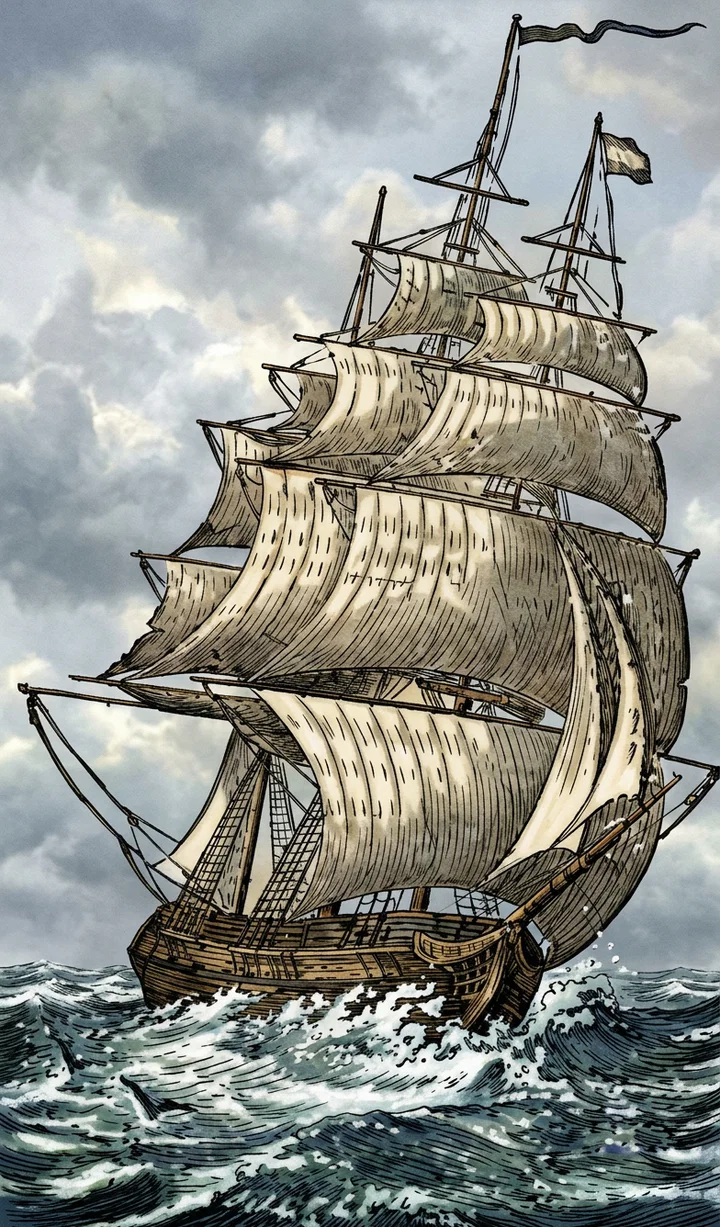
As we approached the eastern edge of the banks of Newfoundland, about two-thirds of the distance across the Atlantic Ocean, I found we were in the place where I was shipwrecked by the ice several years before as shown in No. 2. As this perilous place became the topic of conversation, we learned that a number among us had experienced like difficulties in passing over these banks in the spring season of the year. Capt. Carr said he had made fifteen voyages to Newfoundland and never had seen any ice, and he did not believe there was any in our way. In the P. M. we saw a large patch of sheet-ice. We asked the Captain what he called that? He acknowledged that it was ice. As the night set in the wind increased to a gale from the east. Captain Carr, unmindful of all that had been said to him respecting the danger of ice in our track, still kept the ship scudding before the gale under a close-reefed maintop-sail and foresails, determined to have his own way rather than lay by until morning, as suggested by some of the prisoners. Some thirty of us, unwilling to trust to the captain’s judgment, took our position on the bow and bowsprit of the ship to look out for ice. At midnight the ship was driving furiously before the gale and storm, evidently without any hope of our having time to avoid ice if we should see it; and in danger of being dashed in pieces without a moment’s warning. We also felt a marked change in the air. In this dilemma we decided to take the ship from the captain and heave her to. We found him on the quarter deck conning the ship. We briefly stated our dangerous position and told him that about three hundred souls were at the mercy of his will; and now, if he did not round his ship to, we would do it for him. Seeing our determination to act in this matter immediately, he cried out to his crew, “Round in the larboard main brace! Put the helm a-starboard!” This laid the main-topsail to the mast, and let the ship come by the wind.
This being done, the onward progress of the ship was stayed until the dawn of the morning, which showed us how narrowly we had escaped with our lives. Large islands of ice lay right in our track, and if we had continued to run before the gale wep. 14 should have been in the midst of them, in instant danger of being dashed in pieces. The willfulness of Capt. Carr was now evident to all, and the course we pursued in requiring him to heave the ship to until daylight was also justifiable. And after the ship was again turned on her onward course and passing these huge islands of ice, we were all stirred to watch until we had passed the banks and were again safe in the fathomless ocean. These bodies of ice had the appearance of large cities in the distance, and had it not been for our forethought would in all probability have been the cause of our immediate destruction.
Moreover a large majority of us were satisfied that this was the best time to take the ship from the captain and proceed to New York or Boston, from whence we could more readily reach our homes. For we had decided, and declared, as before stated to Capt. Carr, that his ship should never take us to City Point, Va., where his charter party required him to land us. Having passed beyond all danger from ice, the most difficult point with us to decide was, which of the two ports we should steer for, if we took the ship. Suddenly, and unexpectedly, one of our company placed himself amid-ships upon the main hatchway, and with a stentorian voice cried out, “All you that are for New York go on the starboard side of the ship, and all that are for Boston go on the larboard side!” Sides were immediately taken, when it was declared that the greatest number were on the starboard side; hence the ship was for New York. Capt. Carr stood in our midst near by the man at the wheel, gazing at this unlooked for and strange movement, when suddenly one of our number took the wheel from the helmsman. Capt. Carr demanded that he should leave it immediately, and ordered his man to take the helm again. A number of us also urged Capt. Carr’s sailor to take the helm and we would protect him. At this Capt. C. became very much enraged, saying what he would do with us if he had a crew able to cope with us. But he saw that resistance was vain; we had taken possession of the helm, the ship therefore would no longer be steered by his direction. Seeing what was done he called us a “rabble,” “roughally,” &c., for taking his ship from him on the high seas, and wished to know what we were going to do with her, and who was to be the captain? Captain Conner of Philadelphia was lifted up by those who stood near him, and placed with his feet on the head of the capstan, (a cylinder four feet high, with levers to weigh the anchors, &c.) “There is our captain!” cried the multitude. Said Capt. Carr, “Are you going to take charge of my ship, Capt. Conner?” “No sir,” was the reply. “Yes you shall!” was the unanimous cry. “I don’t want anything to do with her,” said Capt. Conner. “You shall,” was the loud cry, “or we will throw you overboard!” “You hear what they say Capt. Carr. What shall I do?” “Take her, take her, Capt. Conner,” said the English commander This being settled, Capt. Carr began to call us hard names again. Some that stood near him advised him to cease and get down into his cabin as soon as possible out of the way of danger. He did so, and order was soon restored. Capt. Conner took charge of the ship and named three officers for mates. A number of us volunteered as sailors to man the ship, and we were divided into three watches, that every advantage might be taken to urge our ship onward for the port of New York, under all the sail she could bear.
Capt. Carr and crew had their liberty and were treated kindly, but not allowed to interfere with the sailing of the ship. He declared that if the vessel ever arrived in the States he would have us all arraigned before the United States court for taking his ship from him on the high seas. The idea of being deprived of our liberty and arraigned before our country for trial in this case, on our arrival, troubled us some, nevertheless we were resolved to keep charge until we arrived.
A ship was seen bearing down toward us with American colors flying. We hoisted English colors. It was a rare sight to see one of our own country’s ships with the stripes and stars floating at her peak. As she came riding triumphantly within speaking distance by our side, the cry was given, “What ship is that?” “Where are you from?” and “where bound to?” Answer. “From the United States, bound to Europe.” “What ship is that?” &c. Answer. “The Mary Ann of London, a cartel with American prisoners from Dartmoor, England, bound to the United States.” A few more inquiries, and as each ship filed away for their onward voyage, we gave them three loud cheers, so glad were we to see the face of some one from our native country afloat on the wide ocean.
About ten days after the revolution, or time we took the ship, we saw the land looming in the distance before us. As we drew near the coast we learned to our great joy that it was Block Island, R. I., about forty miles from our home. Sail boats were now pushing out from the land to get the first chance for piloting us in. Some of our number thought this would be a rare chance for them to go on shore in their boats, and so got up their hammocks and bags, waiting to jump aboard when they should come along. A heavy squall was now rising out of the north-west, so the topsails were clewed down, and many hands were on the yards reefing them. As the boats came sheering up to our side, the men on the topsail yards cried out, “Don’t you come here! for we have got the plague on board!” The men that were in waiting for them declared that we had nothing of the kind, and bid them come along side. A multitude of voices from the topsail yards was again saying, “Yes we have got the plague on board too! Don’t you come here!” The boats immediately hauled their wind, and steered for the land. Nothing that we hadp. 15 would induce one of them to come on board, for they knew that a bare report of their doing so would subject them to a tedious quarantine. The plague we had on board was this: we were expecting that Capt. Carr would (as he had threatened) have us arraigned before the United States Circuit Court for piracy on the high seas. Therefore we were unwilling to part with them until we learned more about the matter.
The wind died away during the night, and the next morning we perceived that a heavy swell and current was setting us in between the east end of Long Island and Block Island into Long Island Sound. We now concluded if we could get a pilot we would pass up the sound to N. Y. From some one of the many fishing smacks in sight we hoped to find one. At length one of the smacks was induced to come along side. In less than five minutes she was taken possession of, while the captain and crew retreated away to the stern in amazement at the strange work that was going on. We judged that nearly one hundred of our company began throwing their bags and hammocks on board of her, and themselves after them in quick succession. They then cast off from the ship, gave us three cheers, and bore away for Newport, R. I. before we could learn their object. They had no idea of being brought to trial for piracy by Capt. Carr.
As the wind was now unfavorable to proceed to New York, we concluded to go to New London, Ct., at which port we arrived the next A. M., and anchored off the wharf before the town, six weeks from Plymouth in England. A great number of us now crowded aloft for the purpose of furling all the sails at the same time. We then stood on our feet on the yards, and gave three cheers to the gazing multitude on the wharfs in New London. In a few moments more, boat loads of our joyous company, with their bags and hammocks were crowding for the shore, leaving their captured ship and Capt. Carr to find his way from thence for his load of tobacco at City Point, Va., as best he could, or even to find us the next twenty-four hours, if he still felt disposed to prosecute us for our so-called piratical proceedings on the ocean. Doubtless he was so wonderfully relieved at the departure of such a rebellious crew that he had no particular desire to come in collision with them again.
The good people on the land seemed about as glad to see and welcome us on shore as Capt. Carr was to get rid of us. But neither party were half as glad as we were. It seemed almost too much to believe that we were actually on our own native soil once more as freemen, free from British war-ships and their gloomy, dismal prisons. After our joyful feelings in a measure subsided, we were inquiring our ways home. Within twenty-four hours a great portion of our company took passage in a packet for New York city. Four of us by fair promises, without money, chartered a fishing smack at ten dollars per head to carry twenty-two of us around Cape Cod into Boston, Mass. This placed us beyond the reach of Capt. Carr, or ever hearing from him again.
Otsego, Mich.