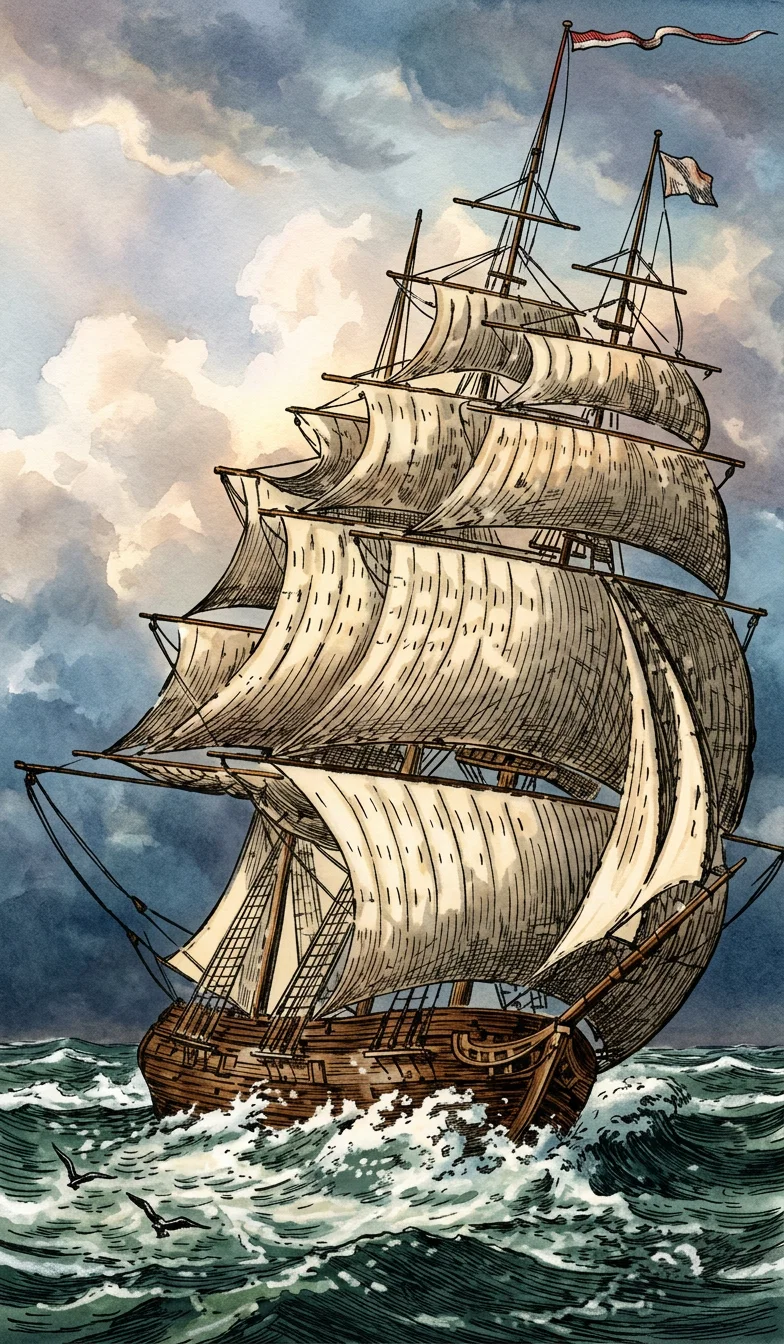
The Criterion in distress—Wrecked in a snow storm—Visit to Baltimore—On board the C. again—Cargo saved—Another voyage—Hurricane—Voyage ended—Married—Another voyage—Captain reefing topsails in his sleep.
Restored with AI
By keeping away from the hot fire until the frost came out of my body, I was the only one that escaped from frozen limbs and protracted sickness. Many years after this I fell in with “Tom,” in South America. He told me how much he had, and was still suffering, since that perilous night. Capt. Merica and his companion (for this was the name of our kind friends), provided us with a warm meal, and very kindly welcomed us to their home and table. After sunrise, by the aid of a spy-glass, we saw the Criterion was afloat, drifting in the ice down the bay towards us, showing a signal of distress, (colors flying half mast.) It was not possible however for any human being to approach them while they were in the floating ice. We expected they were in a sinking condition, as she was cut through with the ice before we were separated from her. As the Criterion passed within four miles of the shore where we were, we could see the captain and pilot pacing the deck, watching to see what would be their destiny. We hoisted a signal on the cliff, but they appeared not to notice it. We saw that the Criterion was careened over to starboard, which kept the holes made by the ice on her larboard side out of the water. Before night the Criterion passed us again, drifting up the bay with the flood tide, and so continued to drift about for two days, until in a violent north-east snow storm she was driven to her final destination and burying-place.
When the storm abated, with the aid of a spy-glass, we saw the Criterion lying on Lone Point, on the east side of the Chesapeake bay, distant about twelve miles. As there was no communication with the sufferers only by the way of Baltimore, and thence around the head of the bay, across the Susquehanna, I decided to proceed to Baltimore and inform the consignees and shippers of her situation. Capt. Merica said it was about thirty miles distant, and a good part of the way through the woods, and bad roads, especially then, as the snow was about one foot deep. Said he, if you decide to go I will lend you my horse; said his companion, I will lend you a dollar for your expenses. After a fatiguing journey from morning until about nine in the evening I reached Baltimore. The consignees furnished me with money to pay our board on shore as long as we were obliged to stay, and orders to merchants in Annapolis for cables and anchors if we needed them to get the Criterion afloat again.
Some two weeks from the time we were separated from the Criterion the weather moderated and became more mild, and the drifting ice much broken. Capt. Merica with some of his slaves, assisted us to cut our boat out of the ice and repair her. With our crew somewhat recovered, and two stout slaves of Capt. M.’s, we run our boat on the ice until we broke through into deep water, and climbed into her. Then with our oars and borrowed sail we steered through the broken ice towards the Criterion. As we drew near her we saw that she was heeled in towards the shore, and a strong current was hurrying us past her into a dangerous place, unless we could get hold of a rope to hold us. We hailed, but no one answered. I said to the men, “Shout loud enough to be heard!” The two slaves, fearing we were in danger of being fastened in the ice, set up such a hideous noise that the cook showed his head at the upper, or weather side, and disappeared immediately. We caught a hanging rope as we were passing her bow, which held us safely. The captain and pilot, in consternation, came rushing towards us, as I leaped on the deck of the Criterion to meet them. “Why,” said Capt. Coffin, as we grasped each other’s hand, “where did you come from, Mr. Bates?” “From the western shore of Maryland,” I replied. “Why,” said he, “I expected all of you were at the bottom of the Chesapeake bay! I buried you that night you passed out of our sight; not supposing it possible for you to live through the night.”
The Criterion had parted her cables and lost her anchors in the violent storm that drove her to the shore. Her cargo was yet undamaged. The captain and pilot consented for me to take part of the crew and return back and procure cables and anchors from the city of Annapolis, which we accomplished, but were prevented from returning for several days on account of another driving storm, in which the Criterion bilged and filled with water, and those on board abandoned her in time to save their lives.
During the winter, with a gang of hired slaves, (our men were on the sick list), we saved nearly all the cargo in a damaged state. The men that were chosen to survey the Criterion, judged there was one hundred and seventy tons of ice on her hull and rigging, caused by the rushing of the sea over her and freezing solid. After stripping her in the spring, she was sold for twenty dollars!
I returned to Baltimore and commenced another voyage as chief mate of the brig Frances F. Johnson, of Baltimore, for South America. Our crew were all black men, the captain’s peculiar choice. I often regretted that we two were the only white30men on board, for we were sometimes placed in peculiar circumstances in consequence of being the minority.
With the exception of some dry goods we disposed of our cargo in Maranham and Para. The last mentioned place lies about one hundred miles up from the mouth of the river Amazon, the mouth of the river being on the equator. Here we took in a return cargo for Baltimore. On our homeward voyage we stopped at the French island of Martinico. After taking our place among the shipping near the shore, and remaining a few days, the captain and myself were unexpectedly ordered on board by the commodore, who reprimanded us because we had failed to comply with a trifling point in his orders, for which he ordered us to leave the place in the morning. We considered this ungenerous and severe, and without precedent; but we obeyed, and had but scarcely cleared ourselves from the island when a dreadful hurricane commenced (which is common in the West Indies about the autumnal equinox) which caused such devastation among the shipping and seamen that about one hundred vessels in a few hours were dashed in pieces and sunk with their crews at their moorings, and some driven to sea in a helpless condition, leaving but two vessels saved in the harbor in the morning!
It was with much difficulty we cleared ourselves from the island during the day, because of the sudden changing of the wind from almost every quarter of the compass. We were pretty well satisfied that a violent storm was at hand, and made what preparation we deemed necessary to meet it. We fortunately escaped from the most violent part of it, with but little damage, and arrived safe at St. Domingo. A sloop from New York city came in a few days after us, the captain of which stated what I have already related respecting the storm and disaster at Martinico. Said he, “We arrived off the harbor of Martinico at the commencement of the hurricane, and as we were driven at the mercy of the storm, in the darkness of the night, while we were endeavoring to hold ourselves to the deck around our boat which was lying bottom upwards, strongly lashed to ring-bolts in the deck, she was taken by the violence of the wind from our midst, and not one of us knew when, or how, or where she had gone.” The miracle with them was that they survived the storm. But still more wonderful with us that we, while attending to our lawful business, should in such an unexpected and unprecedented manner be driven from the place where none but the Omniscient eye of Jehovah, could tell of the terrible destruction that in a few hours was to come upon those we left behind. Surely, through his saving mercy, and providential care we were hurried out of that harbor just in time to be left still numbered among the living.
“God moves in a mysterious way,
His wonders to perform.”
Capt. Sylvester here gave me the command of the F. F. Johnson to proceed to Baltimore with the homeward cargo, while he remained in St. Domingo to dispose of the balance of the outward cargo. At the time of sailing I was sick, and fearing my disease was the yellow fever, I had my bed brought upon the quarter deck, and remained exposed to the open day and night air, and soon recovered my health. We arrived safely in Baltimore the beginning of Jan. 1818. From thence I returned to my father’s in Fairhaven, Mass., having been absent some two years and a half. Feb. 15, 1818, I was united in marriage to Miss Prudence M., daughter of Capt. Obed Nye, my present wife.
Six weeks subsequent to this I sailed on another voyage, chief mate of the ship Frances Hitch, of New Bedford. We proceeded to Baltimore, Md., where we loaded with tobacco for Bremen, in Europe. From thence we proceeded to Gottenberg in Sweden, where we loaded again with bar iron for New Bedford, Mass.
I will here relate an incident which occurred on our passage from Bremen to Gottenberg, to show how persons are wrought upon sometimes in their sleep. We were passing what is called “the Scaw,” up the Cattegat, not a very safe place in a gale, in company with a large convoy of British merchantmen bound into the Baltic sea. Capt. H., unusual for him, remained on deck until midnight, at which time the larboard watch was called. The night was uncommonly light, pleasant and clear, with a good, wholesale flowing breeze,—all the convoy sailing onward in regular order. Capt. H. requested me to follow a certain large ship, and be particular to keep about so far astern of her, and if we saw her in difficulty we could alter our course in time to avoid the same. Before my four hours’ watch was out, captain H. came up to the gangway, saying, “Mr. Bates, what are you about, carrying sail in this way? Clew down the topsails and reef them! Where is that ship?” “Yonder,” said I, “about the distance she was when you went down below!” I saw his eyes were wide open, but still I could not believe he was in his right mind in addressing me in the peremptory manner he did. Said I, “Capt. Hitch, you are asleep!” “Asleep!” said he! “I never was wider awake in my life! Clew the topsails down and reef them!” I felt provoked at this unusual arbitrary treatment without the least cause, and cried out at the top of my voice, “Forward there! Call all hands to reef the topsails!” This waked up the captain, inquiring, “What’s the matter?” Said I, “You have been giving orders to reef the topsails!” “Have I?” “I did not know it. Stop them from doing so, and I will go down again out of the way.”
As Capt. H. was part owner of the ship, with the prospect of making a few thousand dollars with a cargo of iron, he loaded the ship very deep, but did not seem to apprehend any particular danger until we encountered a snow-storm as we entered the North Sea, which determined us to go “north about,” and brought us in the vicinity of “Rockal” in a violent storm in the night, [see No. 15] which aroused our feelings and caused deep anxiety until we were satisfied we were passed all danger from it.