My wife was visiting one of our relatives a few miles distant from home, where a Methodist minister called in to visit the family. He asked why she appeared so sober? He was told that the ship her husband sailed in was out of time, and much fear was entertained for her safety, and particularly at that time as there was a violent raging storm. Said the minister, “I want to pray for that ship’s company.” His prayer was so fervent and made so deep an impression on my wife that she noted down the time. When the ship came home, her log-book was examined which proved it was the same storm.
Somewhere about midnight as the wind had veered round to the north and west, and the furious sea from that quarter had become very dangerous, and was continuing to subdue and overpower the one that had been so dangerous from the S. E., we deemed it for our safety to still bear away and head the ship on to the S. E. sea, and give her the whole of her reefed foresail to drive her from the irregular furious cross sea, that was raging from the west. Thus for four days, by the furious hurricane we were driven onwards to save ourselves from what we considered a more dangerous position than laying too under bare poles, exposing the ship to the irregular cross seas that might render her unmanageable and wrench her in pieces. First steering N. W. before a most violent S. E. gale, and in a moment of time our sails all aback with46the gale from the N. W., then in a few moments a dead calm for about fifteen minutes rendering the ship unmanageable; and then a raging hurricane from the W. S. W., veering in four days round by the N. to the E., our course being N. E. between the seas; then E. and S. E., south and S. W. In this manner in four days we run three-quarters of the way round the compass, some hundreds of miles further from home, than we were at the height of the storm. This was the most peculiar and trying storm in all my experience; neither have I read of the like in its nature and duration. The marvel with us was that our good old ship had weathered this most trying time. Her leak however had increased to twelve thousand strokes of the pump in twenty-four hours.
Again we unanimously decided and launched another twenty tons of our iron cargo into the sea. We endeavored to steer in for a southern port, but the westerly winds continued to check our progress westward. Winter had now fairly commenced and our provisions and water were getting so low that we were about to reduce our allowance, while our constant labor at the pumps was also reducing our strength. We saw vessels occasionally, but at too great a distance to approach them. We made an extra effort and sailed for one until night-fall, and then to induce her to approach us we rigged a spar over our stern, on which we fastened a barrel with tar and fired it to make them believe we were on fire and come to our relief, but to no purpose.
Soon after this when things began to look more dubious, just at the close of a gale of wind about midnight, we saw a vessel directly ahead steering toward us. She soon answered our signal by hoisting her “lanthorn,” and soon we met within speaking distance. “Where are you from?” “New York,” was the reply. “Where are you bound?” “South America.” “Can you spare us some provisions?” “Yes as much as you want; I am loaded with them.” “Lay by us and we will send our boat.” “Very well.”
Capt. Hitch’s heart began to fail him as we began to clear away our small boat. Said he, “The swell is so high the boat will be swamped and I dare not have you go, Mr. Bates. To lose some of the crew now would be very discouraging, and how could the ship be saved in her leaky, sinking condition.” “But, Capt. Hitch, we are in want of provisions and can now get a supply.” He still declared himself unwilling to command any one to attempt it. Said I, “Allow me then to call for volunteers.” He continued irresolute. Fearing we should miss this opportunity, I enquired, “Who among you will volunteer to go with me in the boat?” “I will go for one sir.” “I will go;” “and I will go,” said another. “That will do,” said I, “three is enough.” In a few moments we were almost out of sight of our ship steering for the signal light. One sea boarded us and about half filled the boat. With one hand bailing out the water and the other two at the oars we reached the brig. On account of the rough sea we could carry but a few barrels of bread and flour. I gave the captain a draft on our owners in New Bedford. “Your name is Bates,” said he, “are you related to Doct. Bates of Barre, Mass?” “He is my brother.” “Well I am his near neighbor; I left there a few weeks ago: Don’t you want some more?” “No sir. Only if you will fill away now and tow us up to the windward of our ship we will be much obliged.” This done we reached the ship in safety, and soon had our supply of bread and flour safely landed on deck.
Our boat was stowed away and each vessel filled away on their course. Capt. H. was almost overjoyed at our safe return and supply of provisions to carry us into port. The westerly winds however, prevailed, and our ship’s bottom had become so foul with grass and barnacles that she moved very slowly. We prepared a scraper with which we were enabled in a calm to scrape some of it off. Bushels of barnacles as large as thimbles, and green grass two feet long would rise under our stern as we hauled the scraper under her bottom, all of which had accumulated during our passage. Again we met with a vessel from the West Indies which supplied us with three casks of water; after which a ship from Portland supplied us with potatoes from her cargo. These were very acceptable not only for a change of diet, but also to check the scurvy which is common with those seamen who are obliged to subsist on salted provisions. In a few weeks we obtained another short supply, and were animated with the hope of reaching some port on the coast in a few days. But our buoyant hopes would sink again with the increasing westerly gales, and we would wish that we had taken a larger supply of provisions. Thus we continued to toil on, gaining sometimes a considerable distance westward, and then in one gale lose almost as much distance as we gained in a week before.
Three times after this we obtained a supply of what could be spared from different vessels we met with, making in all seven different times. And it had become a common saying with us that the very time we needed relief, it came. Wicked as we still were we could but acknowledge the hand of a merciful God in it all. Finally we began to despair, contending with the almost continual westerly winds in our disabled condition, and called all hands in “council” to determine whether in our perilous position to preserve our lives, we should change the voyage and run for a port in distress. It was decided unanimously that we bear up for the West Indies. After running about two days south, the wind headed us from that quarter. As the ship was now heading westward, Capt. H. concluded he could reach a southern port in the United States. But the wind changed again which cut off this prospect. Capt. H. now regretted that he had taken it upon him to deviate from the decision of the council, and wished me to call another and see if it would be decided for us to bear up again for the West Indies. The whole crew expressed themselves in favor of adhering to our previous decision to steer for the West Indies, but what was the use in deciding? Capt. H. would turn back again as soon as the wind came fair to steer westward. I stated if he did I should oppose him and insist on abiding by the decision we then made in council. It was a unanimous vote to bear up in distress for the West Indies. Capt. H. was not present.
Shortly after we changed our course we met a schooner from the West Indies bound to New York. We requested him to report the ship Frances Hitch, one hundred and twenty-two days from Gottenburgh in Sweden bound to St. Thomas’ in the West Indies in distress.
As letters had reached our friends advising them of our sailing from Gottenburgh for New Bedford some four months previous, one third of the time47being sufficient for a common passage, various conjectures were afloat respecting our destiny. Few, if any, believed that we were numbered among the living.
As the New York packet was leaving the wharf for New Bedford and Fairhaven, the schooner arrived and reported us. In about twenty-four hours the N. Y. packet touched at Fairhaven wharf with the report, one day in advance of the mail. My wife, father, mother and sisters were on a social visit at my sister’s, near the wharf. Mr. B., my sister’s husband, left them a few moments and was standing on the wharf with other citizens of F. when the first item of intelligence from the packet as she touched the wharf, was that a schooner had arrived in New York from the West Indies which had fallen in with the ship Frances Hitch, in Lat. — and Long. — one hundred and twenty-two days from Gottenburgh, bound to St. Thomas’ “in distress.” With this unexpected item of news Mr. B. hurried back to the family circle declaring that the ship Frances was still afloat bound to the West Indies. In a moment the scene was changed, and the news spread throughout the village to gladden other hearts, for there were other husbands and sons on board the long looked for missing ship. On the arrival of the mail the next day the news was confirmed. No piece of intelligence for many years had caused such universal joy in F. The principal owner of the ship and cargo (Wm. Roach, of New Bedford), said it gave him more joy to hear that the crew was all alive, than all his interest in the ship and cargo. Owners and friends were exceeding anxious to hear particulars how we had been sustained such a length of time with only provisions and water for about half said time, also what had caused our delay.
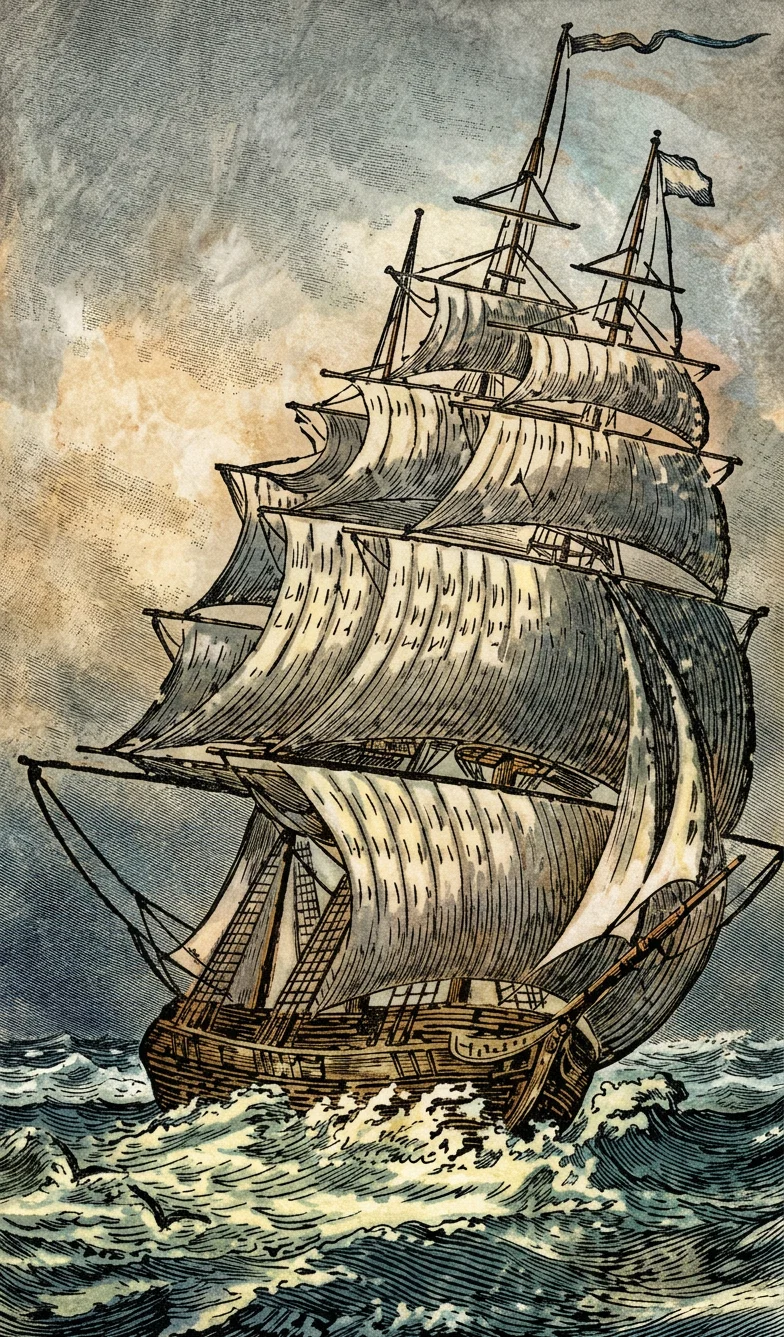
We had a successful run and passage to St. Thomas, one of the Virgin Islands in the West Indies belonging to Denmark. The night preceding our arrival, a schooner came in company with us, bound on the same course. By request of Capt. H. she consented to keep our company during the night, as he professed to be well acquainted with that region. The night was delightful, with a fair wind. The schooner took in all her sail except her top-sail lowered on the cap. We were under a cloud of sail, lower, topmast, and top gallant steering sails, all drawing and filled with the pleasant gale. (See the ship.) The Capt. of the schooner seemed out of all patience with us because we did not sail fast enough to keep up with him. About midnight he sheered up within speaking distance, and cried out, “Ship, a hoy!” “Hallo!” replied Capt. H. “Do you know what I would do with that ship if I commanded her?” “No,” was the reply. “Well sir,” said he, “if I had charge of that ship, I would scuttle her and send her to the bottom with all hands on board!” Our ship’s bottom was so full of grass and barnacles that she sailed only half her speed with a clean bottom.
We arrived however the next day, and thought we felt thankful to God for preserving and sustaining us through the perilous scenes we had experienced. Even when our ship was safely anchored and our sails all furled, for a while we could hardly realize that we were safe in the harbor of St. Thomas. Careening our ship to clean the bottom, it was wonderful to behold the quantity of green grass from two to three feet long, and large barnacles on the bottom. The “survey” decided that the ship could be repaired to proceed to the United States.