INCIDENTS IN MY PAST LIFE.—No. 17.
BY ELD. JOSEPH BATES.
Allowance of Water—Casting cargo into the Sea—Allowance of Provisions—Dreadful Storm—Gulf Stream—Dead Calm and rushing Hurricane—Silent Agony—Wallowing between the Seas.
Our heavy cargo of iron and prevailing westerly gales caused our ship to labor so incessantly that she began to leak very freely. We got up about twenty tons of iron and secured it on the upper deck. This eased her laboring some, but still the westerly gales prevailed, and we gained westward but slowly. At length said Capt. Hitch, “We must come on an allowance of water;” and asked how much I thought we should begin with? I answered, “Two quarts per day.” “Two quarts of water per day!” said he, “why, I never drank two quarts of water a day in my life. I drink two cups of coffee in the morning, and two cups of tea at night, and two or three glasses of grog during the day (temperance societies were not known then), and that is about all I drink.” Said he, “I have been following the sea for about thirty years and never have yet been put on an allowance.” I had not been so fortunate, but had been on an allowance of food five years, and several months on a short allowance of water. I said to Capt. H., “The very idea of being on an allowance of water will increase your desire for more.” Well he knew nothing about that, but said, “We will wait a little longer, for I don’t believe I ever drank two quarts a day.”
As we were still hindered in our progress, and the ship increasing her leak, Capt. H. said, “It is your morning watch to-morrow, I think you had better begin and measure out the water, and fasten up the water casks.” “Very well, sir,” said I, “but how much shall I measure for each man?” “Well, begin with two quarts.” This was done, and the Captain’s two quarts taken to the cabin. As I was walking the deck about seven o’clock in the evening, the after hatchway being open, I heard Capt. H. in the dark say in a loud whisper, “Lem! you got any water?” (Lemuel T. was a nephew of Capt. H., and messed in the steerage) “Yes sir.” “Give me a drink will you?” In a few moments I heard the Captain gurgling the water down out of “Lem’s bottle” as though he was very thirsty, and yet it was but twelve hours since his two quarts had been measured out. At the breakfast table next morning, said I, “Capt. Hitch, how did you make out for water last night?” He smiled and acknowledgedp. 38 he was mistaken. “The thought of being on an allowance (as you said) makes one feel thirsty. I never tried it before.”
After encountering another heavy gale, Capt. H. became seriously alarmed, fearing the Frances was too deeply laden to cross the Atlantic in safety. A counsel was held which decided to relieve the ship of part of her burden by casting the twenty tons of iron overboard. In a few hours this work was accomplished, and the long bars of iron were gliding swiftly to their resting place some five or nine miles below us, into what the sailors call “Davy Jone’s Locker.”
Twenty tons more were taken on deck. This change relieved the ship very perceptibly, and enabled her to make better progress. But still the Captain was fearful of carrying a press of sail for fear her leak would increase and carry us all down to the bottom.
Our stock of provisions getting low we came on a stated allowance of beef and bread, our small stores being about exhausted. We all began to feel anxious to get to our destined haven. When the Captain was asleep we would venture sometimes to crowd on a little more sail. After a westerly storm the wind had come round to the east during the night. To improve this favorable wind, by the time the morning watch was called we had all the reefs out of the top-sails, top-mast and lower studding sails set with a good top-gallant breeze, but rather a heavy head-beat sea. Capt. H. came on deck and looked around a few moments and said, “Mr. Bates, you had better take in the main top-gallant-sail. Also the lower and topmast studding sails. Now we will double and single reef the topsails.” This done he concluded the ship would get along much easier and almost as fast.
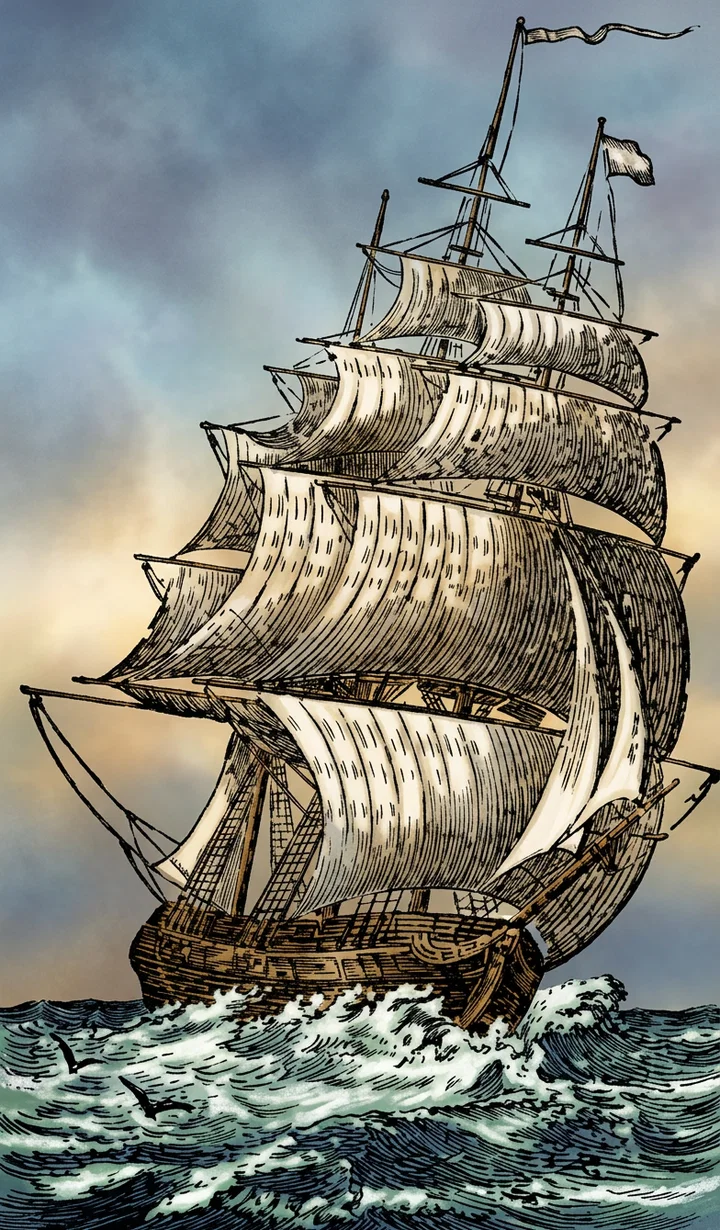
At length the winds favored us and we were making rapid progress. The last three days the wind had been increasing from the south east, and according to our reckoning if it continued we should reach New Belfast in three days more, making our passage in seventy days from Gottenburgh. In this we were sadly disappointed, for by the third day at midnight the gale had increased to a dreadful height. The raging elements seemed to set at defiance every living creature that moved above the surface of the sea. In all my experience I had never witnessed such portentous signs of a dreadful devastating storm in the heavens. The sea had risen to such an awful height, it seemed sometimes that it would rush over our mast-heads, before our heavy laden ship would rise to receive its towering, foaming top, and the howling, raging wind above it, straining every stitch of sail we dared to show, and then dash us headlong again into the awful gulf below. All the canvas we dared to show was a close reefed maintopsail and reefed foresail. We needed more to hurry the ship off before the foaming sea, but were in great fear that the heavy gusts of wind would wrench them from the bolt-ropes, and leave us in the power of the next sea to be overwhelmed and sink with our iron cargo to the bottom of the sea.
We charged the watch that were going below not to lay off any of their clothing, but be ready at a moment’s warning. We considered ourselves in the eastern edge of the Gulf stream, one of the most dreaded places for continual storms on the American coast, or any other coast in the world. Cross it somewhere we must to reach our home.
I entered the cabin for a moment to inform Capt. H. of the increasing storm. He was unwilling to see it, but said, “Mr. Bates, keep the ship dead before the sea!” That was our only hope. Our tiller had been broken off within four feet from the rudder-head, a short time previous by a violent sea that struck us on the bow. We had spliced it, and now with tiller-ropes and relieving tackles it required four experienced men, with our utmost skill in “cunning” them, to manage the helm to keep the ship running directly before the foaming, mountainous seas. Our continual work was something like the following: “Starboard your helm!” “Starboard, sir,” was the reply. “Steady, here comes another dreadful sea!” “Steady,” was the reply. “How do you head now?” “N. W.,” was the reply. “Steady, keep her head just so. That was well done!” If the ship had not answered her helm as she did, it appeared that that fearful sea would have rushed over our quarter and swept us all by the board. “Port your helm! here comes another on the larboard side! Steady now, the sea is square on our stern,” &c.
With the dawn of the morning the rain came down upon us in such torrents that it was with much difficulty that we could see the shape of the sea until it was rushing upon us. This rain was ominous of a change more dreadful (if possible) than our present situation. My short experience had taught me that the Gulf stream* was more dangerous for navigators on this account than any other navigable sea.
Between 7 and 8 o’clock in the morning, as sudden as a moment, the wind struck us from the opposite quarter, and our sails were struck against the mast. The simultaneous cry was uttered, “The ship’s aback!” “Hard aport your helm!” “Quick! quick!” It seemed as though I touched the deck but twice in getting some thirty feet to the main-mast where the weather forebracers were belayed, and whirled them from the pins and shouted, “All hands on deck in a moment!” Descending from the top of the sea the ship answered herp. 39 head paid off the N. E. The foresail filled again, or we should inevitably have gone down stern foremost from the overpowering rush of the next sea. The wind came furiously from the west for a few moments, and suddenly died away, leaving us in a dead calm. “Lash your helm to the starboard!” “Call the captain, one of you!” “Clew up the main-topsail!” “Haul up the foresail!” “All hands aloft now, and furl the main-topsail.” “Make haste, men, and secure it to the yard as fast as you can!”
The ship was now unmanageable. The sea described above, now on our lea beam, and seemed as though it would either run over our mast-heads or roll us bottom upwards to windward. As the captain came up from the cabin and saw our situation he cried out, “O my grief!” and for a while was silent. The ship was now writhing and wrenching some like a person in perfect agony. Her tumbling in such a tumultuous and violent manner made it very difficult for the men to get aloft. Before they reached the topsail-yard, the wind came rushing upon us like a tornado from the W. S. W. This was what we feared, and why we hurried to save our storm-sails if we could. It was some time before the men could secure the sails. When this was done, and the ship pumped after a manner, the crew were all clustered on the quarter deck, except Lemuel T., and George H., the captain’s nephew and son, who, by the captain’s orders, were fastened below for fear they would be swept from the deck; also one passenger. Said the captain, “Cook, can you pray with us?” The cook knelt down where he could secure himself, the rest of us holding on upon our feet, and prayed most fervently for God to protect and save us from the dreadful, raging storm. This was the first prayer that I ever heard uttered in a storm upon the ocean. Sinners as we were, I believe it was remembered by him whose ear is not closed to the distressed mariner’s cry; for the Scriptures testify that “he commandeth, and raiseth the stormy wind, which lifteth up the waves thereof. They mount up to the heaven, they go down again to the depths: their soul is melted because of trouble. They reel to and fro, and stagger like a drunken man, and are at their wit’s end. Then they cry unto the Lord in their trouble, and he bringeth them out of their distresses.” Ps. cxii, 25–28.
We seemed to be placed in the very position the Psalmist speaks of. After we had done all we could to save our lives from the raging elements of the past night, until our ship was rendered unmanageable, our sails secured and the helm lashed a-lee, then we were at our “wit’s end,” and prayed to the Lord for help, and secured ourselves to the mizen rigging and quarter deck, there in deep contemplation and utter silence to wait the issue of our case. Capt. H. doubtless felt that he had neglected his duty in commending us to God daily, during our long voyage, and now in this perilous hour, when we were at our “wit’s end,” his confidence failed him. Himself and the cook were the only professors of religion on board. They both belonged to the Close Communion Baptist church, in New Bedford, Mass. The cook was the only colored man on board. I have always believed that the Lord specially regarded his prayer. Once only during the voyage I heard the captain pray. I had become almost exhausted from extreme labor in some of the storms I have before mentioned, and was losing two hours of my evening watch to get some rest, when I overheard Capt. H. in a dark part of the cabin praying the Lord to raise me to health and strength. In saying this I mean no disrespect to Capt. H., for he was a gentlemanly, good-hearted man, and treated his officers and men with kindness and respect.
After the cook’s prayer I secured myself to the weather foremost mizen shroud, to watch the furious, raging storm. Capt. H. was next behind me, the second mate and crew all ranged along the weather side of the quarter deck, waiting in silence the decision of our case. The wind was so unabating in its fury that it would whirl the top of the contending seas over us, and drench us like pouring rain from the clouds. The labor of the ship seemed to be more than she could long endure. The marvel was that she had held together so long. It seemed sometimes when she was rushing from the top of some of those mountain seas, broadside foremost, that she would either turn clear over or rush down with such impetuosity that she never would rise again. After a while the sea became furious from the west, and the two seas would rush together like enemies contending for victory. We had remained in silence about three hours, when I said, “Our ship can stand this but a little longer.” “So I think,” replied the captain. I said, “It appears to me that our only hope is to loose the wings of the foresail, and drive her between these two seas on a N. E. course.” “Let us try it,” said Capt. H.
Soon our good old ship was making her way through between these two tumbling mountains, being most severely buffeted, first on the right and then on the left. And when our hearts would almost sink for fear of her being overwhelmed, she would seem to rise again above it all, and shake herself as though some unseen hand was girding her from beneath, and with her two little outstretched wings, filled to overflowing with the howling, raging wind, she would seem to move onward again with more than mortal energy. Thus she wallowed along until midnight between these tumbling seas, wreaking, tumbling, wrenching and groaning with her heavy iron load and precious living souls that she was laboring to preserve in answer to the poor negro sailor’s prayer, that had passed from her upper deck, away from amidst the distracting hurricane and dreadful storm to the peaceful mansions of the GOVERNOR OF HEAVEN, AND EARTH, AND SEAS.