BY ELD. JOSEPH BATES.
After a pleasant season of a few months at home with my family, I sailed again for Alexandria, D. C., and shipped as chief mate on board the ship New Jersey, of Alexandria, D. C., D. Howland commander. We proceeded up James River near Richmond, Va., to load for Europe. From there to Norfolk, Va., where we finally loaded and sailed for Bermuda.
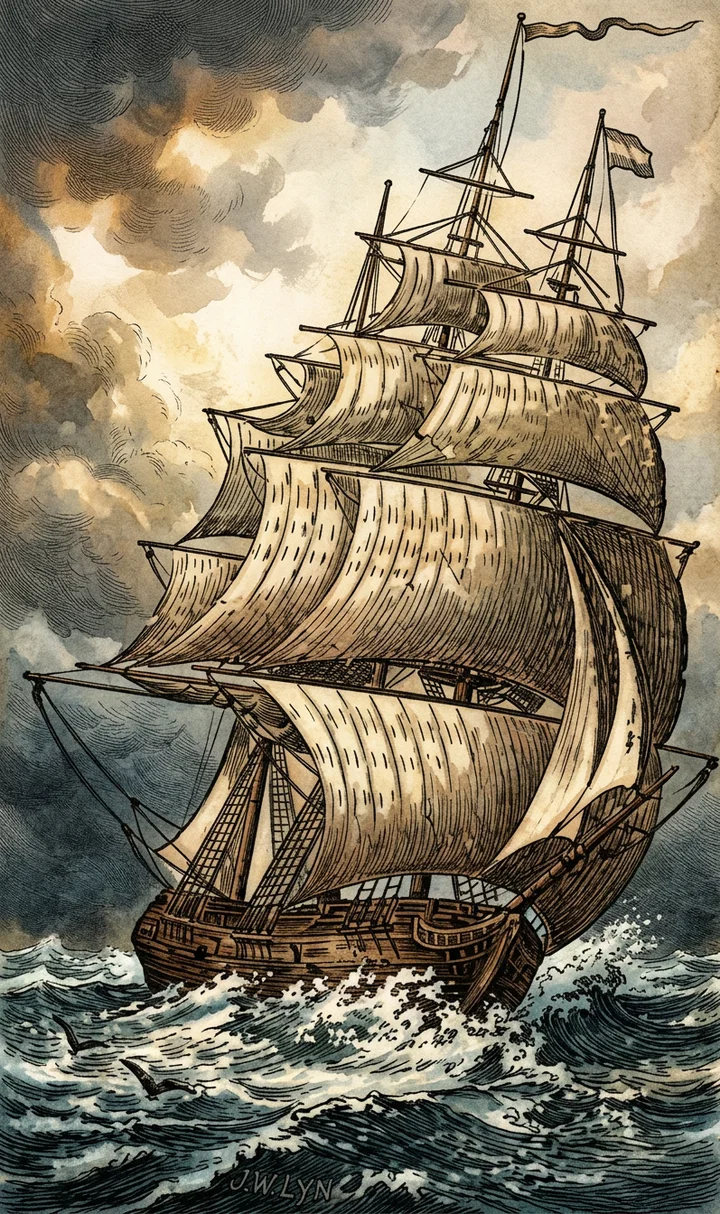
On our arrival at Bermuda our ship drew so much water that it became necessary for us to anchor in open sea, and wait for a smooth time and fair wind to sail into the harbor. The captain and pilot went on shore expecting to return, but were prevented on account of a violent gale and storm which came on soon after they reached the shore, which placed us in a trying and perilous situation for nearly two days. We were unacquainted with the dangerous reefs of rocks with which the North and East side of the Island were bounded, but with the aid of our spy-glass from the ship’s mast head, still many miles off in the offing I could see the furious sea breaking mast head high over the reefs of rocks, East and North, and on the West of us the Island of Bermuda, receiving the whole rake of the beating sea against its rock-bound coast, as far as the eye could extend to the South. From my place of observation I saw there was a bare possibility for our lives if during the gale our ship should be driven from her anchors, or part her cable to pass out by the South, provided we could show sail enough to weather the breakers on the South end of the Island. Our storm sails were now reefed and every needful preparation made if the cables parted to chop them off at the windlass, and crowd on every storm sail the ship could bear, to clear if possible the breakers under our lee. As the gale increased we had veered out almost all our cable, reserving enough to freshen the chafe at the bow which was very frequent. But contrary to all our fearful forebodings, and those onp. 62 shore who were filled with anxiety for our safety, and especially our captain and pilot, our brave ship was seen at the dawn of the second morning still contending with her unyielding foe, holding to her well bedded anchors by her long straitened cables which had been fully tested during the violent storm which had now begun to abate. As the sea went down the captain and pilot returned, and the ship was got under way and safely anchored in the harbor and we discharged our cargo.
We sailed from Bermuda to Turk’s Island for a cargo of salt. In the vicinity of this Island is a group of low, sandy Islands where the inhabitants make large quantities of salt from the sea water. Passing by near these Islands strangers can see something near the amount of stock they have on hand, as it is heaped up in stacks for sale and exportation. A little way off these salt stacks and their dwelling houses very much resemble the small houses on the prairies in the West, with their numerous wheat stacks dotted about them after harvest. Turk’s Island salt is what is also called “rock salt.” Here we moored our ship about a quarter of a mile from the shore, our anchor in forty fathoms or two hundred and forty feet of water, ready to ship our cables and put to sea at any moment of danger from change of wind or weather; and when the weather settled again return and finish loading. In a few days we received from the natives by their “slaves” twelve thousand bushels of salt which they handed us out of their boats by the half bushel in their salt sacks. The sea around this Island abounds with small shells of all colors, many of which are obtained by expert swimmers diving for them in deep water. We returned to Alexandria, D. C., in the winter of 1820, where our voyage ended.
Before the cargo of the New Jersey was discharged, I was offered the command of the ship Talbot of Salem, Mass., then loading in Alexandria for Liverpool. In a few weeks we were again out of the Chesapeake Bay, departing from Cape Henry across the Atlantic Ocean.
Soon after our leaving the land, a violent gale and storm overtook us in the Gulf Stream attended with awful thunder and vivid streaks of lightning. The heavy, dark clouds seeming but just above our mast heads kept us enshrouded in almost impenetrable darkness as the night closed around us. Our minds were only relieved by the repeated sheets of streaming fire that lit up our pathway and showed us for an instant that there was no other ship directly ahead of us, and also the shape of the rushing seas before which we were scudding with what sail the ship could bear, crossing with all speed this dreaded, dismal, dark stream of warm water that stretches itself from the Gulf of Mexico to Nantucket shoals on our Atlantic coast. (Before referred to in No. 17). Whether the storm abated in the stream we crossed we could not say, but we found very different weather on the Eastern side of it. I have heard mariners tell of experiencing days of very pleasant weather while sailing in this Gulf, but I have no knowledge of such in my experience.
After this we shaped our course so as to pass across the southern edge of what is called the Grand Banks of Newfoundland. According to our reckoning and signs of soundings we were approaching this noted spot in the afternoon. The night set in with a drizzling rain which soon began to freeze, so that by midnight our sails and rigging were so glazed and stiffened with ice that we were much troubled to trim them and steer the ship away from the Bank again into the fathomless deep, where we are told that water never freezes. This was true in this instance, for the ice melted after a few hours run to the South. We did not stop to sound, but supposed we were in about sixty fathoms of water on the Bank, when we bore up at midnight. Here about one third of the three thousand miles across the Ocean, and hundreds of miles from any land, and about three hundred and sixty feet above the bottom of the sea, we experienced severe frosts from which we were entirely relieved after a run South of about twenty miles. If we had been within twenty miles of land the occurrence would not have been so singular. We at first supposed that we were in the neighborhood of Islands of ice, but concluded that could not be as we were about a month too early for their appearance. This occurrence was in April.
In a few weeks from the above incident we arrived in Liverpool, the commercial city where ten years before I was unjustly and inhumanly seized by a government gang of ruffians, who took me and my ship-mate from our quiet boarding house in the night, and lodged us in a press room or filthy jail until the morning. When brought before a naval officer for trial of my citizenship, it was declared by the officer of the ruffian gang that I was an Irishman belonging to Belfast in Ireland. Stripped of my right of citizenship, from thenceforth I was transferred to the naval service of King George III, without limitation of time. Then myself and Isaac Baily of Nantucket, my fellow boarder, were seized by each arm by four stout men, and marched through the middle of their streets like condemned felons to the water side; from thence in a boat to what they called the old Princess of the Royal navy.
During these ten years a great change had taken place with the potentates and subjects of civilized Europe. The dreadful convulsions of nations had in a great measure subsided. First by the peace between the United States and Great Britain, granting to the U. S. “Free trade and sailor’s rights;” secured in a few months after the great decisive battle of Waterloo in 1815, followed by what had been unheard of before, — a conclave of the rulers of the great powers of Europe, united to keep the peace of the world. (Predicted in olden times by the great Sovereign ruler of the universe. Rev. vii, 1.)
The two great belligerent powers that had for about fifteen years convulsed the civilized world by their oppressive acts and mortal combats by land and sea, had closed their mortal strife. The first in power usurping the right to seize and impress into his service as many sailors as his war ships required, without distinction of color, if they spoke the English language. The second with all his ambition to conquer and rule the world, was banished on what was once a desolate, barren rock, far away in the South Atlantic Ocean, now desolate and dying.
The people were now mourning the death of the first, namely, my old master, King George III. His crown was taken off, his course just finished, and he laid away in state to sleep with his fathers until the great decisive day. Then there was a female infant prattling in its mother’s arms destined to rule his vast kingdom with less despotic sway. During these ten years my circumstances also had materially changed. Press gangs and war prisons with me were things in the past, so that I uninterruptedly enjoyed the freedom of the city of Liverpool in common with my countrymen.
As we were about loading with return cargo of Liverpool salt for Alexandria, a man dressed in blue jacket andp. 63 trowsers, with a rattan whip in his hand, approached me with, “Please your honor, do you wish to hire a ‘lumper’ to shovel in your salt?” “No,” I replied, “I do not want you.” “Why, your honor, I am acquainted with the business, and take such jobs” I again refused to employ him, and said, “I know you.” He asked where I had known him? Said I, “Did you belong to his Majesty’s ship Rodney of 74 guns stationed in the Mediterranean in the years 1810-12?” He replied in the affirmative. “I knew you there,” said I, “Do you remember me?” “No, your honor. Was you one of the lieutenants, or what office did you fill? or was you one of the officers of the American merchant ship we detained?” “Neither of these,” I replied. But from the many questions I asked him he was satisfied I knew him. We had lived and eaten at the same table for about eighteen months.
Monterey, Mich., July 6, 1860.