CITIES OF REFUGE.
By J. E. White
In ancient times there was a custom that if a person killed another, whether intentionally or by accident, the relatives of the deceased could put him to death.
This custom was so firmly fixed that when the children of Israel went into the land of Palestine, instead of doing it away fully, the Lord commanded Moses to appoint six cities of refuge to which person killing another could fly and be safe from the avenger until the law decided whether he was really guilty of murder, or whether it was merely an accident. If it was merely an accident, he was safe within the walls of the city. If he was really a murderer, he was put to death by law.

But even if it was proved to be an accident by which he had killed his fellow-man, still his only safety was by remaining within the walls of the city until the death of the high priest, when he could go free. Before the death of the high priest, if his enemies should find him outside the walls of the city they could slay him with impunity.
There were three of these cities on either side of the river Jordan. On the west side were Kedesh, Shechem, and Hebron. On the east side were Golan, Ramoth-Gilead and Bezer. Joshua 20:7, 8.
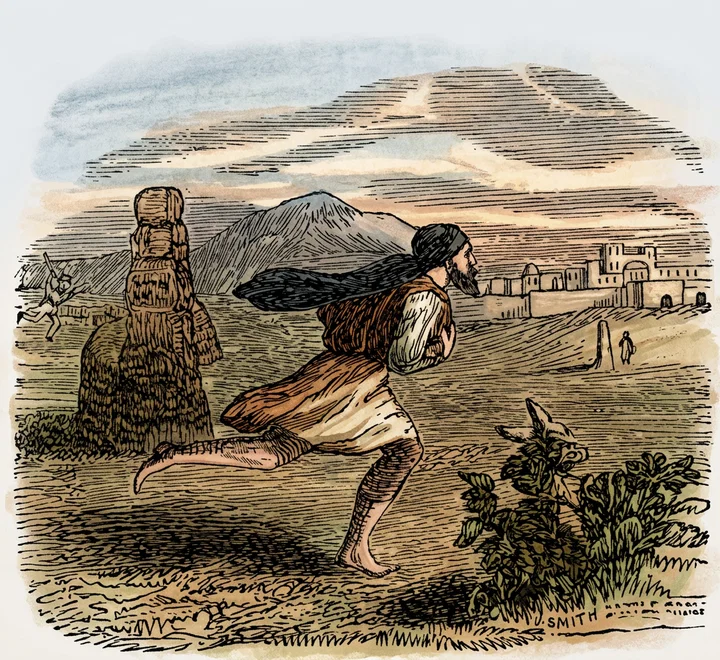
You see in the above picture that the man in the foreground is running for dear life for the city in the distance. Away off to the left is another man in pursuit, who hopes to overtake him, and avenge the death of his friend before he can reach the city where he knows he will be out of his power.
I am glad such a revengeful custom is done away with now, for “vengeance is mine and I will repay, saith the Lord.”
There is a city of refuge for sinners exposed to the second death, if they will only fly to it in time. Oh! let us fly in time to the bleeding side of our Saviour and be washed from our sins so that we may have an abundant entrance into this city of refuge from whence we “shall go no more out,” and where “God shall wipe away all tears from their eyes; and there shall be no more death, neither sorrow, nor crying, neither shall there be any more pain.”
How happy we shall be if we can call Christ our friend in that terrible day when the wicked shall be consumed with unquenchable fire from Heaven. Dear readers, shall we find a refuge with our Saviour at that time? J. E. WHITE.