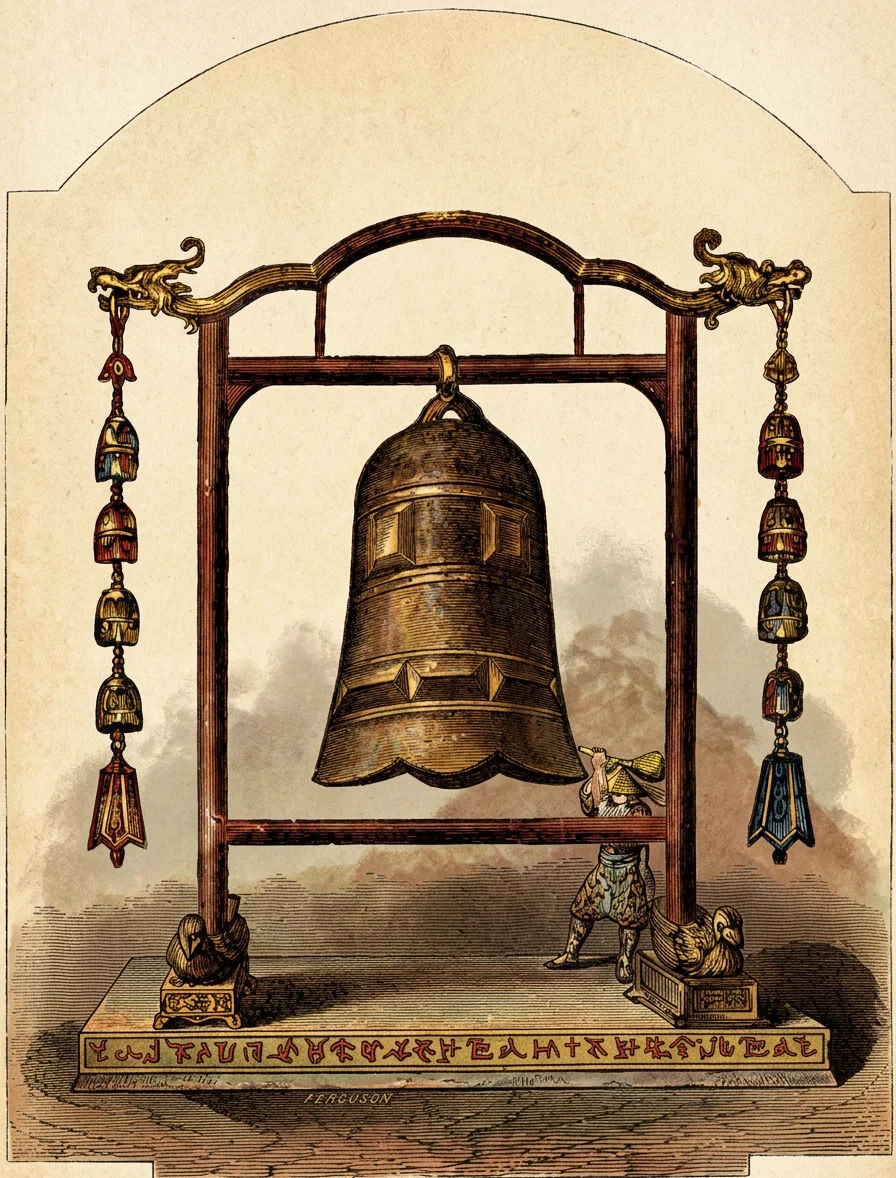
The bells of China rank next in size to those of Russia. It is the opinion of persons prepared to judge, that China is the country whence large bells have their origin. It is said to be not uncommon throughout the Celestial Empire to see enormous bells lying upon the ground, their great weight having broken down the towers in which they were suspended.
Restored with AI
The “Great Bell of China,” in Pekin, weighs 120,000 pounds, and is 14 feet high, and 12 feet in diameter. It is used to denote the watches of the night. In Nankin there is a bell now fallen to the ground which weighs 50,000 pounds.
In Japan, bells are very commonly used. In form and composition they greatly resemble the bells of China, and are found of every size, and in great numbers. They are suspended in low towers, near the temples. At the commencement of worship, the bell is sounded to arouse the deity, and have him wide awake to listen to the calls of the devout. Our engraving on the next page shows a Japanese bell mounted after the custom of that people.
The bells of Holland and Belgium are remarkable for their size and number. Says a writer of the Netherlands, “The inhabitants are enthusiastic in their fondness for bells, which they never leave at rest.”
The weights of several of the so-called large bells of the world are as follows:—
A bell in Vienna, Austria, weighs 40,000 pounds. Another, in Olmutz, is of equal size. A bell in Rouen, France, weighs 36,000 pounds. The largest bell in England, at Westminster, weighs 30,000 pounds. There is a famous bell at Erfurt, Germany, named Susanne, of the same weight. Its tone was long regarded as without equal in all Europe. It was cast in 1497. Martin Luther, when a schoolboy, must have listened to its earliest peals.
The largest bell in America is in the cathedral at Montreal, and weighs 25,000 pounds. Another in the church of Notre Dame, Paris, is of the same weight. The bell in St. Peters, at Rome, weighs 17,500 pounds, and “Great Tom,” at Oxford, is nearly the same size. This last bell strikes 101 times every evening at nine o’clock.
The largest bell in the United States is the Alarm Bell on City Hall, New York. It was cast in Boston, and weighs 23,000 pounds. Its diameter is 8 feet, its height, 6 feet, and it is 7 inches thick.
But the bell of special interest in this country, is the famous old “Liberty Bell,” now standing on a pedestal in the State House in Philadelphia. It was imported from England in 1752, and being cracked on trial, was re-cast. On its brazen sides are the following words of the Bible: PROCLAIM LIBERTY THROUGHOUT THE LAND UNTO ALL THE INHABITANTS THEREOF. It was under this very bell that the brave representatives of the Thirteen Colonies first “Proclaimed Liberty,” and this bell, with its iron tongue, started the tidings throughout the land. It was afterwards cracked when being rung in honor of Henry Clay in Philadelphia.
On the continent of Europe, chimes frequently consist of forty or fifty small bells, and are played by means of a barrel like that in a hand organ, or by clock-work.90
Restored with AI
THE “GREAT BELL OF CHINA.”
The system now generally adopted in chime ringing is that of having each bell mounted stationarily, with cords leading from the ends of the clappers to manuals, arranged in the forms of levers, and operated by a single player.
The number of changes which can be played upon a chime of bells is almost marvelous, twelve bells allowing a no less number than 479,001,600.
In former times, it was a common belief that the ringing of bells would drive away demons and evil spirits. One old writer even asserting that if all the bells of England should be rung together at a certain hour the devil would have no abiding-place in all England!
Akin to superstition, there has always been a sincere affection connected with the chiming of bells. It is recorded of a friar, that upon the destruction of his monastery he regretted nothing so much as the loss of a favorite bell, which, after diligent search, he found had been removed to a village church. He then submitted to become a common laborer that he might end his days within the hearing of it. Even the ambitious Napoleon was ever deeply stirred at the sound of bells. “How often,” says Bourrienne of the emperor, “has the booming of the village bell broken off the most interesting conversation!” the monarch refusing to move lest the action of the feet should interfere with the sacred sounds.
Formerly it was quite customary to ring bells to avert tempests, or to drive away pestilence. Even at present, in France, it is usual throughout the vinelands to ring the bells at the approach of storms, to break the clouds. In Switzerland, it is said that the muleteers, at certain passes, tie up their little bells, lest their tinkle should shake the delicately poised snow, and bring down an avalanche.
Most touching is the tradition told in connection with the peal in Limerick cathedral. It was said to have been brought from a convent in Italy, for which place it had been manufactured by an enthusiastic native with much labor and skill. The Italian, having acquired a competency, fixed his home on the convent cliff; and for many years enjoyed the chimes of his beloved bells. But in some political revolution, the monks were driven from the monastery, the Italian from his home, and the bells were carried to the Emerald Isle. After a long interval the course of his wanderings brought him to Limerick. On a beautiful evening, as the vessel which bore him floated on the Shannon, he suddenly heard the bells peal forth from the cathedral tower. They were the long-lost treasures of his memory! Home, happiness, friends,—most tender recollections, were in their sounds. Crossing his arms on his breast, he lay back in the boat. When the rowers looked round they saw his face still turned toward the cathedral, but his eyes had closed forever on this world.
We will conclude this sketch with the apt remark of the noted Robert Southey: “Great are the mysteries of bell ringing. And this may be said in its praise, that of all devices which men have sought out for obtaining distinction by making a noise in the world, it is the most harmless.”