BELLS are instruments of great antiquity, being spoken of in the book of Exodus as an appendage to the sacred dress of the high priest. It is thought that the word bell is derived from the old Saxon word bellan, which in that language meant to bawl, or bellow. The most joyous and the saddest feelings of mankind are very closely associated with bells.
The praises of this musical instrument have been repeatedly celebrated in both poetry and prose. Who has not heard the familiar lines of Moore,—
“Those evening bells, those evening bells,
How many a tale their music tells”!
It has been conjectured that the oldest bells in existence are those that were discovered by Mr. Layard in the ruins of Nimroud, Assyria. It is also interesting to add that when Columbus was at Cape Honduras, a trading canoe of the Indians had on board some small bells; and they also have been found in the tombs of the old Peruvians.
The ancient Persians had bells attached to their royal costumes, and in later times the Goths suspended them to their garments. In Egypt, and in some other countries, the girls wore strings of little bells attached to their ankles, as is common in Cairo at the present time. To this singular custom the prophet Isaiah doubtless refers in chap. 3:18. Among the old Greeks, a bell was sometimes hung on the neck of a malefactor on his way to execution.
A silver bell was the prize frequently run for at a race; hence the expression, “Bearing away the bell.” The Greeks and Romans attached bells to the necks of their cavalry horses to accustom them to noise, so they might not be affrighted at the horrid din of battle.
Restored with AI
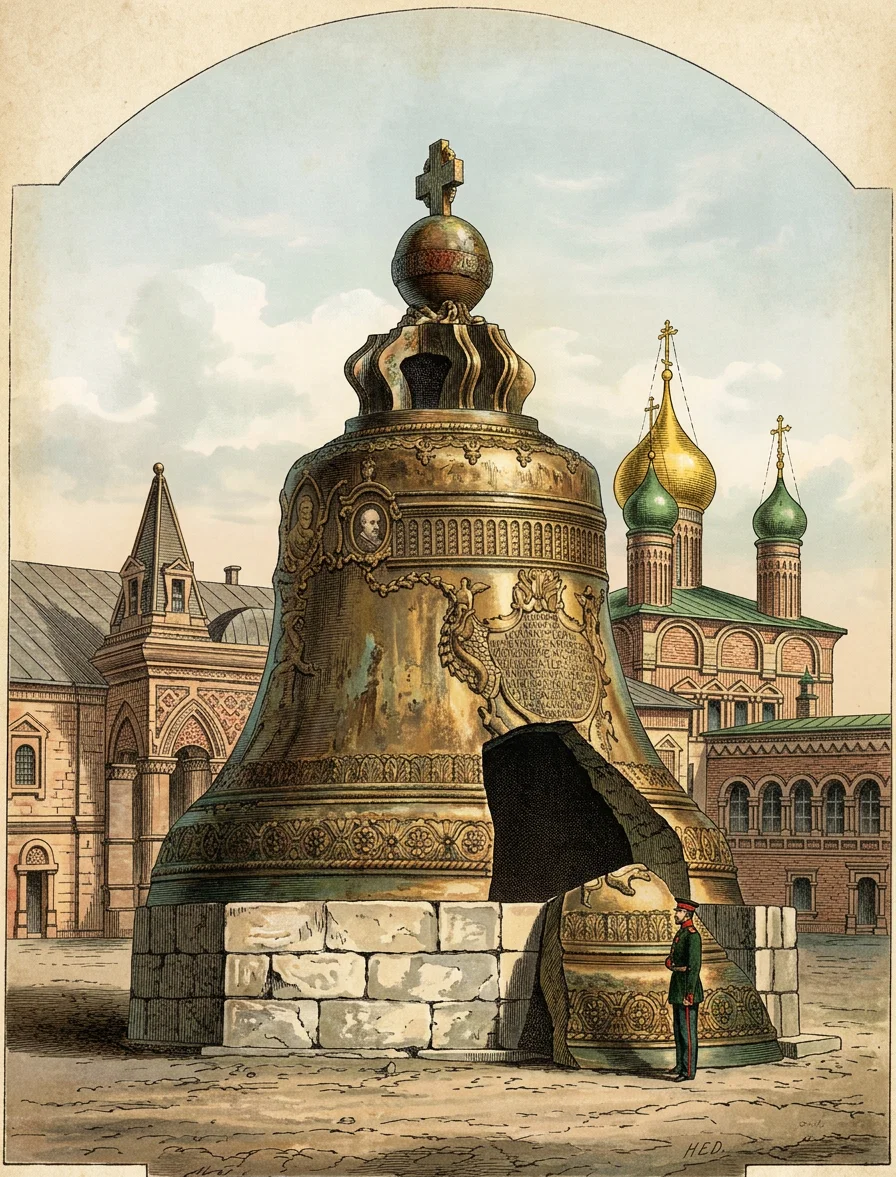
THE “GREAT BELL OF MOSCOW.”
As a signal, to call the people together for some concerted action, the bell has been in use from remote times. Even in China, according to some, bells were used for religious purposes 2000 years prior to the Christian Era; this, if true, would take us back to the days of Abraham, and even much farther! All nations, with the exception of the Turks, have a mutual admiration for bells, one quaint writer even seriously maintaining, in a large volume upon the subject, that the employment of the blessed in Heaven would principally consist in the ringing of bells!
Associated in various ways with the ancient ritual of the church, bells seem to have naturally acquired a kind of sacred character. In early times in the Roman Church, for a long period it was the priest’s office to ring the bell. Bells also were washed and named and even blessed. The ceremony was called, “The Baptism of Bells.” As might be supposed, bells were early used in the Christian church; but it is not positively known who was the first to introduce them into the buildings. Some maintain that Bishop Paulinus, of Nola, a city in Campania, was the first to use bells in churches. Whether this be true or not, in some of the languages of Europe, bells are still called by the names Nola and Campania.
In the tenth century, Pope John XIII. named a large bell after himself—JOHN.
In the Middle Ages bells had attained a very prominent position. An old writer describes their three-fold use as follows:—
“To call the fold to church on time,
We chime.
When joy and mirth are on the wing,
We ring.
When we lament a departed soul,
We toll.”86
Many of their special uses were designated by the names given to certain bells. Thus, the Ave Maria, or Pardon Bell, was tolled at certain hours, when every one was enjoined to offer prayer to the Virgin Mary.
The Vesper Bell was the call to evening prayer.
The Sanctus Bell was rung at the words in the service, “Sancte, sancte, sancte, Deus Sabaoth,” i. e., “Holy, holy, holy, Lord of Hosts,” and every one on hearing it was expected to prostrate himself.
The Passing Bell was so named as being tolled when any one was passing from this mortal life.
The Curfew Bell (from the French couvre feu, or, “cover the fire,”) was a signal for the inhabitants who lived in wooden houses to put out the fires, and retire for the night.
The Toesin, or Alarm Bell, was sounded from castles and fortresses to announce the approach of an enemy. In the year 610, when Sens was besieged, the bishop of Orleans ordered the bells of St. Stephens to be rung to intimidate the enemy, and as late as 1457, Pope Calixtus III. employed the same device as a protection against the Turks, who with a strange superstition regarded bells as their most dangerous foe.
The modern Fire Bell is well described by the American poet, Edgar A. Poe:—
“Hear the loud alarum bells,—
Brazen bells!
What a tale of terror now their turbulency tells!
In the startled ear of night,
How they scream out their affright!
Too much horrified to speak,
They can only shriek, shriek,
Out of tune,
In a clamorous appealing to the mercy of the fire,
In a mad expostulation with the deaf and frantic fire.”
But any history of bells would be far from complete without reference to the great bells of the world. In respect to these, Russia far surpasses all other nations.
In the city of Moscow, alone, before the great revolution, there were no less than 1706 large bells.
But the “Great Bell of Moscow,” or Czar Kalokol (i. e., the emperor of bells), is most noteworthy. Its weight is about 440,000 pounds, being a little mountain of metal. The cost of the bell metal alone is estimated at upwards of $300,000, to which, reliable writers say, $1,000,000 more was added in jewels and plate by the nobles at the time of casting. The dimensions of this monster bell are about 21 feet in height, 22 feet in diameter, and 40 feet 9 inches in circumference. Its sides are 16½ inches thick. It is ornamented on the sides by figures of Christ and the apostles and the Virgin Mary; also one of the Empress Anne, by whose order it was cast. The bell was originally suspended from beams, which being destroyed by fire in 1737, permitted the heated bell to fall to the ground and break, since which time it has remained dumb. The Emperor Nicholas had it raised in 1837, and placed upon a low, circular wall in the Kremlin. It is now consecrated as a chapel, the opening in its sides being large enough to admit two men standing abreast. The bell is carefully guarded, as we see in the engraving, and the Russians will not allow a single particle of the metal to be taken away. The piece which is broken out, is of triangular shape, being 6 feet high, and 7 feet at the base. Its estimated weight is 11 tons.
There is another monstrous bell in the cathedral of Moscow, weighing 120,000 pounds. This bell is suspended in the tower of Ivan Velik, and when it is rung, which is but three times a year, all the other bells are silent. Its mighty voice is said to produce a tremulous effect throughout the city, and a noise like the roaring of distant thunder.