A HUMANE ELEPHANT

10%

S. D. A. Publishing Association · Battle Creek, Mich. · Aug 20, 1879

FromThe Youth’s Instructor, Vol. 27, No. 33.

Read the full edition

A HUMANE ELEPHANT.

A HUNTING excursion in India, upon the backs of elephants, is rare sport; and the rajahs, or governors, sometimes invite their friends to make up a party, and take their spears and hunting-equipments for a chase after tigers and other wild animals.
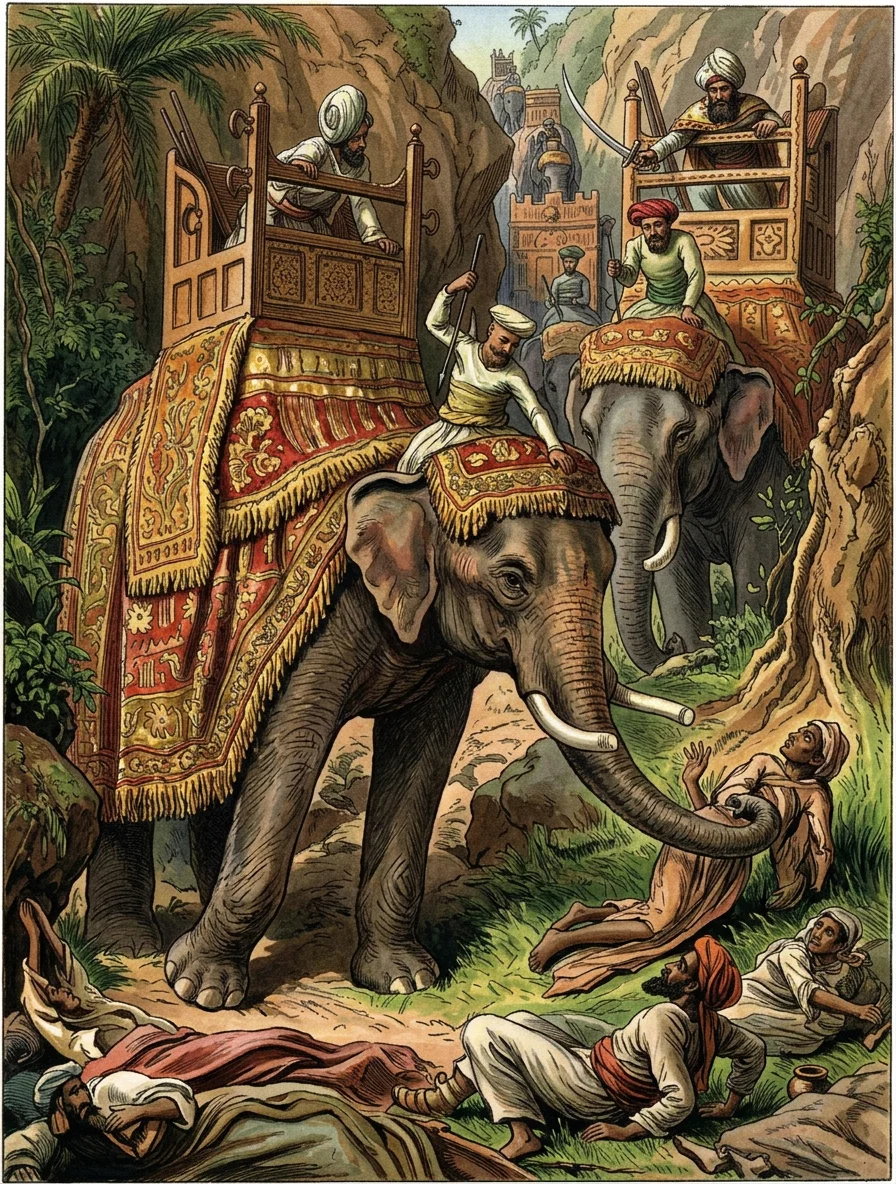
The men in this picture are hunters. How gorgeously they are mounted! See the gay housings or saddle-cloths of the elephants, with heavy, rich fringes falling over the head and sides of the animals! And what a fine seat the rajah has in his square “castle in the air”! He could not expect any one to disobey orders from such a commanding position. The driver sits upon the elephant’s neck, with a sharp-pointed stick to spur up the animal, or guide him to the right or left. This party have been coming down that ravine between the rocks upon a brisk trot; when all at once the turbaned riders are brought to a “halt” without orders.
The leader in the chase, a noble elephant, suddenly comes upon this group of sick people in the grassy meadow, where they are lying in the sunshine and fresh air to recover from battle-wounds and fever. Some have lame feet, and can just raise themselves upon their elbows; others stretch their hands imploringly above their heads; while some are too weak to help themselves at all. One mother looks up in terror, with her sick child clinging to her arm, so that she cannot even remove the jar of cool water, or stir from the spot.
Restored with AI
The cruel rajah sees all these sufferers, and will make the whole party trample over them if he can. He orders the driver of the leading elephant to urge him forward, but on reaching the first sick man the sagacious animal will not advance another step.
In angry fury the rajah shouts, “Stick him in the ear!” The driver goads, and the riders shout, “Go ahead!” But all in vain: the elephant, more humane than his cruel master, will not trample upon the sick people; he turns his eyes first upon one side, and then the other, as if to say, “Don’t be afraid; I won’t step on a single one of you.” And the kind animal actually lifted them gently to the right and left as he passed along, thus clearing a path for the whole party to pass, without doing any harm to the frightened, helpless people.
I hope this noble animal had his hurt ear nicely bathed; for an elephant’s ear is very useful to him, not only to hear with, but as a fan to brush away insects, and a handkerchief to wipe his eyes. The rajah should have given orders for a nice bunch of the most luscious bananas for this elephant’s dessert, and he deserved something more golden for observing the Golden Rule that his master had yet to learn. I do not wonder that ignorant people worship the elephant, if he is so much more merciful and intelligent than man. In Siam the rank and title of “king” is given to the white elephant; and he is called the “Pure King,” “Wonderful King.” His tusks are ornamented with gold rings, and gold chains are hung upon his head.
People in India and Siam are learning to worship the Creator, and not the creature; and they will “love mercy and deal justly” when they have learned the religion of Jesus.—Well-Spring.
Restored with AI