Young readers, do you know that many animals—birds, beasts, and even insects—are good mechanics, skilled in business and building operations? This is true; and what they do is done systematically, with neatness and dispatch. Nor do they idle, lounge about, or stop to play, till the work is done, and well done.
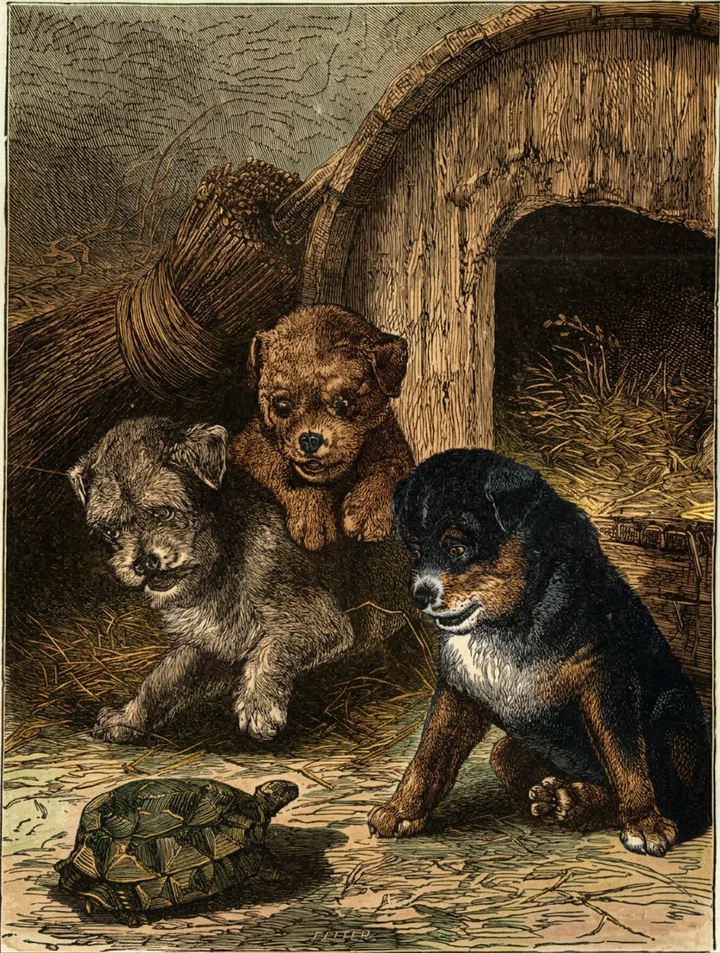
Of all the lower animals, the dog is most remarkable for sagacity and faithfulness. In some countries he acts as a shepherd, often filling the place of several men. Some dogs serve as watchmen, some are hunters, and others are messengers, delivering with fidelity whatever is intrusted to them. The Newfoundland dog, and the dogs of St. Bernard, belong to the Life-Saving Society, as could be testified by hundreds of human beings whom they have saved from a watery grave or a no less terrible death among the mountain snows.
The otter and the heron are fishermen, though they use neither line nor net. The otter we seldom see, for he works his traps mostly under water; but the heron may be often seen standing with his long, thin legs in the shallow part of the stream, suddenly plunging his long bill below the surface, and bringing up a fish.
Ants are day-laborers, and very industrious in their calling; they always seem in earnest at their work. Catch them asleep in the day-time if you can! They set us an example of industry.
The swallow is a fly-catcher; and the number that he daily catches would astonish you. You often see him in his vocation, skimming along the surface of the brook or pond.
The beaver is a wood-cutter, a builder, and a mason; a very good workman at all these trades. He fells the small trees with his teeth; and after he has built his house he plasters it skillfully with his tail-trowel.
The wasp is a paper-maker. His paper is water-proof, and made of materials that no other paper-maker would use. Look at the curious paper dwellings of wasps and hornets—not patented, are they?
Singing birds are amateur musicians, andp. 154 excel all others in harmony. Hardly can we decide which of them most excels—the lark, the robin, the thrush, or the nightingale.
The fire-fly and the glow-worm are lamplighters.
The bee is a professor of geometry; for he constructs his cell so scientifically that the least possible amount of material is formed into the largest spaces with the least waste of room. Not all the mathematicians of Cambridge could improve the construction of his cells. Nor can the best hermetical sealers among us preserve provisions so well.
The caterpillar is a silk-spinner, far excelling any other in his line of business; indeed, we do not know an art that would supply any silk worth the name without him.
The mole tunnels like a skillful engineer.
The nautilus is a navigator, hoisting or taking in sail as he goes, or casting anchor at pleasure.
Young friends, is not this wonderful, marvelously wonderful? Who endowed these animals with wisdom? God? Yes; God. Who of us could make cells and honey and wax, like the bee, silk like the silk-worm, or music like singing-birds? The goodness and glory of God are seen in all his works. “Oh that men would praise the Lord for his goodness, and for his wonderful works to the children of men!”