THE IGNIS FATUUS

8%

S. D. A. Publishing Association · Battle Creek, Mich. · Nov 5, 1879

FromThe Youth’s Instructor, Vol. 27, No. 44.

Read the full edition

THE IGNIS FATUUS.

This singular light, frequently seen in marshy places, differs so much from common lights that it has received the name of Foolish Fire. It is also called “Will-o’-the-wisp,” and “Jack-with-a-lantern.”
It is a pale, bluish-colored flame, and generally appears a little after sunset. Sometimes it shines steadily all night, at other times disappears, and returns after short intervals. It floats in the air about two or three feet from the ground, and travels away from any one who attempts to approach it. Sometimes two or three appear together, dancing merrily up and down.
The ignis fatuus is of frequent occurrence in Northern Europe, but is seldom seen in this country. In one place in Massachusetts it has appeared several times. Once it was seen about ten o’clock in the evening, and was as large and brilliant as the light of a lantern. It passed up the road two or three rods distant from the persons who saw it, and did not vanish until it had floated some forty or fifty rods. Just below the place where this light started, was a low piece of ground. The weeds on this ground had been pulled, and piled in heaps; and it was supposed that the gas rising from these decayed weeds produced the light. Indeed, it has been clearly ascertained that the gas arising from decaying matter sometimes takes fire on coming in contact with the air, and thus produces this strange light.
Restored with AI
In former times, however, this light was an object of superstition, and was believed to be caused by some evil spirit, attempting to lead the benighted traveler to his destruction. Thus, Parnell, in his “Fairy Tale,” says,
“Then Will, who bears the wispy fire, To trail the swains among the mire.”
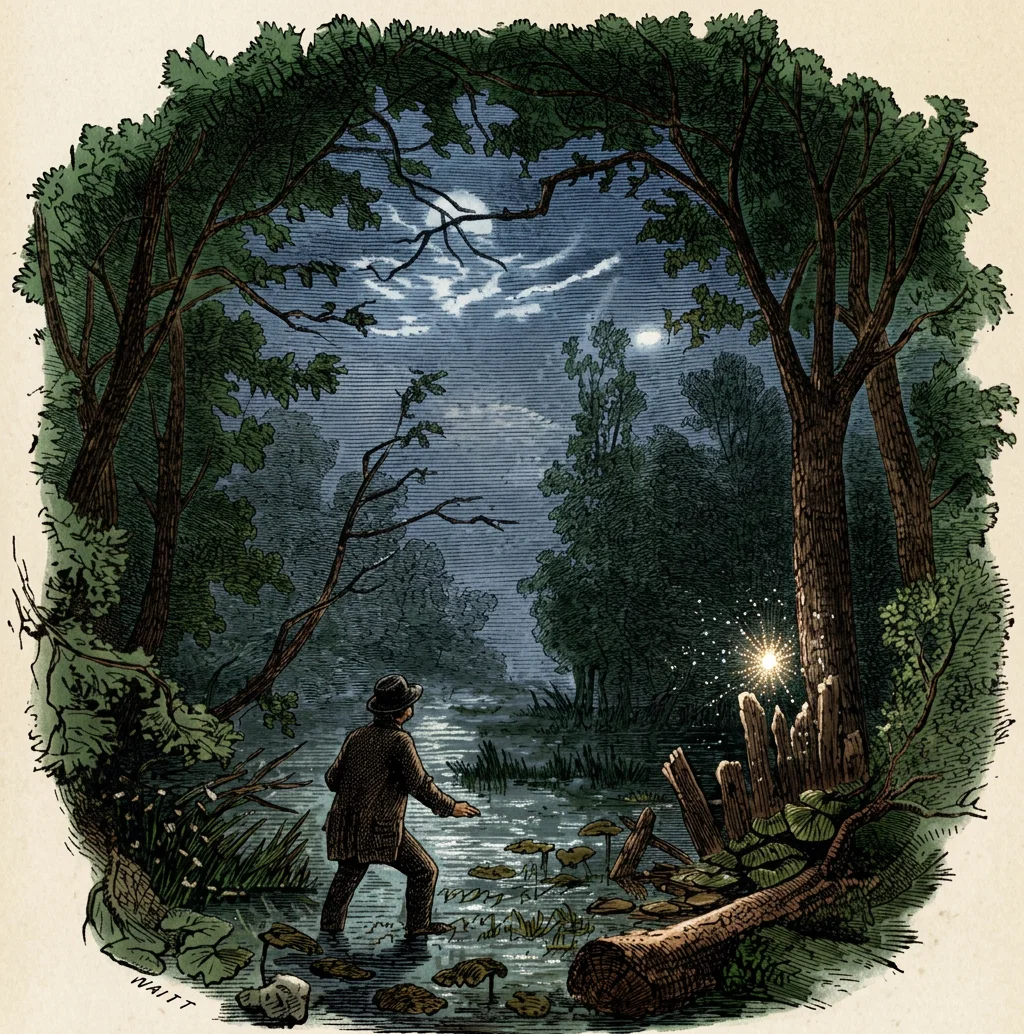
There are instances on record, of travelers, who, mistaking this flame for a lamp, have followed it until they were decoyed into some swampy spot, where they perished.
The man in the picture is attempting to go to one of these lights. It is in the night. See, he is now wading in the water. Soon the deceptive light will disappear, and he will be left in the marsh, perhaps to die.
This is a striking illustration of the experience of many who seek so earnestly for the pleasures of this world. Infatuated by the weird flame, they press eagerly on toward the glittering prize, which is ever just beyond their reach; and finally, when seemingly within their grasp, the false light will vanish entirely. Whoever is thus enticed from the path of right, will find at last that he is, like the traveler, led away but to perish.
E. B. M.
Restored with AI