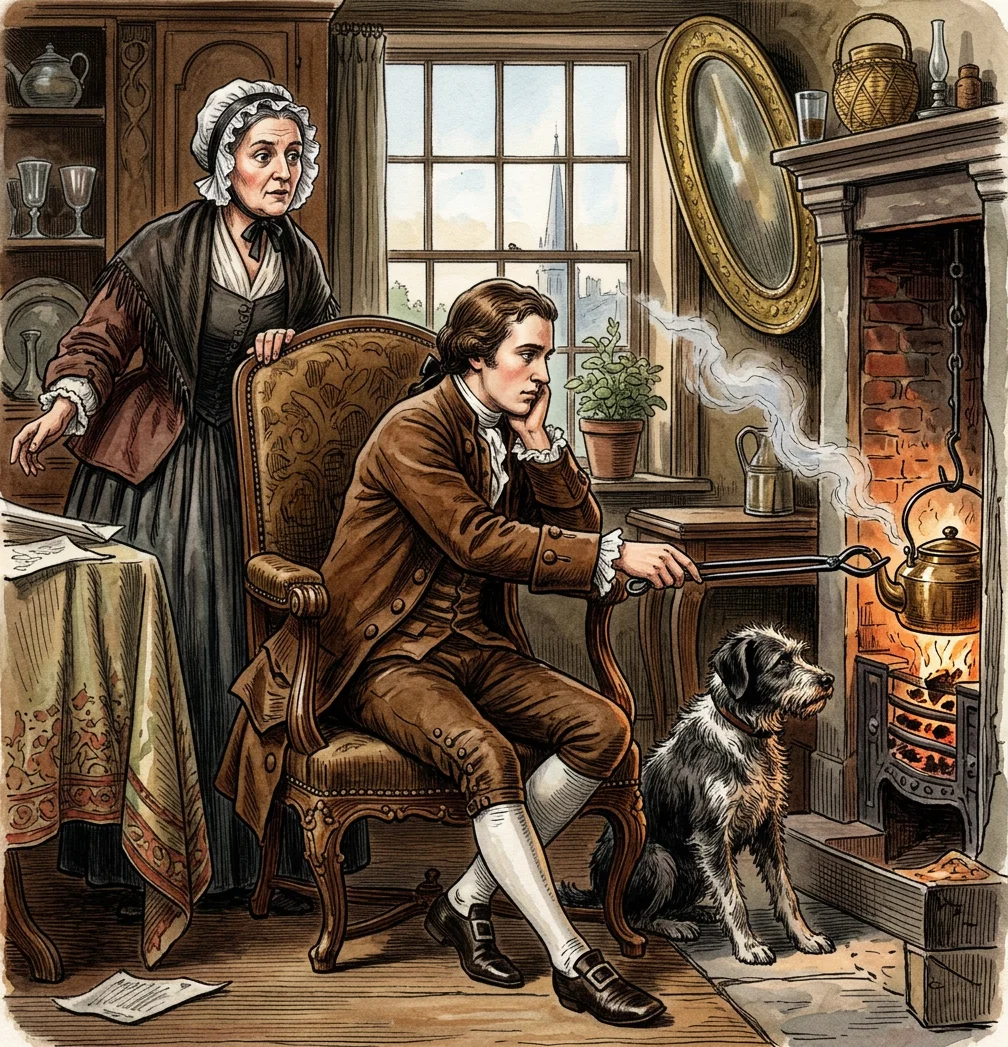
“What do you suppose,” said papa, “that the boy in the picture is doing?”
“He’s playing with the tea-kettle,” replied Lucy.
And Johnny, who is a little more observing, said, “He’s holding the tongs over the nozzle to make the cover dance;” for Johnny had done the same thing himself.
“Yes,” said papa, “and he is learning a great lesson from that tea-kettle.”
“What kind of a lesson?” asked Lucy. “I always thought lessons had to be learned from books, and I don’t see any book.”
“Ah!” said papa, “some of the grandest lessons ever taught have been learned without books. That boy is James Watt; and instead of playing with the tongs and tea-kettle, as you thought, he is learning a lesson about the power of steam. That old black tea-kettle, smoked by the open fire, is to the studious, thinking boy, the germ of the mighty steam-engine.”
“Oh, yes!” cried Johnny, “I read about that in my reader; and when the neighbors thought he was idling his time away by the fire, he was studying out great improvements in steam power.”
Restored with AI
“Yes,” said papa, “and when you ride on the cars or on a steamboat, or see the ponderous machinery driven by the steam-engine, you can look back in imagination to the boy by the fire, and the tea-kettle on the hearth, as the starting-point of it all.”
“But,” inquired Lucy, who was still troubled about the lesson without books, “how did the tea-kettle teach him a lesson?”
“I am glad you asked that question,” replied papa, “for I want my children to form the habit of learning by observation. The boy had often seen the lid of the tea-kettle lifted by the steam, and he reasoned that there must be much power in it. When he held the blade of the tongs over the nozzle, he found that the cover was lifted with much more force; and so he reasoned that confined steam was more powerful than free steam.”
“Is the steam confined in the engine?” inquired Lucy.
“Yes, until it has done its work. The steam you see escaping in puffs has exerted its force in pushing the piston of the engine, and is then free to escape into the air. The great roaring fire under the boiler keeps making more steam from the water, and so the engine is kept running.”
“And so,” said Johnny, “we can ride on the lightning express, instead of the stage-coach, because James Watt studied the tea-kettle when people thought he was playing with it.”
“Yes,” returned papa, “and did you ever162think what a power for good the steam has become? It carries the preachers of God’s truth from State to State, and from country to country; it drives the presses on which the papers, tracts, and books are printed, and the machinery by means of which they are bound, and then it propels the cars and the steamships that carry them to thousands of readers all over the world.”
“I never thought of that before,” said Johnny.
“Well,” said papa, “I hope you will learn to think on all subjects that are worthy of thought; for thinking, united to earnest work, has given us nearly all the inventions which add so much to our happiness and do so much good in the world.