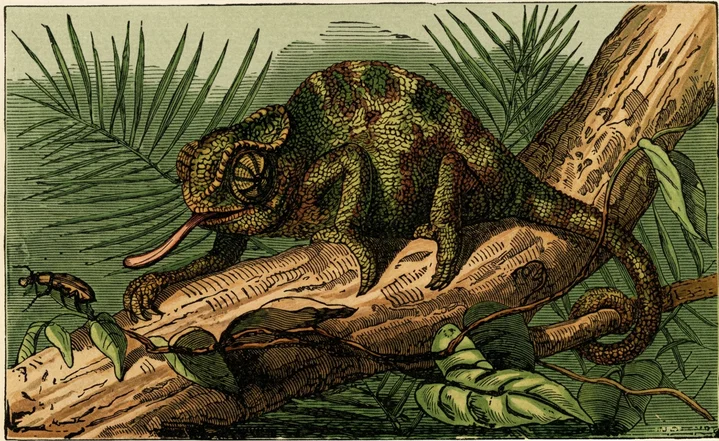
If your tongue were as long as your body, wouldn’t you think it a long one? Well, odd as it is, there is a little fellow, who lives in Africa, with just such a tongue, and you can’t imagine how useful it is to him.
You see he is a dignified, slow-moving little fellow, and he lives on insects and such lively game. He could never catch them, and might starve to death, only that he can dart out his tongue, as quick as a flash, and as long as his body. The end of this droll weapon is sticky, and holds fast any unfortunate bug or fly it touches.
The little animal I speak of is a chameleon, and his tongue is not the only droll thing about him. His eyes are very curious. They are large and round, and stick out like big beads on the side of his head. And the funniest thing is that he can turn them different ways, so as to see all around him. He can turn one up and the other down, or he can turn one forward and the other back, and thus see everywhere. It must be a very small bug which can escape these sharp eyes.
These eyes are covered with eyelids all the time. To be sure, there is a hole in the middle, where the bright eye looks out, and he can contract or expand it as he likes, but he can’t uncover his eyes as we can.
But his tongue and his eyes are not the only odd things about him—his feet are as strange as the rest. He has five toes, just as you have, though they are more like a bird’s claws than like your toes. They are all long and have claws on the ends, and then they are fastened together by skin in a curious way. Three of them are fastened into one sort of bundle, and the other two into another.
You can see how nicely this arrangement enables him to hold on to the branches of trees, where he lives. All four of his feet are fixed in the same way. And, as if four such hands and feet were not enough, his long, slim tail is as good as another foot. He can curl it around a branch, as a monkey can his, and hold on with it.
Even when he walks on the ground—which he doesn’t much like to do—he steadies himself with this useful tail.
Everything about this fellow is odd. His skin is not fastened tight to him, as it is to most animals. It is more like a loose bag, and he can swell it out into queer shapes, or rather into a shapeless mass, by filling it with air. And another oddity about the skin is that, by a peculiar arrangement of the coloring matter, he sometimes looks one color and sometimes another, according to the way the light strikes him. It is something like what you have seen in changeable silks.
Strange stories were told about this curious little fellow in old times. It was really believed that he had no regular color of his own, but that he took the color of the thing he was near, being green among the leaves and brown on the ground. That error was caused, of course, by the changes of color I spoke of.
Another error was the effect of his curious habit of blowing himself up like a bladder. It was said that he had no particular shape. In fact, he had no character of his own any way—neither color nor shape!
The wisest men of old times believed these stories, and it seems droll enough to read of it in serious, wise books. Even the name of the honest little fellow got to mean one who changes his opinions to suit everybody and has no fixed ideas of his own.—Olive Thorne.