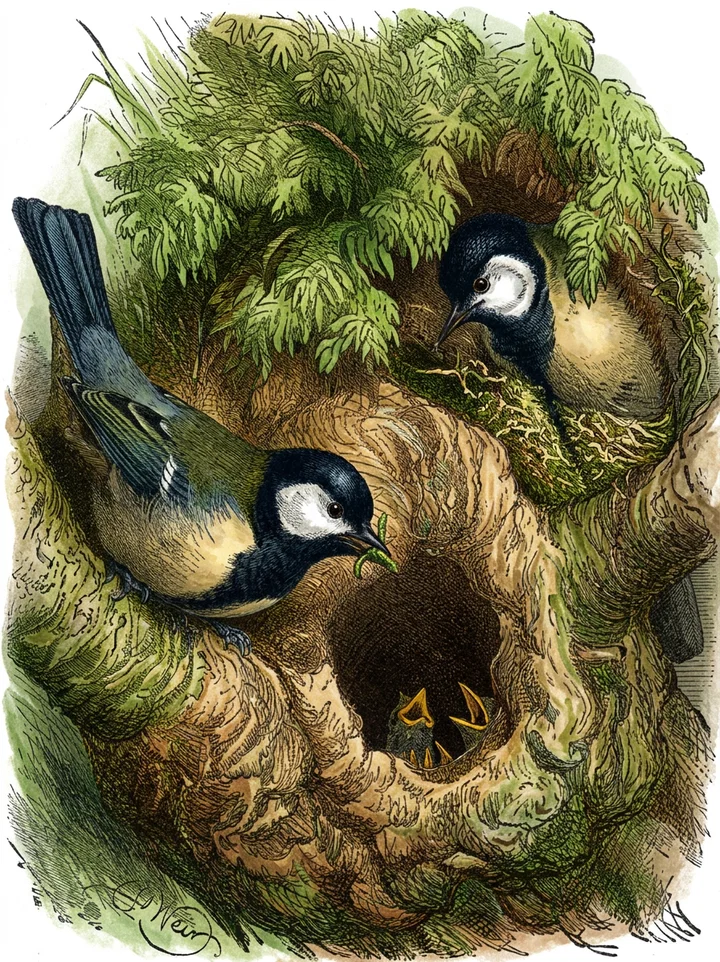
Whoever lives in the country without studying the birds, shuts out one source of enjoyment at least; for no one thoroughly enjoys them without in some way cultivating their acquaintance. I believe in bird’s-nesting, though I do not uphold the cruel boys who rob and destroy the homes of the small feathered people; but there is a privilege of bird’s-nesting, however, with which even the most tender-hearted need not be shocked. I will risk any boy or girl who carries a good heart, in any lane or hedge-row; and I will suffer them to discover and enjoy twenty bird’s nests, if they are fortunate enough to find them, without any wanton destruction of eggs or birds, or any damage to their own sensibilities. If you are a real student of Nature, you will look reverently on all her wonders, as one who remembers that the Lord of creation has made special mention of his care over them. “A sparrow shall not fall on the ground without your Father.”
“The American robin, which the naturalists call Turdus Migratorius, comes early in the spring, and is found during the summer throughout the whole of North America. This little favorite of both old and young is the most familiar of all our birds, and seems to seek to place its nest where it will be under man’s protection. His arrival is hailed with joy, as an unerring harbinger of spring. But sometimes the season is late, and he finds snow and ice on his coming; but he is a brave bird, and though he goes about chirping sadly (thinking perhaps of the mistake he made in leaving his sunny southern home so early) he flies swiftly around, looking sharply with his keen brown eyes for the remaining berries on the sumach, mountain ash, and red cedar; for he well knows that “brighter days will come at last.” As soon as it comes warmer, he is busy making a new home or repairing his old one; for the robin is a social little fellow, and seems to like to build in the same place year after year. That last year’s nest of moss and clay has stood the storms of fall and winter, and is as round and trim as ever, and with a few repairs, a bit of fresh clay here and there, and a new lining of fine dried grass from the hillside, is every bit as good as new. Then come four blue eggs, a few weeks of watchful care, four open mouths to feed; and Sir Redbreast and lady have all they can do to support their little family for the next six weeks.
Another sociable bird is the oriole, who often hangs her pretty cradle on the end of an apple-bough. Sometimes you may find one of these wonderful hanging nests three or four feet long, sometimes only about seven inches, and nearly as wide. At the bottom of it you will find four spotted eggs,—blue, if it is an orchard oriole; pink, if it is a Baltimore oriole’s nest. This nest is most elaborately woven into a fabric like a plaited straw hat. A gentleman counted the stitches which an oriole had made with one long wisp of hay, and found that it had passed through thirty-four times. A lady suggested that the bird might be taught to darn stockings.
Nothing can be more confidential than the habits of the swallows, who glue their bits of masonry by scores in our very chimneys. If you pass along the river bank, or wherever sand-hills lie, look for the bank-swallow, or sand-martin’s nests. Hundreds of them burrow into the perpendicular bank, sometimes to the depth of three or four feet, and at the further end construct a nest of a little straw.
The woodpecker’s nest is ingeniously built. She sounds her hammer along the limb of a tree till she finds one that betrays decay; then she bores a hole down deep into the heart of the bough, and lays her four pure white eggs on the dust at the bottom. One nest was found where the bird had dug forward five inches, and then downward twice that distance, through solid black oak. At the bottom of this hole the little woodpeckers first saw twilight—daylight would hardly be expected in such a place. This is the great red-headed woodpecker, who may be seen in all his magnificence, sunning himself on the fence-rails at almost any time.
The house wren (*Troglodytesp. 86 Ædon*) is a familiar and interesting little bird, common in all parts of the United States from April until the beginning of October, when it retires to the South; but the place where it winters seems yet to be unknown. The wren is sprightly, active, and diligent. Its nest is formed with coarse sticks and shreds of bark and wood, in some cavity, such as a hollow stump, or the vacant space at the foot of a brace in the frame of a building. You would not think of finding a bird’s nest in a coat sleeve, but a wren once built there. A mower hung up his coat in a shed by the barn, where he left it two or three days. On putting it on again, he found the sleeve filled with rubbish, as he called it. He pushed it out, and behold! a wren’s nest, just ready for housekeeping. The poor little owner flew about in great trouble and surprise, but was made satisfied with an old hat nailed to the weather-boards, where she built again. Look under the eaves of the porch, or in any snug corner, for a neat little nest, quite round, with a small hole on one side; and you have a wren’s nest. In it you will find from six to eight little flesh-colored eggs, with purple spots. The wren is a very persevering little creature; and when its nest is destroyed, will rebuild it time after time in the same place.
Perhaps you have never heard the fable of the eagle and the wren. When the world was young, there arose a great contention among the birds as to which should be king. The eagle drew himself up in pride, flapped his monstrous wings, and in a voice that terrified the smaller birds and frightened Lady Magpie so badly that she fainted away, exclaimed: “Let this dispute be settled in this wise: We will all start together; the one who soars the highest will forever remain your acknowledged king.” They all agreed; very soon the eagle had outstripped them all, and was only a mere speck between the earth and sun. Then out spoke the bold eagle, “Behold, I am king.” Just then a little shrill voice exclaimed, “I beg your pardon; I am above you, therefore, I am king.” The astonished eagle looked over his shoulder and saw a tiny wren perched upon his back. He was very wroth and dashed the frightened little bird from him, exclaiming, “Go down to earth for your folly; you shall never fly higher than a man’s head.” The moral is good. We should never aim to fly higher than our own wings will carry us.
These are only a few of the many things that might be related about the birds and their queer ways; but those who will take the pains to watch the little warblers, may, before this summer is over, learn many curious things in regard to them. You will find interest enough in seeking their haunts and watching their habits without any intrusion upon their rights. Nothing pays young people better than that culture of eye and ear which springs from such rambles. COM.