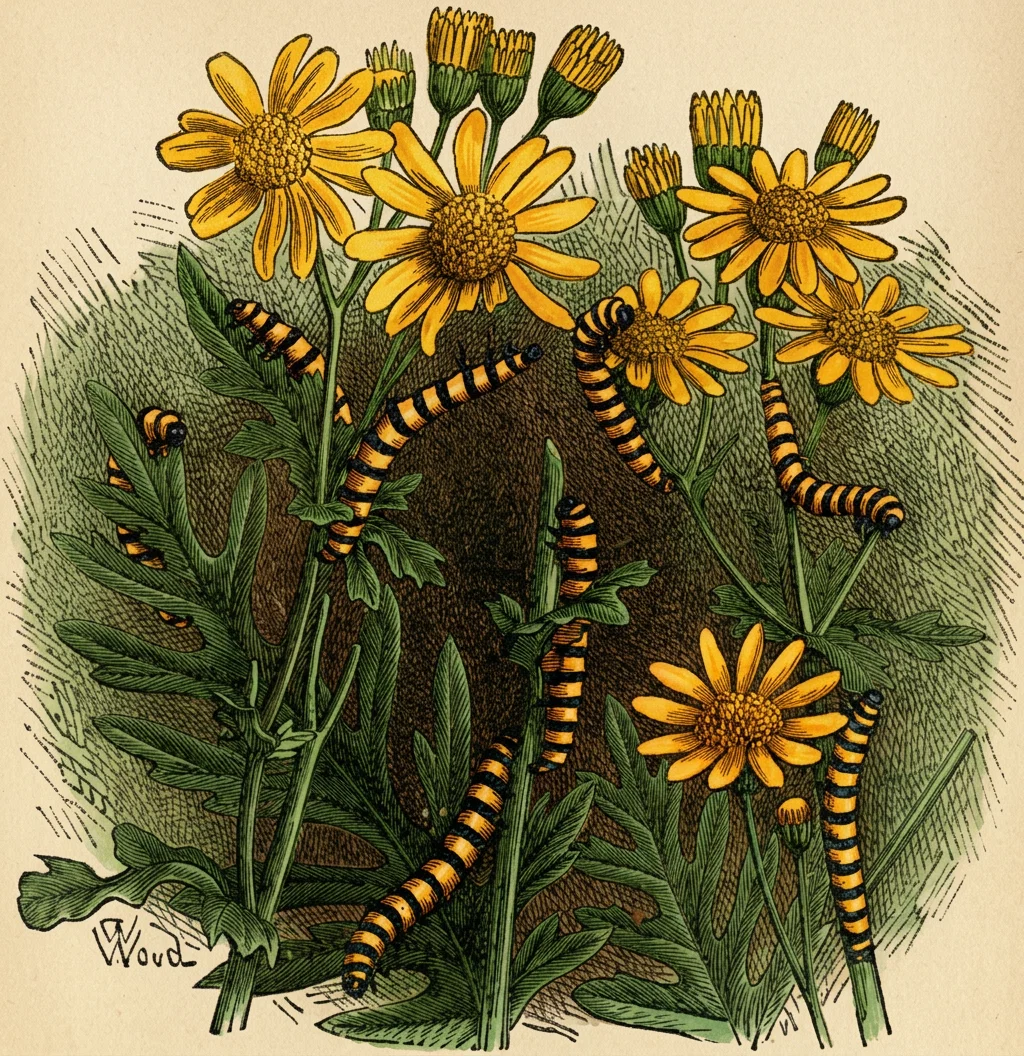
Among caterpillars, protective coloring is the most general and conspicuous. An immense number of these creatures are green, corresponding with the tints of the leaves on which they feed, or brown when they rest on bark and twigs.
Every one knows, however, that there are a number of very brightly colored caterpillars, and it may be asked how these are protected, or why the others need protection if these can do without it. Bright-colored caterpillars, such as the Jacobæ and the hairy and spiny ones, feed freely by day, fearless of observation, while the green and brown hide, seeking their food at night. Repeated observations have shown that birds, and even frogs, lizards, and spiders greedily eat the less showy ones, universally rejecting the gaudy; so the conclusion may be drawn that, in the latter case, the little creatures need no protection, being unfit for the food of other animals.
In the same way, the beautiful “calico-bug,” or “lady-bird,” differs from other beetles, in having no means of defense and seeking none, presumably for a similar reason. The rainbow tints of many moths and butterflies may properly be imputed to a like cause.
But there are other modes of protection besides a nauseous taste, which render concealment unnecessary. Many insects are armed with stings, or shells, or spines, so as to be practically uneatable,—we all know how gay are the colors of wasps, and bees, and hornets. Sometimes, as we have intimated, brilliant hues themselves form the best protection. An excellent example of this is afforded by the caterpillar of the emperor moth. The green body adorned with pink spots is, in most situations, conspicuous; but it feeds on heather, and its color then so completely harmonizes with the young, green shoots and small, pink flowers, that it is with difficulty detected.
Among reptiles protective tints are very apparent. Lizards and snakes, in temperate climates, are all more or less brown or olive-tinged. This is the case, also, with nocturnal snakes of all latitudes. In the tropics alone, reptiles are often of a vivid green, exactly corresponding with the vegetation among which they dwell.
Restored with AI
Many fishes, also, present examples of protective coloring. Such as rest on the bottom of the ocean, like the flounder and skate, are invariably of the color of the bottom, and often singularly speckled, so as to resemble sand or gravel. Such as swim near the surface of the water are almost always dark-bluish or greenish above and white beneath, colors which evidently tend to their concealment from enemies in the air above them or in the water below. The gaily tinted fishes from warm seas are many of them well concealed when surrounded by the brilliant sea-weeds, corals, sea-anemones, and other marine animals, which make the sea-bottom sometimes resemble a fantastic flower garden.
Larger animals also give striking examples of the theory of protection by colors, their tints corresponding to their habits, needs, and the countries in which they live. Canon Tristram, who has traveled much in the Sahara, thus describes the characteristics of its animal life: “In the desert, where neither trees, brushwood, nor even undulations of the surface, afford the slightest protection against its foes, a modification of color which shall assimilate an animal to that of the surrounding country is absolutely necessary. Hence, without exception, the upper plumage of every bird, whether lark, chat, sylvian, or sand-grouse, and also the fur of all the smaller mammals, and the skin of all the snakes and lizards, is of one uniform sand color.” In the arctic regions, with a few exceptions, these gray and brownish tints give place to pure white. All the bears of the globe are brown or black, except the polar bear, which is white. The polar hare, the snow-bunting, the snow-owl, and the jer-falcon are also white or nearly so; while the arctic fox, the ermine, and the Alpine hare change to white in the winter. The Highland ptarmigan is a fine example of protective coloring. This bird’s summer plumage so exactly harmonizes with the lichen-covered stones among which it delights to sit, that a person may walk through a flock without seeing a single bird; and when it changes to white in winter, it is equally protected amid the snow which covers the mountains.
How marvelous! When we study the works of the Creator, we are lost in wonder and admiration!—Arthur’s Home Magazine.