Of all the strange creatures worshiped as gods by the ancient Egyptians, perhaps none were so favored as the crocodiles inhabiting the sacred river. The banks of the Nile were dotted with the low huts of keepers, whose only care was to decorate the scaly heads of the monsters with gold and precious stones, and feed them with costly viands served on vessels splendidly wrought in silver. Daily, at noon, the king came in state with his household to view them as they lay warming their great ugly backs in the sun, and at night and early morn, the priests, offering incense, implored them to hear the prayers of the people. And it was not enough that homage should be paid them while living, but after death their bodies were carefully embalmed, wrapped in fold upon fold of perfumed cloths, and buried with magnificent pomp in a sepulcher sacredly consecrated as their final resting-place.
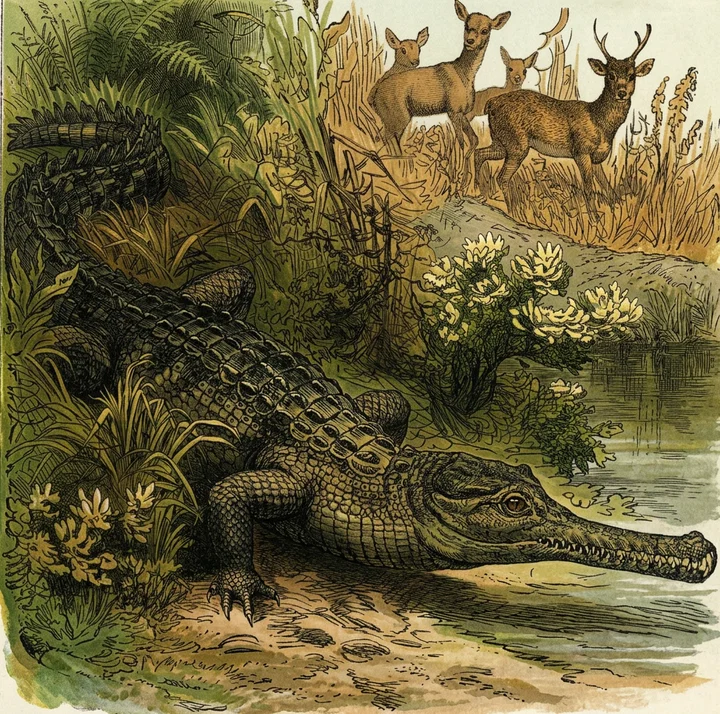
This now famous Crocodile Cave extends underground for several miles, and is a curious object of interest to travelers in the East. Its entrance is a small, square aperture, eight by twelve feet, in the flat summit of a low range of hills crossing the desert in upper Egypt, and the succession of narrow chambers is exceedingly difficult to explore on account of the quantities of dust and half-fallen rocks which choke up the winding passage-way.
Here lie the defunct gods of all sizes; some of them huge, shapeless masses eighteen to twenty feet in length; others, tiny objects but a few inches long, packed in layers with palm leaves between. Think of embalming, not to say worshiping, a crocodile just out of the egg! Such heathen idolatry seems impossible in these days of light and progress, and we cannot be too thankful that, long ago, the crocodile descended to his proper level.—Classmate.