“Would you like another chapter, Lilian dear?” asked Kate Everard of the invalid cousin, to nurse whom she had lately come from Hampshire.
“Not now, thanks; my head is tired,” was the reply.
Kate closed her Bible with a feeling of slight disappointment. She knew that Lilian was slowly sinking under incurable disease, and what could be more suitable to the dying than to be constantly hearing the Bible read? Lilian might surely listen, if she were too weak to read for herself. Kate was never easy in mind unless she perused at least two or three chapters daily, besides a portion of the Psalms; and she had several times gone through the whole Bible from beginning to end. And here was Lilian, whose days on earth might be few, tired with one short chapter!
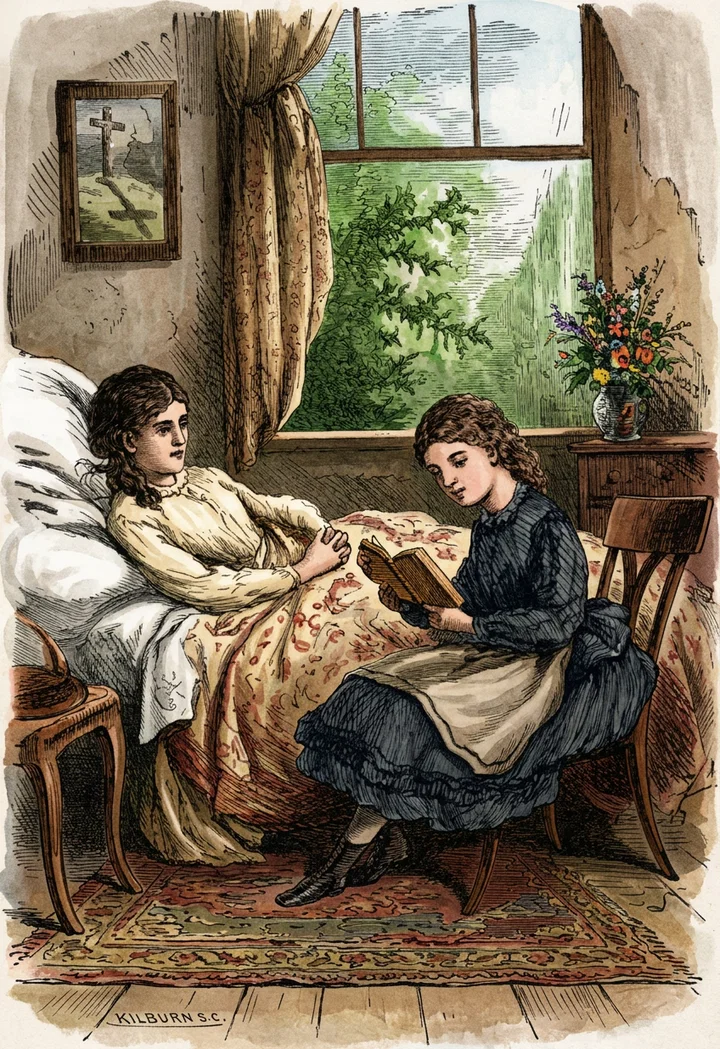
“There must be something wrong here,” thought Kate, who had never during her life kept her bed for one day through sickness. “It is a sad thing when the dying do not prize the word of God.” Such was the hard thought that passed through the mind of Kate, and she felt it her duty to speak on the subject to Lilian, though she scarcely knew how to begin. “Lilian,” said Kate, trying to soften her naturally quick, sharp tones to gentleness, “I should think that now, when you are so ill, you would find special comfort in the Scriptures.”
Lilian’s languid eyes had closed, but she opened them, and with a soft, earnest gaze on her cousin, replied, “I do—they are my support; I have been feeding on one verse all the morning.”
“And what is that verse?” asked Kate. “ ‘Whom I shall see for myself,’” began Lilian slowly; but Kate cut her short—“I know that verse perfectly—it is in Job; it comes just after ‘I know that my Redeemer liveth;’ the verse is, ‘Whom I shall see for myself, and mine eyes shall behold, and not another.’”
“What do you understand by the expression ‘not another’?” asked Lilian.
“Why of course it means—well, it just means, I suppose, that we shall see the Lord ourselves,” said Kate, a little puzzled by the question; for though she had read the text a hundred times, she had never once dwelt on its meaning.
“Do you think,” said Lilian, rousing herself a little, “that the last three words are merely a repetition of ‘whom I shall see for myself’?”
“Really, I have never so particularly considered those words,” answered Kate. “Have you found out any remarkable meaning in that ‘not another’?”
“They were a difficulty to me,” replied the invalid, “till I happened to read that in the German Bible they are rendered a little differently; and then I searched in my own Bible, and found that the word in the margin of it is like that in the German translation.”
“I never look at the marginal references,” said Kate, “though mine is a large Bible and has them.”
“I find them such a help in comparing scripture with scripture,” observed Lilian.
Kate was silent for several seconds. She had been careful to read daily a large portion from the Bible; but to “mark, learn, and inwardly digest it,” she had never even thought of trying to do. In a morep. 70 humble tone she now asked her cousin, “What is the word which is put in the margin of the Bible instead of ‘another’ in that difficult text?”
“A stranger,” replied Lilian; and then, clasping her hands, she repeated the whole passage on which her soul had been feeding with silent delight: “‘Whom I shall see for myself, and mine eyes shall behold, and not a stranger.’ O Kate,” continued the dying girl, while unbidden tears rose to her eyes, “if you only knew what sweetness I have found in that verse all this morning while I have been in great bodily pain! I am in the Valley of Shadow—I shall soon cross the dark river; I know it: but He will be with me, and ‘not a stranger.’ He is the Good Shepherd, and I know his voice; a stranger would I not follow. And in the glad resurrection morn, it is the Lord Jesus whom I shall behold—my own Saviour, my own tried friend, and ‘not a stranger;’ I shall at last see Him whom, not having seen, I have loved.”
Lilian closed her eyes again, and the large drops, overflowing, fell down her pallid cheeks; she had spoken too long for her strength, but her words had not been spoken in vain.
“Lilian has drawn more comfort and profit from one verse—nay, from three words in the Bible, than I have drawn from the whole book,” reflected Kate. “I have but read the Scriptures—she has searched them. I have been like one floating carelessly over the surface of waters under which lie pearls; Lilian has dived deep and made the treasure her own.”—Advocate and Guardian.