(Concluded.)
A CURIOUS thing in the natural history of spiders is their power of reproducing their limbs after they have been broken off. In such cases it is never a part of a limb which is reproduced; but if a portion is removed, the wise spider proceeds at once to throw off the residue; and after the next moult behold the entire missing limb again appears!
Spiders’ webs have been manufactured into a delicate fabric for dresses and gloves; but it is said that to obtain one pound of spiders’ silk, the webs of six hundred thousand spiders would be needed. Probably the production of silk from spiders will always be more a matter of curiosity than of utility. But spiders serve one important purpose in the economy of nature,—they catch an abundance of flies and insects by their geometrically constructed webs, and, in turn, they are devoured by birds and reptiles. And, disgusting as it may seem, they form a part of the diet of barbarous peoples, as the Indians, Africans, and Australians. Spiders’ webs are also in high repute among physicians for staunching the flow of blood from wounds.
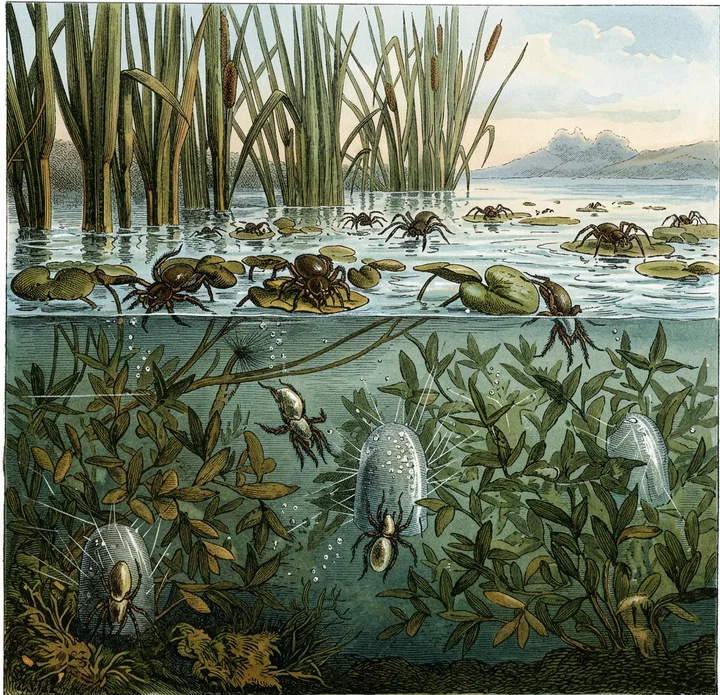
We have already remarked that there are a number of species of the spider family. One class, called Natantes, or Swimmers, are water-spiders. Such are the nimble little water-skippers shown in the engraving. This variety are wholly aquatic in their habits. They spin a cup-like web, which answers the purpose of a diving bell. They can readily exhaust the air from this miniature web-cup, which is about half the size of a common acorn, and then descend beneath the surface to feed on water insects below; or when they wish, come to the top to disport on the water. Their tiny hairs keep their bodies from becoming wet, and in their nests in the water they are as dry as if they were in a hole in the wall.
One species of spider, known as the Attidæ, i. e., Jumping Spiders, makes no web, but wanders in search of its prey. It is common in summer on the walls and windows, basking in the sun. It crawls stealthily up to flies, and jumps with great accuracy upon its victims. Before leaping upon a fly it fixes a thread to secure itself from falling. Mr. Livingston mentions a South African spider of this variety which can leap a foot.
Another species is called Thomisidæ, orp. 190 Crab Spiders. Some of them seem to walk better sidewise than forward. The large crab spider of South America is able to leap upon and destroy humming-birds and lizards. That part of its victim which it does not eat, it suspends by a cable from a limb for future use. This spider is about three inches long, and its legs extend over a space of eight or ten inches.
The Lycosidæ, or Running Spiders, have long legs, and are very active, living in open places, and catching their prey without webs.
The Agalenidæ, another variety, make flat webs, with a funnel-shaped tube at one side, in which the spider remains waiting for his prey.
The Mygalidæ includes the largest spiders known. They live only in warm countries. They have marked anatomical differences from the other families of spiders.
The long-legged cellar spider, called the Pholcus, has a curious habit of hanging on a cable by its legs and whirling round so fast that it can scarcely be seen.
The distinguished naturalist, Walckenner, divides all spiders into five different groups as follows: 1. Hunting Spiders; 2. Wandering Spiders; 3. Prowling Spiders; 4. Sedentary Spiders; And, 5. Water Spiders.
Daddy Long-legs, frequently called Grandfather Graybeard, is of the spider species. Little cow-boys frequently catch them and make them point in the supposed direction that the cows are, before going for the evening herd.
Spiders have the bad reputation of being animals that bite; but Mr. Emerton, a very careful writer about their habits, says, “Notwithstanding the number of stings and pimples that are laid to spiders, undoubted cases of their biting the human skin are very rare; and the stories of death, insanity, and lameness from spider-bites are probably all untrue.”
The lives of pious persons have been saved in times of persecution by a spider spinning his web across the entrance to the cave in which they were secreted, their persecutors thinking that no one could have entered without tearing away the web.
In the Holy Scriptures the little spider is referred to as an emblem of industry.
G. W. AMADON.