THE ATLANTIC COAST.—NO. 2.
As intimated in our last, Salem, Massachusetts, was for some length of time the seat of government of that colony, although Boston afterward became, and still is, the capital of the State.
There are some curious circumstances connected with the early history of Salem. In 1688 a child thirteen years old, living in the family of John Goodwin, was taken with fits. An Irish woman was charged with bewitching the child. She finally made a confession in which she claimed that she made children have fits by means of an image made of rags and stuffed with goat’s hair. Silly as this was, some devout persons, and even ministers, indorsed it and proclaimed against witchery.
In 1691 and 1692, a daughter of Mr. Paris, and also a niece, neither of them yet in their teens, had convulsions, and complained of being pinched and beaten by invisible agents. The ministers of the gospel claimed that these children were bewitched by Tituba, an Indian girl, and two English women. When brought before the magistrates for trial, Tituba confessed that she did it, and bore witness against the other two. After she was liberated she said that she had told in the trial just what Mr. Paris, the minister, wanted her to say. Soon Tituba had fits, as did many others in town. This raised a great excitement, and in a few weeks the prisons were full of those accused of witchery.
June 2d, 1692, a court of Oyer and Terminer was opened at Salem, by Wm. Phipps, for the trial of witches. Bridget Bishop, an old woman, was sentenced and hung on the 10th of June. Next, five women were sentenced. By the close of September, 1692, twenty persons had been put to death, and fifty-five had been tortured or threatened into making confession. One hundred and fifty persons were in prison, and above two hundred more were under accusation. Several of the accused managed to make their escape. The lives of those who confessed were invariably spared. This “Salem witchcraft” was an exciting theme for a time, and many innocent persons were put to death. Finally, judges of the courts ceased to allow trials to proceed, and the excitement soon passed away.
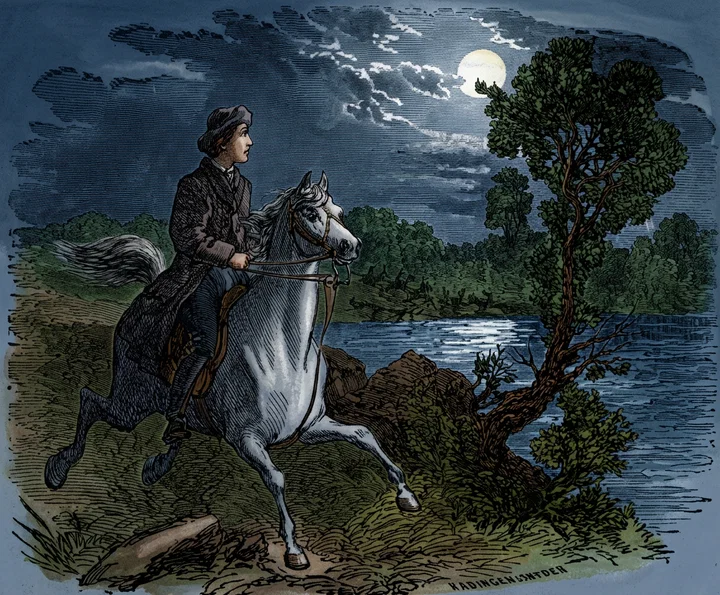
In and around Charlestown and Boston are spots memorable for the struggle made by the colonists in seeking freedom from the rule of the British crown. As the British troops, on April 18, 1775, were preparing to attack the colonists, Paul Revere went flying on the back of his steed through Medford, Lexington, etc., on his way to Concord to rally the forces of the colonists for the struggle. It was on the 17th of June of the same year that the noted battle of Bunker Hill was fought. Though this battle was not of itself a great victory for either side, it gave the English to understand the character of the foe they had to meet, and gave the colonists some idea of their own power of endurance, and so was one of the most important events of the early times of the Revolution. This event has been commemorated by the erection of the Bunker Hill Monument. This shaft is of granite and is 223 feet in height. From its top, which can be reached by a winding stairway on the inside, a good view can be obtained of Boston, and the scenery for many miles around. The corner-stone of this monument was laid on the anniversary of the battle, June 17, 1825, by General Lafayette.
Copp’s Hill, Boston, is another point of much interest. On this hill a cemetery was opened in 1660. In this cemetery are many of Boston’s early illustrious dead. Here are the tombs of the three Mathers,—Increase, Cotton, and Samuel. This cemetery was a point occupied by a portion of the British forces at the time of the battle of Bunker Hill. On some of the tombstones are still seen marks of bullets, caused by the soldiers amusing themselves in “firing at the mark.”
But we must prepare for our voyage over the deep blue Atlantic.
J. N. L.