From Sea to Sea: Blondin's Tightrope Walk at Niagara

8%

S. D. A. Publishing Association · Battle Creek, Mich. · Jan 21, 1880

FromThe Youth’s Instructor, Vol. 28, No. 4.

Read the full edition

From Sea to Sea: Blondin's Tightrope Walk at Niagara

FROM SEA TO SEA.—NO. 21.
Leaving Suspension Bridge, we walk up to the falls, a distance of two miles, on our way catching occasional glimpses of the river deep down in its channel. Having gone about two-thirds of the distance, we come to “the place where Blondin walked.” Nearly twenty years ago, while the Prince of Wales was making a visit to the falls, Blondin, a tight-rope performer, took advantage of the occasion to get notoriety by walking a tight rope in the presence of the prince and the thousands who had assembled with him. A rope was stretched across the river from bank to bank, over two hundred feet above the water.
After he had walked across once, he returned, bearing a small cooking furnace. When about half-way back he sat down upon the rope, and at this giddy height balanced himself and his furnace, while he kindled a fire, cooked some eggs, and let them down by a cord to a little steamer, called “Maid of the Mist,” which was immediately below.
Going to the shore with his cooking utensils, he next tried walking across perched upon stilts. In the bottom of the stilts he had driven spikes to prevent their slipping off the rope. In this walk he succeeded very well until about half-way across, when, undertaking to jump up from the rope and onto it again, he fell; but fortunately he saved himself from destruction by falling astride the rope. Here he balanced himself, and, regaining his standing on the rope, completed his third trip, the crowd cheering him lustily for his fool-hardy exploits.
What a striking proof of the depraved tastes of mankind is the fact that they take pleasure in seeing how near they can expose themselves to destruction and yet escape with their lives. For ourselves we take more pleasure in viewing the beautiful and wonderful in nature and art.
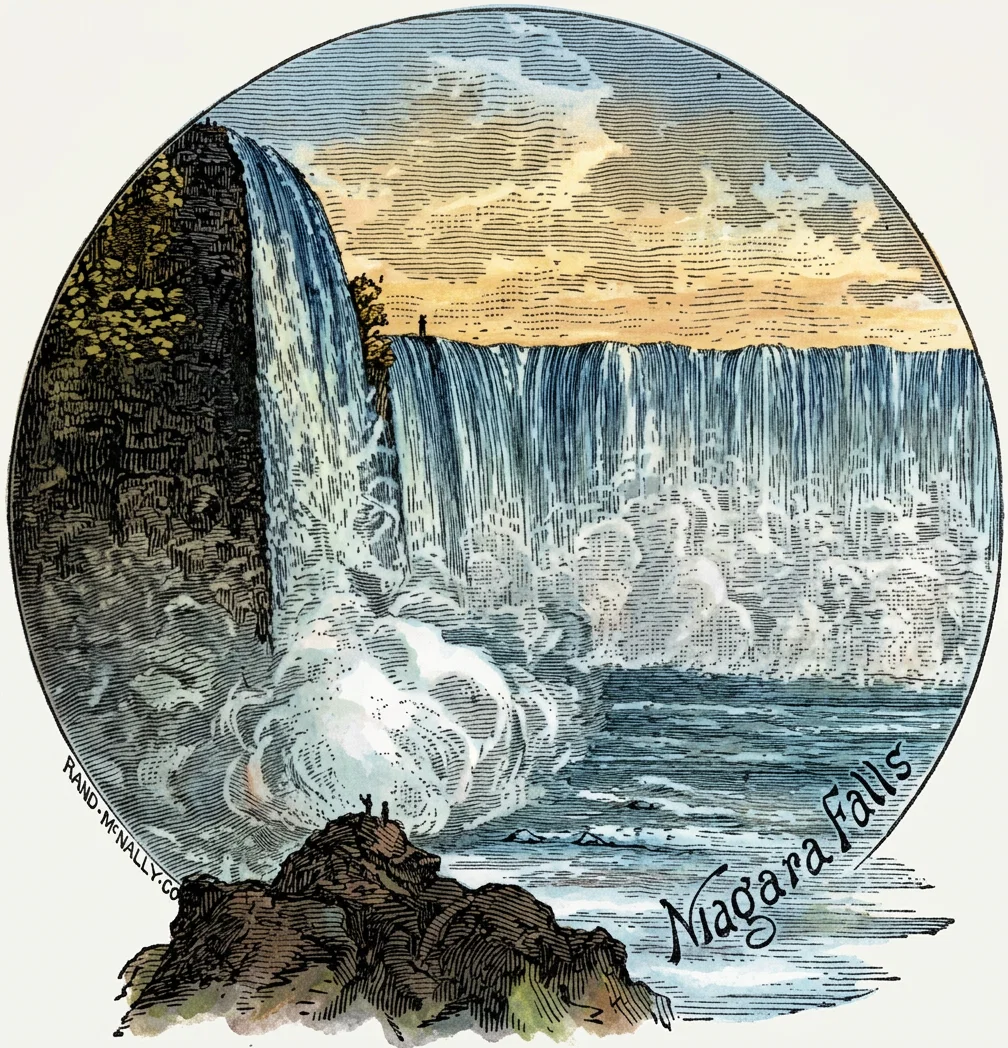
We pass on a few rods and come to the falls of Niagara, where, for thousands of years, with almost deafening roar, the waters of this mighty cataract have been pouring into the vast abyss below. To gain a nearer view, we go down several hundred steps to the water’s edge, where a foot path has been constructed out onto a huge pile of rocks, which at some time have fallen from the cliffs above. Here we find a constant mist, caused by the spray from the descending waters. Raising an umbrella to prevent getting wet in this mystic shower, we succeed in holding our position until the sun shines out brightly, when, lo! the mist and spray are suddenly ornamented with a most gorgeously resplendent rainbow.
How awe-inspiring is the scene before us! As we look up two hundred feet on either side of the river, we see bare rocks hanging over us, while about thirty feet before us is this massive sheet of water, 1,100 feet wide, pouring down nearly 200 feet into the unfathomable waters below. This, with the over-arching rainbow and the spray and flying drops glistening like pearls and diamonds under the rays of the golden sun, gives a combination of nature that to be enjoyed must be seen.
As we see this rainbow (God’s appointed sign that he will not again deluge the world), so near this roaring cataract, it is no great stretch of the imagination to call to mind the surging of the waters in the flood, when rivers left their channels, fountains of the mighty deep were broken up, and roaring cataracts rushed in mad array to the destruction of sinful man.
Restored with AI
This mighty river has undoubtedly poured its waters over these rocks with the same doleful and yet majestic roar for more than four thousand years. Yea, ever since the time when it served as a channel through which the retiring waters of the flood revealed to sight “what desolations” the Lord had made in this part of the earth.
With these thoughts we feel with weight the words of another: “How dreadful is this place; for God is here. His name is graven on the eternal rocks, with iron pen, and diamond point.” But we must now retrace our steps to the bank, take our lunch, and view the falls from another point.
J. N. L.