THE AQUARIUM

13%

S. D. A. Publishing Association · Battle Creek, Mich. · Apr 27, 1881

FromThe Youth’s Instructor, Vol. 29, No. 17.

Read the full edition

THE AQUARIUM.

It is very interesting to study the various plants and animals which God in his wisdom has created, and to observe their manners and habits—for botanists tell us that plants, as well as animals, do have habits. To do this most successfully we must go to their homes, for there only do we find them really in a natural state. But this is not always practicable,—few can traverse foreign lands, few can go to the depths of the sea or to the heart of old tropical forests, and many not even to the lakes and woods of their own country,—so men have devised various ways of bringing rare plants and curious creatures where they may be admired and studied by all. Thus we have the menagerie and zoological gardens, where one may go and see birds and animals from every part of the world; and conservatories and green-houses, where are plants and flowers of all kinds, from our simple home-flowers to the rare exotics of the tropics. This is all very nice; and though it is not of course as pleasant as to see them in the freedom of their wild state, it is much better than not to see them at all.
Aquatic plants and animals, or those which naturally live in the water, are perhaps most difficult to preserve in their natural state. The aquarium is one device by which they are kept alive and in a condition to be watched and studied. Aquaria are of various sizes and shapes, and may be simple and cheap, or elaborate and expensive, according to the taste and means of the owner. Into a glass globe or tank of some description is placed either salt water or fresh—it matters not which, only so the plants and animals whose home it is to be, are those which live naturally in the kind of water used. In the bottom of the reservoir are also placed sand, shells, and rock-work, to make the new home of the occupants as much as may be like the old one.
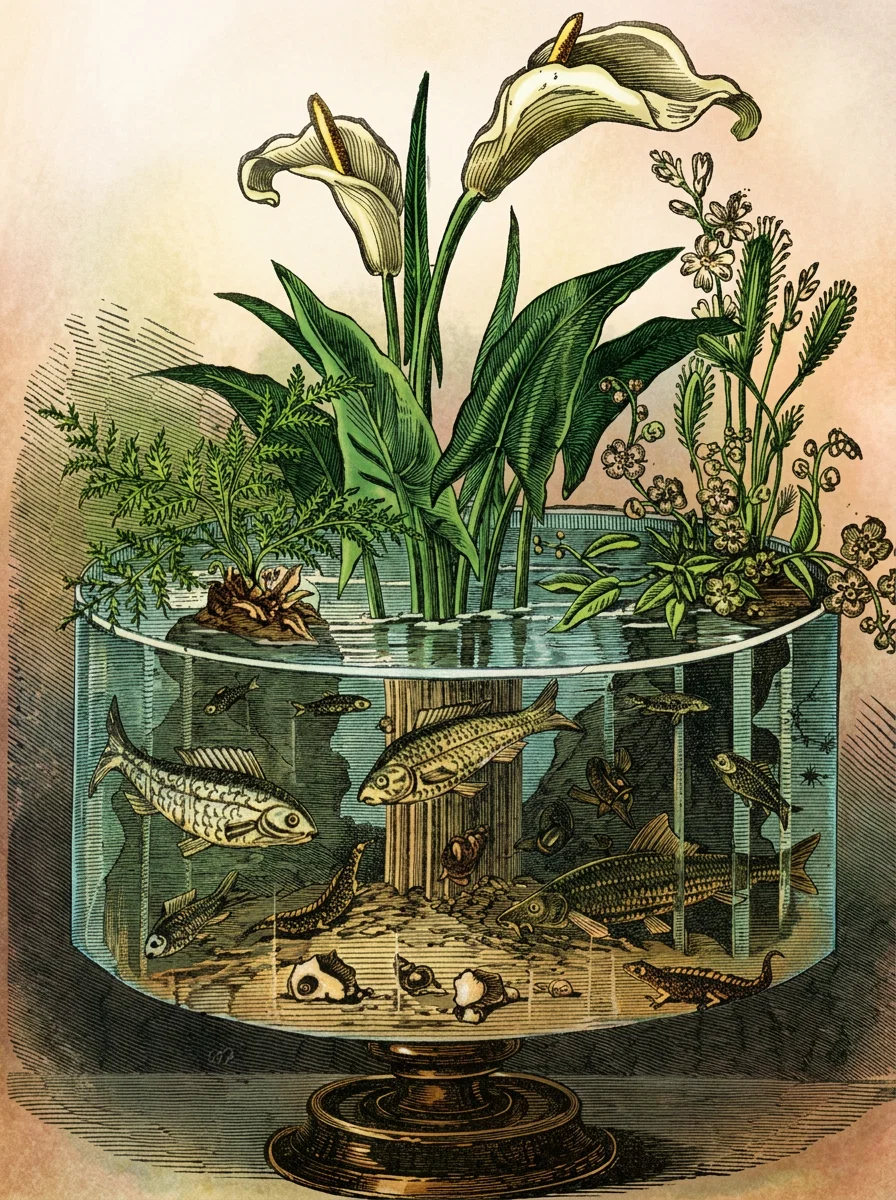
Our picture represents a small though very beautiful fresh-water aquarium, such as might find room upon the table of any of our sitting-rooms; but sometimes the aquarium itself is larger than an ordinary room. A very large one—said to be the largest in the world—was erected in Regent’s Park, London, in 1853. It is a glass building some sixty by twenty-five feet, and is in the form of a parallelogram. The walls are of thick plate glass. It is divided into different compartments, or tanks, some of which are supplied with salt-water and aquatic plants and animals, and others with fresh. The former are supplied with sand, gravel, rocks, and sea-weeds, to imitate the rock-pools left on the sea-shore by a receding tide.
Restored with AI
Though requiring some intelligence and considerable skill and care in its management, an aquarium is certainly a very beautiful ornament, and at the same time furnishes an ever-changing volume for study. To the student of natural history it presents an opportunity for the close observation of the habits of the occupants of the waters, such as is afforded in no other way, while a new source of amusement is furnished continually in watching by one’s own fireside the maneuvers of animals whose haunts are ordinarily the obscure recesses of oceans, rivers, and ponds.
Much might be said about the manner of arranging and conducting both a fresh and sea-water aquarium, but probably it would be of little service to most who will read this, and must therefore be tedious. The principal thing is to maintain a proper equilibrium between the plants and animals, otherwise the animals must soon die.
One or more of these miniature seas is usually found in every floral or horticultural garden; and when you visit such a place, be sure to take a good look at the aquarium, and see what you can learn. E. B.