FROM SEA TO SEA.—NO. 20.
Having again taken the cars, a few minutes’ ride brings us to the great Suspension Bridge. Here we must stop and view this work of art, and also one of the great wonders of nature, the falls, two miles up the river. Even here at the bridge, we hear the loud roar of the falls, as the river pours its vast volume of water over the rocks into the abyss below.
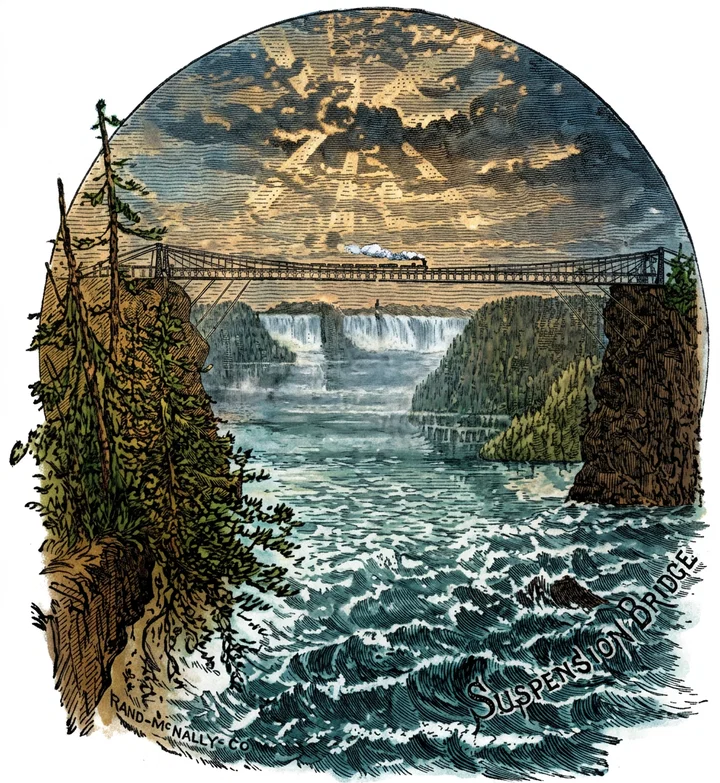
The chasm over which the Suspension Bridge is constructed, and through which the Niagara River runs, is about eight hundred feet wide. When we think of the chain of great lakes that pour their waters through this narrow channel, we would suppose the water must be very deep. Recent sounding, and actual measurement of its depth, have proved it to be the deepest river in the world. Not far from this bridge, the water is seven hundred feet deep.
The track of the railroad bridge is two hundred and fifty feet above the water, and below this is a bridge for carriages and foot passengers. Thus we see this is really a two-story bridge. Each of these bridges is supported by two cables. Each cable is ten inches in diameter, and is composed of 3,569 No. 9 wires, so bound together as to make an exceedingly tough wire rope.
These great cables are passed over the tops of four towers, two of which are on either side of the river. These towers are constructed of huge stones, and are about eighty feet in height, sixteen feet square at the base, and eight feet square at the top. The weight of the whole structure of the bridge between the towers is about eight hundred tons, and the bridge is supposed to be capable of supporting about five hundred tons beside its own weight.
After passing the ends of these cables over the tops of the towers, they were carried back some sixty feet from the shore, and securely anchored thirty feet below the surface of the earth in stone mason work. These cables being very heavy, could not of course be drawn straight. Although they pass over towers eighty feet high, the middle of the cables sags nearly to the level of the bridge. The cross-pieces supporting the platform of the bridge, are hung to these cables by strong wire ropes, and there are six hundred and twenty-four of these suspenders. On each side of the bridge are twenty-eight strong wire rope stays, passing from near the center of the bridge to the rocks on either side of the river, where they are firmly secured. These stays keep the bridge from swinging side-wise. In making the cables, suspenders, and stays to the bridge, the architect claimed that he used four thousand miles of No. 9 wire.
The first time that I crossed this bridge was over twenty years ago, some two weeks after the lower, or carriage, bridge was completed. Ten of us went over in an omnibus, and more fear was manifested than we now see when a train of cars with three hundred passengers is passing over the upper bridge. It looks strange indeed to stand upon the shore and see a whole train of cars hung up at so giddy a height. Having safely passed over and viewed the bridge, we will look at the falls from the American side before resuming our journey.